
15 January 2026 – Arrival in Dominica After the Atlantic Crossing from Cape Verde
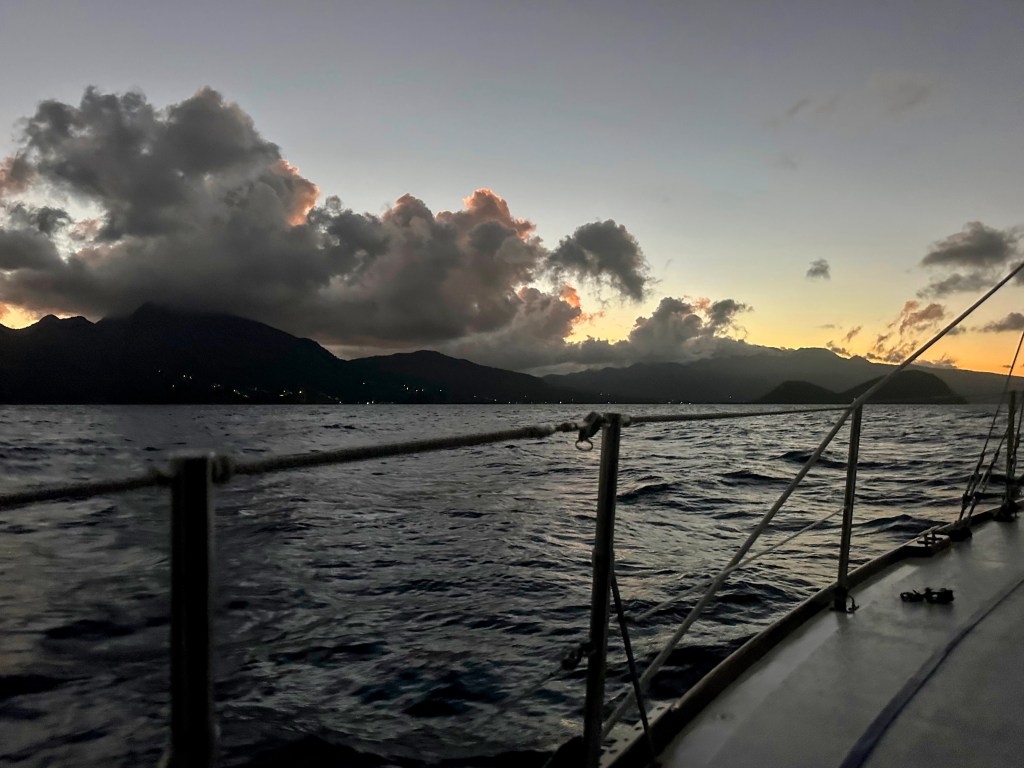
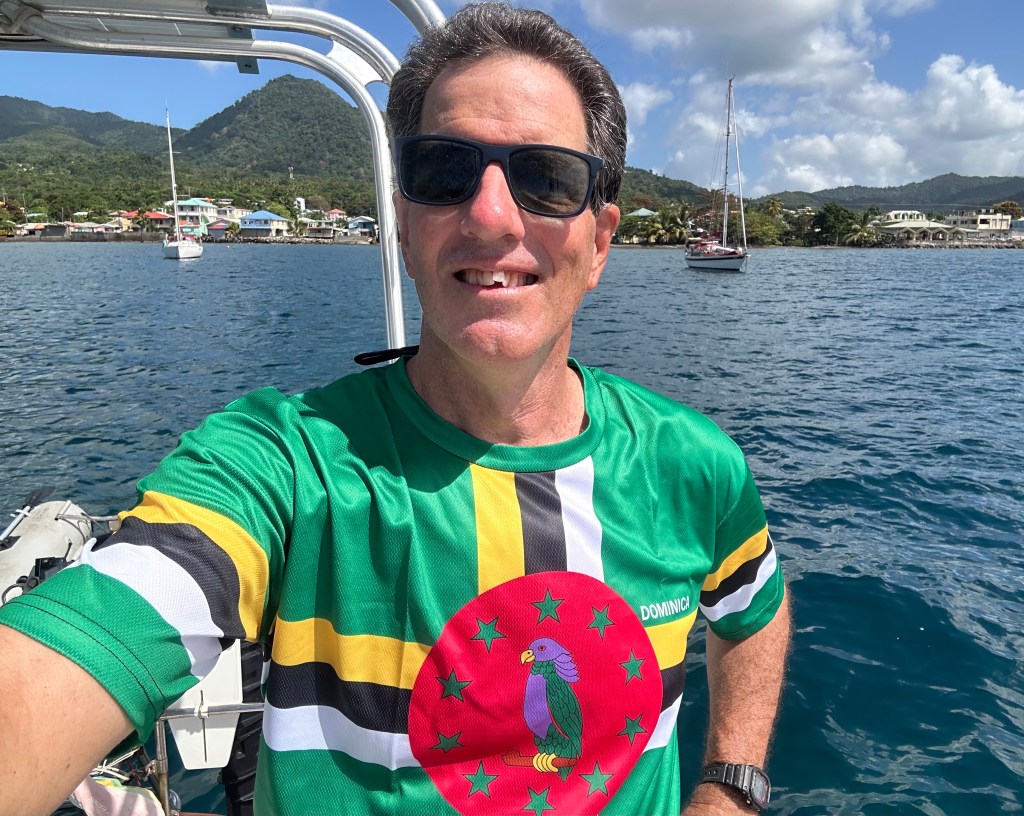
At sunset on Friday, January 9th, I first spotted Dominica far in the distance, a faint silhouette of land against the orange sky. I had been at sea for twenty days and had sailed 2,250 nautical miles since departing Mindelo on the island of Sao Vicente, Cape Verde on December 21st. From that point on until I dropped anchor the next morning in the harbor of Portsmouth on the opposite side of the island, I knew I wouldn’t be getting any sleep. Being that close to land, it was no longer possible for me to safely leave the helm, so I braced myself for a long night. Sailing through the jet black of the night, I spent all the ensuing hours in the cockpit, many of them in my foul-weather gear, as I continued to encounter occasional rain squalls. I passed the time by looking at the stars when they poked through the low hanging clouds, singing quietly to myself, and monitoring my course and speed as I passed through the strait between Dominica and the small island of Marie-Galante, and then Guadeloupe.
I rounded the northern tip of Dominica early in the morning on Saturday, January 10. The adrenaline started to flow again as I prepared to make a turn from due west to due south to sail down the western coast of the island. I could just make out the dark shape of the land against the first light of sunrise and the twinkling of lights along the coast. As the land slid quietly by off my port side, the sea state and winds eased significantly. I was now in the wind shadow on the lee side of the island. It was a perfect scenario. I still had more than adequate wind to keep sailing, but the calmer conditions meant it would be an easy entry into the harbor. After another hour, I was able to turn off my headlamp and manage the boat with the growing daylight. I realized that when I made the ninety-degree turn into Prince Rupert Bay, I would turn directly into the wind and would find it difficult to manage under sail, unless I tried to tack my way in. I decided to try my usual tactic, dropping the mainsail first and then sailing in with partially furled genoa, knowing I’d have to get lucky with the winds to make much progress without the motor.
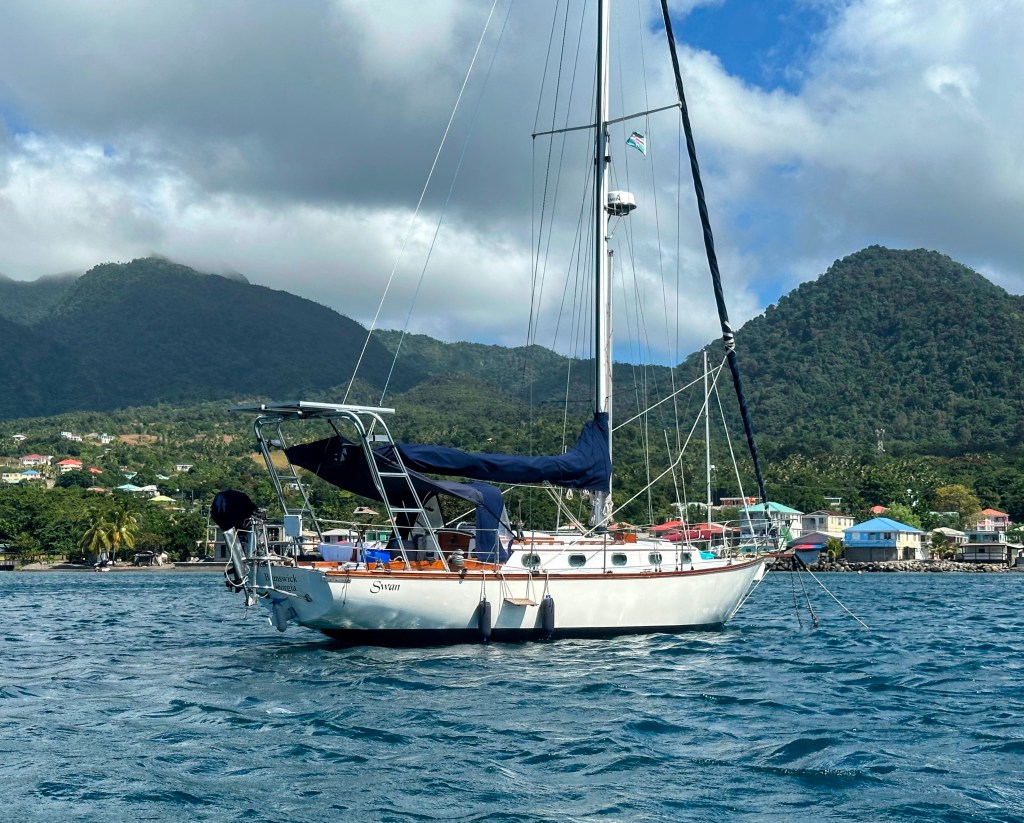
As it turned out, I made the turn into the huge, beautiful bay and encountered minimal winds and glassy water, which was ideal for the ePropulsion Navy 6.0 electric outboard. Even though I still had about a half mile to go, I switched over to motor propulsion and furled in the genoa. At this point, all sails were down, and the boat was ready to drop anchor. I ghosted into the massive bay at about two knots, completely silent due to the stealthy quiet of the electric motor. The shore along the inside of the harbor extends a mile or more, and most of that area is suitable for anchoring. However, the area on the north side is the preferred anchorage for sailing vessels, given the good holding and proximity to shore services. I scanned the harbor ahead and spotted the other sailboats at anchor and headed in that direction. As I got closer, I was a bit unsettled by the depth. With just a few hundred meters to go, I was still in deep water – eighty feet or more – and I wanted to drop the hook in thirty feet or less. I glanced at the chart plotter and saw that there was a steep drop-off, and sure enough, the depth sounder showed a quick shallowing of the water as I inched forward. In less than a minute, I was in a good anchoring depth. After gliding into an open spot, I allowed the boat to come to a stop, then walked slowly to the bow and released the anchor from the bow.
When the anchor hit bottom, I felt pure euphoria. I’d made it. Three full weeks at sea. Over 2,200 nautical miles. Three time zones. My longest passage both in distance and duration. And now, suddenly, here I was in this gorgeous expansive harbor, safely anchored, the journey completed. Mixed with this euphoria was utter exhaustion, not only from having completed the voyage but also from having had no sleep for the last twenty-four hours. The final approach of any passage is always high intensity. It requires extra care and vigilance sailing near shore and into an unknown harbor and anchorage. This time was no different, but at least the weather gods were kind on this day, and I was blessed with benign wind conditions and sea state, allowing for a simple and straight-forward final approach into the harbor. Nonetheless, after the anchor was secured, I fully expected that I would collapse onto my berth and sleep for the rest of the day.
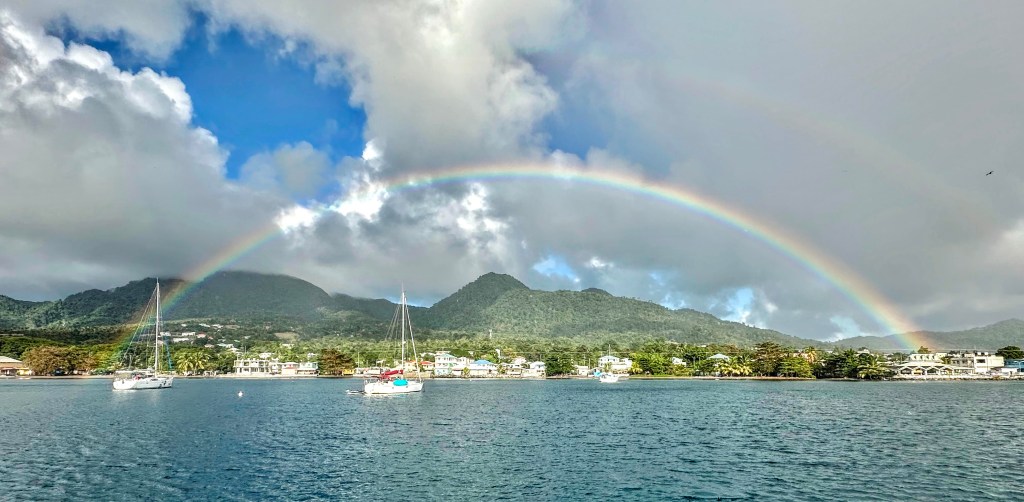
Instead, I felt a new rush of adrenaline and an unexpected boost of energy, fueled by the early morning rays of sunlight lighting up the lush green mountains and the beautiful bay surrounding me, now coming into full view. Standing at the bow, I spread my arms, smiled and dove into the next task at hand, namely, tidying up and stowing all the sailing gear. Methodically, I clicked through the usual list, lashing the mainsail to the boom, attaching the mainsail cover, coiling and stowing the sheets and other lines in the cockpit, stowing the lazy jacks, wind vane, autopilot, and electric motor, and turning off the electronics, including AIS, VHF, depth sounder, chart plotter, and Inreach satellite tracking devices. With the boat safely at anchor and now tidy and shipshape, I felt the last fumes in my own fuel tank dissipating rapidly, so I went below to get some sleep.
I expected to be out cold for twelve hours and to wake up after dinner time with my internal clock turned completely upside down. Instead, when my eyes opened, I was surprised to check my watch and find that I’d only slept a couple hours. It was still late morning, and I had the whole day ahead of me. I hadn’t intended to go ashore on my arrival day, due to pure fatigue if nothing else, but I was feeling refreshed and still had plenty of time left in the day. I decided to deploy the dinghy and go ashore to see the lay of the land and take care of whatever errands I could. Portsmouth is interesting and attractive for many reasons, and one standout feature is the organization called PAYS – Portsmouth Association of Yacht Security – whose sole purpose is to serve the community of visiting sailboats. They offer a dinghy dock, mooring balls, security patrols of the anchorage, immigration and customs clear-in services, water, trash, laundry, and showers. Many of their members offer ecotourism tours of the island. I figured that the best first stop would be the PAYS office, so I pointed my dinghy toward their dock, about a quarter mile north of Swan. As I made my way along the shore, with the beach off to my right, and the anchorage to my left, I passed several wrecks that were quite startling. There are two forty-foot monohull sailboats dramatically beached on their sides in shallow waters along the way. One still has remnants of a sail fluttering in the wind. Two large rusting coastal power vessels also sit listing at odd angles in the shallows. I crept up closely in the dinghy to inspect and take photos of these odd monuments welcoming the newly arrived crews anchored just meters away.
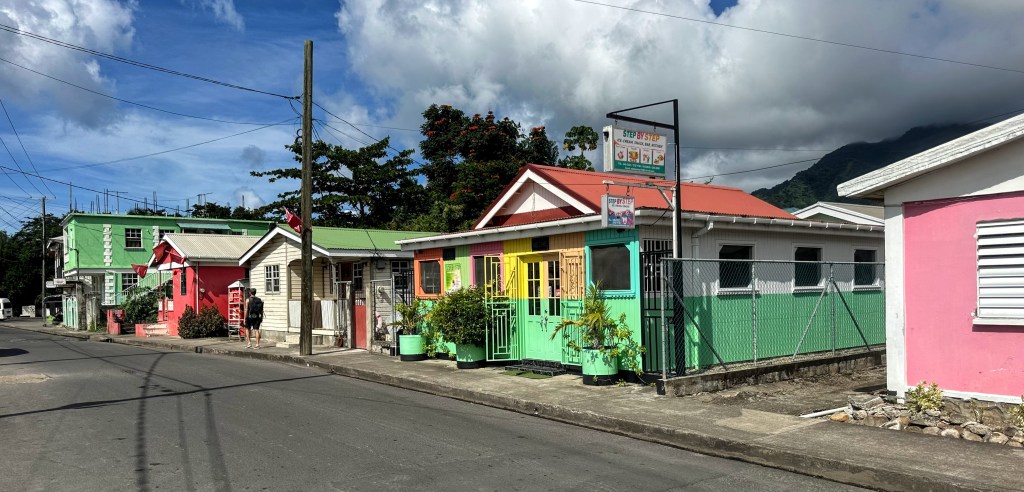
I spotted the large concrete dock maintained by PAYS and steered the dinghy in that direction, edging around one of the large hulking steel wrecks sitting in the shallow water just a few meters away. PAYS has a kind of small compound on the beach with several small wooden structures tucked under the shade of the palm trees. These include a small outdoor meeting and dining area, a small beach bar and restaurant, restrooms and showers, and their administrative office. I was able to drop off my trash and start the customs clear-in process, which I’d have to come back later to complete. From there, I ventured down the narrow two-lane road heading south along the beach toward the center of town. My first impression was that Dominica, and Portsmouth specifically, was the least developed location I’d visited on the entire voyage. Goats and chickens crossed the road. Structures were small and simple and often in need of repair. Shops I passed seemed minimal in their scale and offerings
That said, I immediately liked the vibe of the place. It was quiet, relaxed and peaceful. People I encountered were friendly and open. I found on a visit ashore a couple days later that the town bustles with activity. I saw groups of grade school students walking home along the road in their school uniforms, customers lined up outside the tiny bakery, groups of local Portsmouth residents of various ages gathered here and there greeting one another and engaged in conversation, cars zipping through the town on the narrow main street, taxis parked in their designated area waiting for customers, and small colorful handmade tour boats preparing to take tourists up the Indian River. It was during this second visit that I started to get a better feel for the charm and vitality of the town.
On that first day, when I returned to Swan, the fatigue again settled in, and I slept for a full twelve hours. The next morning, Sunday, I reassessed my anchor situation and decided I was too close to the steep drop-off behind me and needed to move. From the foredeck of Swan, I scoped out two other promising locations, raised anchor, and glided quietly over to the first spot, which struck me as being a bit tight, so I moved on to the second, which was just south of the main fishing dock. This was an improvement, and I went ahead and deployed a second anchor from the dinghy once the first was dropped and secured. Swan very likely was the only boat with a second anchor deployed, but I had my reasons. When I was anchored at Porto Santo in the Madeira group, James had advised me to put out a second anchor given the exposure to the sea and the direction of the prevailing winds, which were coming from the shore. His point was that a failed anchor shackle or link of anchor chain could result in me losing the boat. Once adrift, even a gentle breeze would take her out to sea, where she would simply vanish. If I were ashore, I would come back to find the boat gone for good. This stuck in my mind, and when I realized that the Portsmouth anchorage presented the same scenario, I opted immediately to go for a second anchor. Fortunately, there is just enough room here that I can deploy it without interfering with other boats. Once the anchors were deployed, I spent most of the rest of the day on phone calls with Kai and Leah, James, and John, and catching up with emails and text messages with family and friends.
The next morning, I poked my head out of the companionway hatch and saw that two boats that had been anchored in the ideal location had left and that this perfect spot was now sitting wide open and beckoning. I looked at my own anchor situation and realized that the room I had to drag to the steep drop-off was still a concern, so I decided to go for it and move once again. This time it was more of a project because it required that I recover both anchors, not just one. I managed to take in my secondary anchor simply by standing at the bow and pulling the rode in, which gradually moved Swan to a spot directly over the anchor. From there, I just hauled hard and pulled the anchor up and over the bow.
When I dropped anchor in the new location, I was in a perfect depth of twenty feet, and when the boat floated back with the full anchor rode deployed, I was still in only twenty-five feet with plenty room around me. I was planning to stay in Dominica for at least a month, and I’m glad I jumped at the opportunity to move Swan to the most secure spot I could find. With the two anchors out again, I likely will not need to fuss with the anchors again until my final departure several weeks from now. I will also be able to venture off and explore the island without fear that Swan will have vanished off into the horizon when I return.
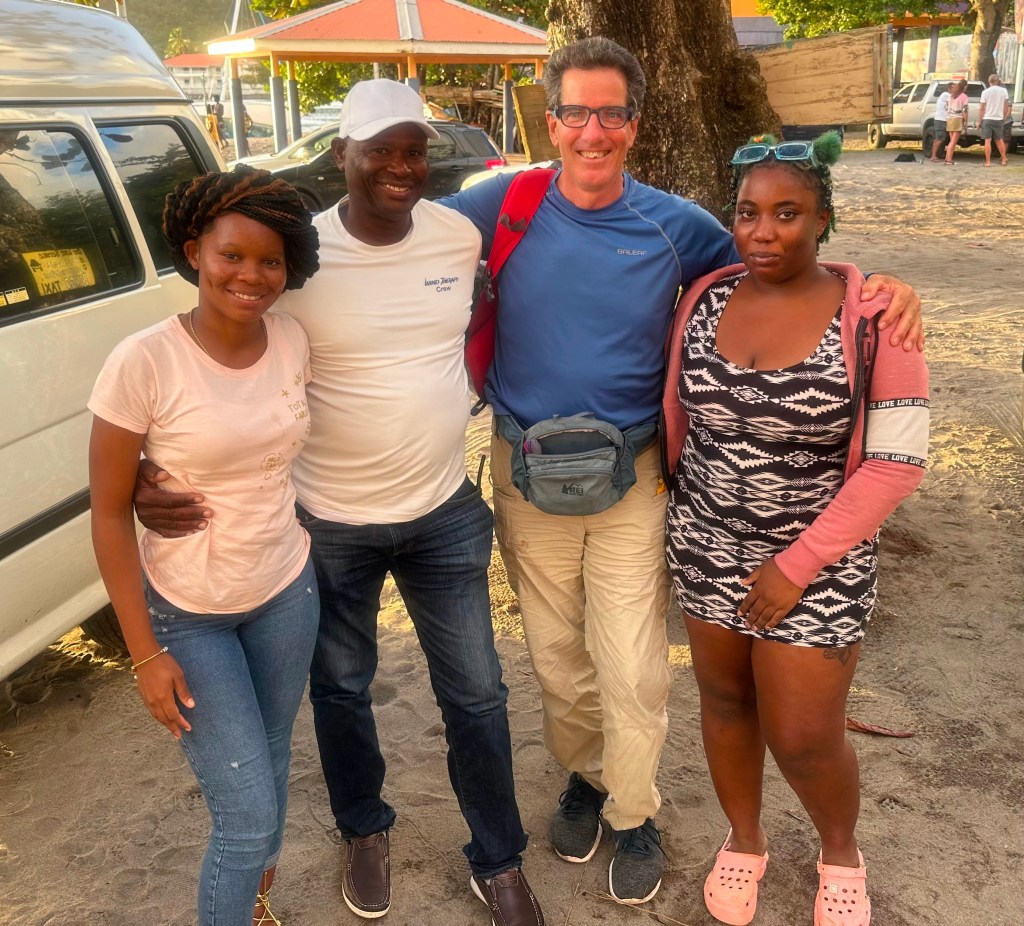
In the afternoon, I ventured ashore again and was able to complete the paperwork for my clear-in. Valesha and Sasha were the two kind ladies at the PAYS office who took care of it for me. They also took my bag of laundry and said it would be ready for pick up the next day, and they directed me to the spigot nearby where I could fill jugs with drinking water. From there, I ventured back toward town and found the small bakery along the way, just a tiny structure with a window where you place your orders from outside. After the bakery, I walked further, making it passed the fishing dock and all the way down to the bridge crossing the Indian River, where the colorful homemade guide boats were tied up and waiting to take customers on the tour upriver.
The next day, Tuesday, I knew would be dedicated to repairing the genoa. I noticed offshore that the sheets had chafed severely against the jaws of the whisker pole just next to the clew knot, so the chafed portions needed to be cut off and the sheets retied. In addition, I noticed another tear on the leach immediately adjacent to the spreader. This is a vulnerable spot, and James and I had already repaired it twice in the past with patches. I needed to inspect the damage and possibly sew on a new patch. Luckily, the winds in the harbor had so far generally been very light, so I guessed I’d have a nice opportunity to drop the genoa in calm conditions in the early morning hours. As soon as I woke up, I checked outside, and sure enough, the flags on the neighboring boats were hanging limply, indicating that conditions were ideal to open the large genoa and drop it to the deck with minimal drama. Within thirty minutes, the genoa was tightly lashed on the port side-deck with several ties securing it snuggly to the stanchions. I then dove into the repair work, and by the end of the day had retied the sheets and hand-sewn a new patch over the tear on the leach. I wrapped up the day with a quick trip to PAYS to pick up my laundry and separate calls to Mom and Robert, and to Dad.
On Wednesday, I spent the morning making various adjustments and repairs to the whisker pole, including sewing fast the knot that held a jury-rig retaining loop I had attached to the end of the pole while underway, which served as the tie-off point for the aft guy and the fore guy. The original steel cable loop had almost cut through and failed while I was offshore, and the jury-rig solution needed to be checked and secured now that I was at anchor. I also re-lubed the inner tube that telescopes into the pole, as it tends to freeze up and prevent the jaws from rotating with the genoa sheet. For good measure, I deployed the pole off the starboard side of the boat to make sure everything was in good order and double-checked the lengths of the fore guy and aft guy. With the pole inspection and repairs completed, I’d finished the major repair tasks on my list after the long passage. In the evening, I stopped by a beach barbeque hosted by PAYS and had the chance to meet some other sailors.
After any long passage, I find it takes me about a week to transition back to life at anchor. These first days tend to focus on rest and recovery, boat clean-up and repairs, ensuring a secure anchor set-up, and various errands, including customs clear-in, laundry, trash, water, shower, cash, and groceries. I also spend time catching up with friends and family, either by phone or email. I can hardly believe it, but I’ve already been anchored at Portsmouth for five days, so I’m well into this initial transition week. Fortunately, the key items on the task list have been crossed off. This afternoon, I will venture ashore again and pay a visit first to the local bakery and then to Cabrits National Park, which is walking distance from the anchorage. The first adrenaline-soaked days since arriving have passed, and I look forward to settling into the rhythm of life at anchor and exploring this amazing island of Dominica, my new temporary home.
25 October 2025 – Reflections on the Atlantic Crossing
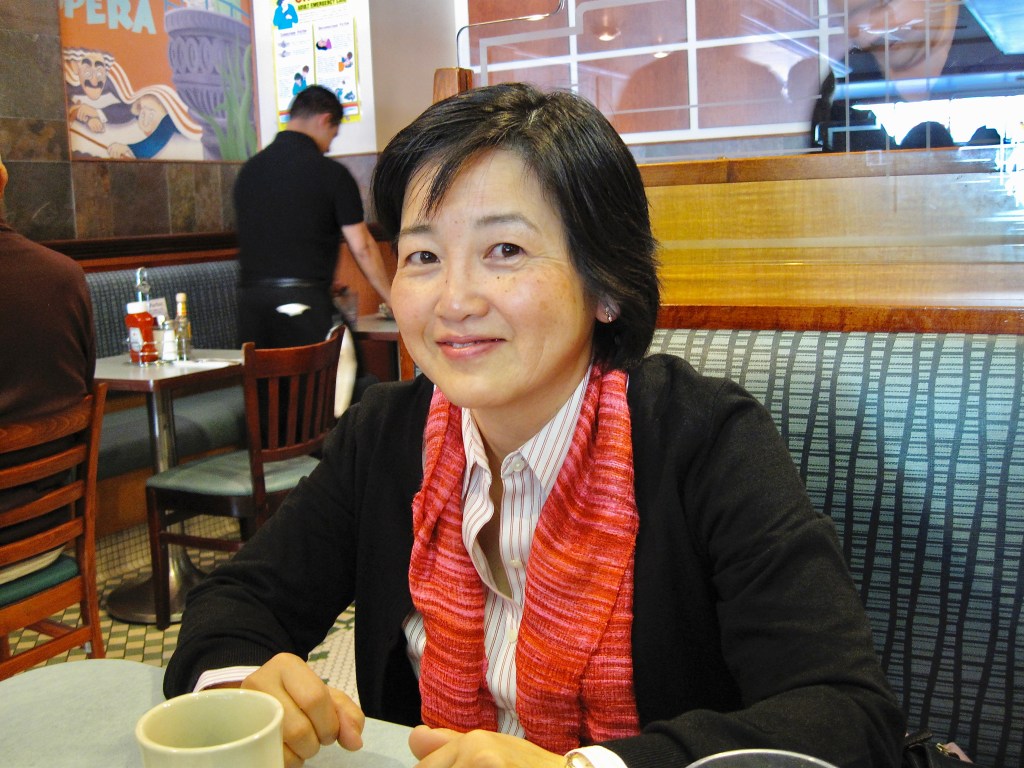
I met my wife, Kyoko, during my second semester at Oberlin College back in 1983. I had just turned nineteen. We ended up spending thirty-seven years together and had two wonderful children, Leah and Kai. In 2020, at the age of fifty-seven, Kyoko died of cancer. She was always my guiding light, and she remained so throughout this journey on SV Swan – through all the highs and lows, the moments of exhilaration, the challenges, and the solitude. I know she is still there, quietly watching over me. This voyage is dedicated to her.
—————–
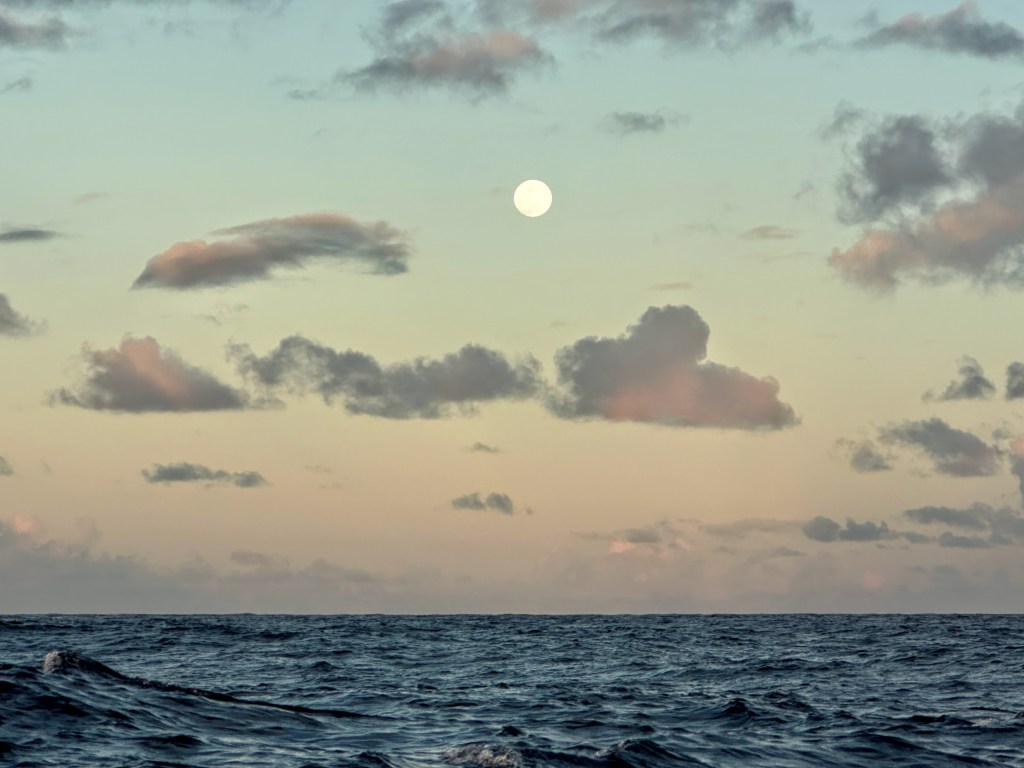
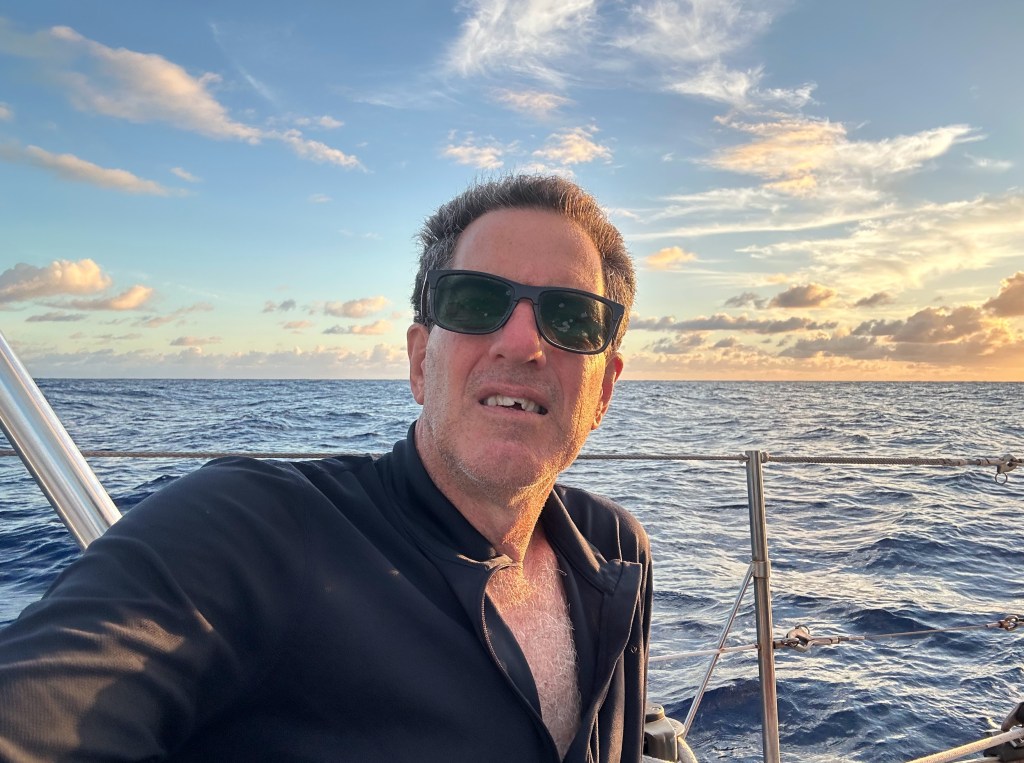
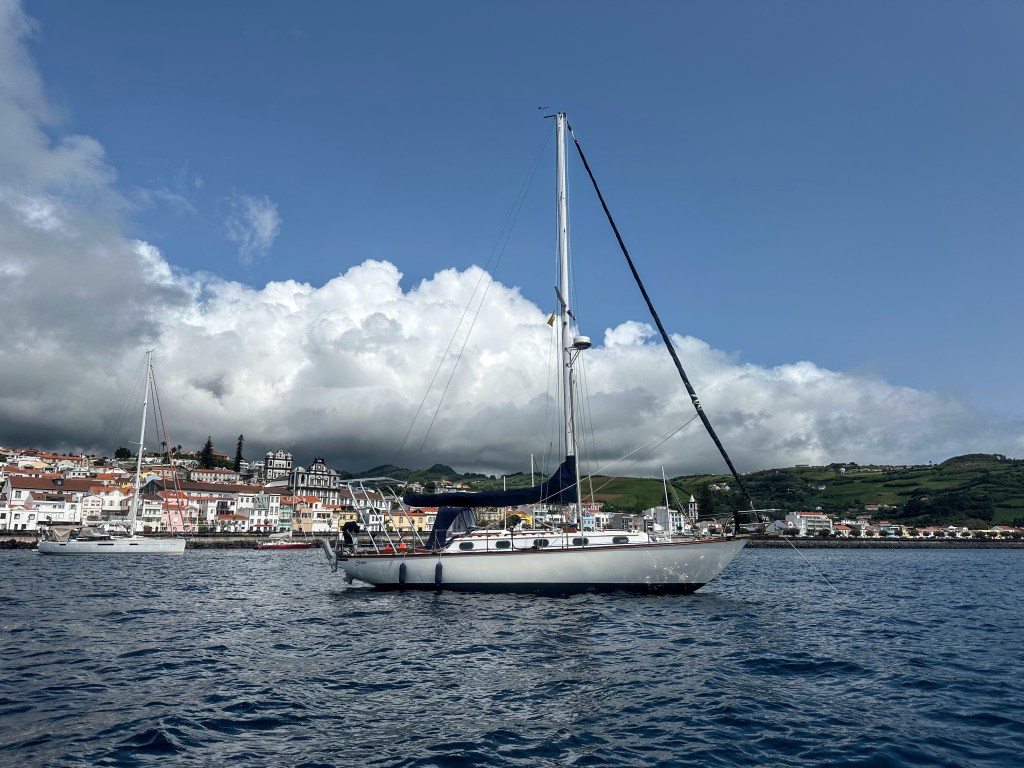
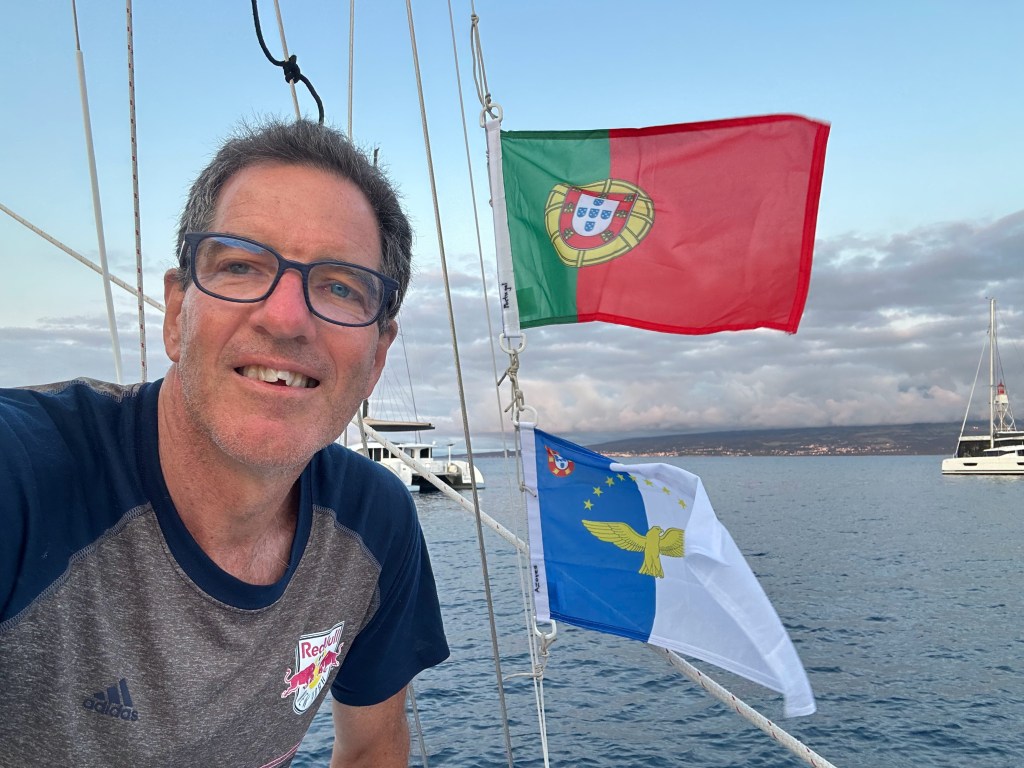
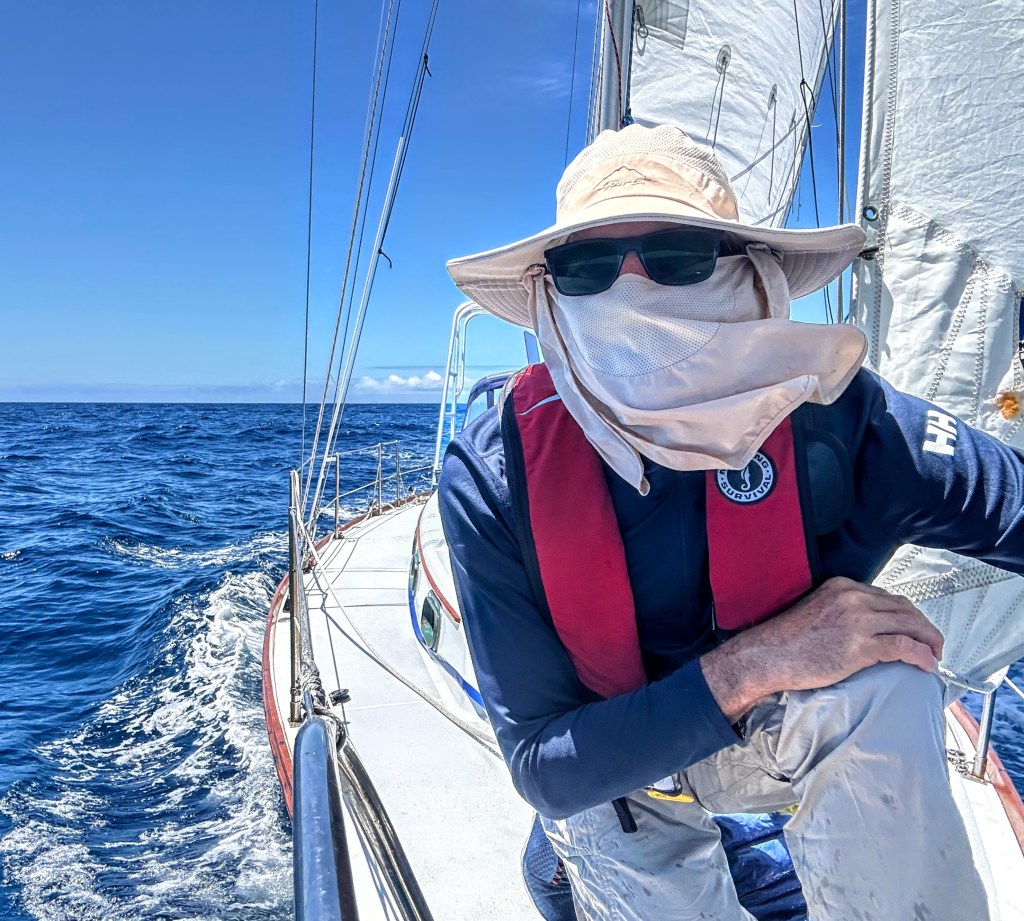
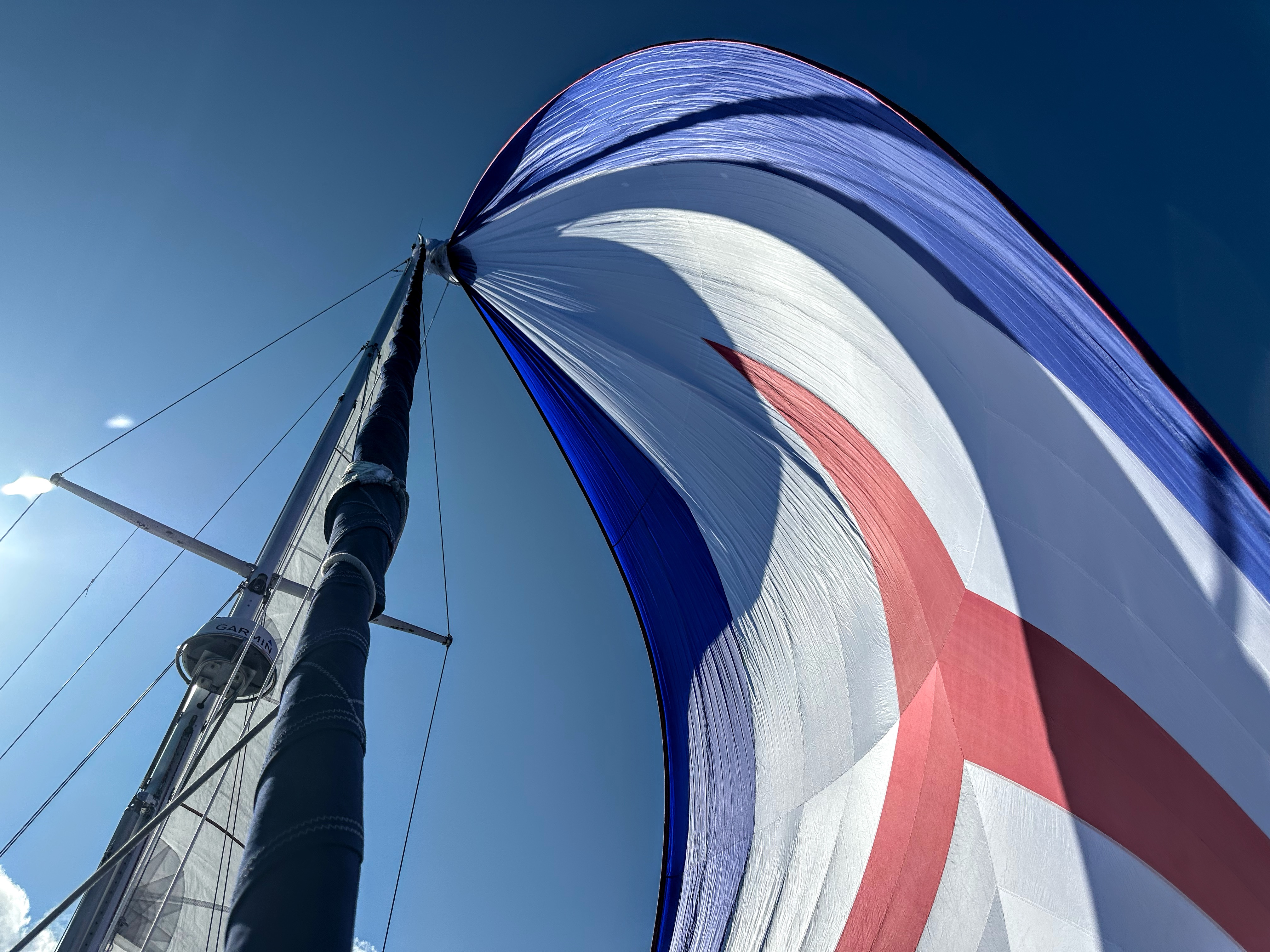
In the darkness of the early morning hours on May 2nd, 2025, I walked to the bow of SV Swan and began raising the anchor off St. Simon’s Island, Georgia. The chain clattered loudly as it dragged across the bow roller and into the chain locker, rudely breaking the silence of the night. Once the anchor was firmly secured on the bow, all was quiet again, and Swan began gliding slowly without a sound through the inky black water. She was blanketed in darkness. I turned her slowly and pointed her bow out of St. Simon’s Sound and toward the sea. It was day one of my solo crossing of the Atlantic Ocean.
During the ensuing months, Swan and I sailed more than 4,000 nautical miles to cross the Atlantic Ocean, making stops in St. George’s, Bermuda, Horta and Praia da Vitoria in the Azores, Porto Santo in the Madeira group, and Agadir, Morocco, where I am now.
The Atlantic crossing was the culmination of years of work and planning, of thousands of miles of single-handed sailing on Swan, of facing down fears and doubts, and somehow persevering. I remember the moment I first saw the Moroccan coastline through the late afternoon haze on that day in early September. I was overcome with a sense of elation and personal fulfilment. Several days later, my head is still spinning. It’s hard to believe I made it. But here I am.
Overall, the crossing went well. I was blessed to have experienced no major mishaps, but it wasn’t easy.
I’m not so young anymore, and I felt my age. My physical and mental stamina were put to the test on each passage. It was tough to go up to the foredeck in rolling seas to put in a reef, or deploy the whisker pole, or take down the staysail. It was even harder doing it at night. The rough ride alone could be draining, often continuing for days on end. Somehow, I managed, and over time, things became easier. I found that being deliberate and methodical was the key. One step at a time. No need to rush. I also realized how important it was to take care of myself, which could be easy to overlook. Eat well. Sleep well. Get into a good rhythm and routine. I tried to stick to these simple guidelines, and it worked well for me.
Solitude was another challenge. I didn’t expect it to bother me. It crept up quietly and engulfed me before I knew it. I had two or three terrible days on the way to Bermuda. The fifth anniversary of Kyoko’s death landed right in the middle of the passage, and it sent me into a tailspin. I was able to pull myself out of it, but it was not pleasant. Throughout the Atlantic crossing, solitude was inescapable. In port, there was less of an edge, but it was still there. New friendships lasted a day or two, a few weeks at best. Offshore, alone in the open sea, the sense of solitude was more acute. Over the course of the journey, I got better at dealing with it, but it’s always there. After the Bermuda passage, at least I was no longer blindsided by it. I knew it was lurking, and I was better prepared. That alone made things easier.
Two other factors loomed large during the crossing. One was weather. I learned firsthand that weather dwarfs all other factors when it comes to the actual sailing. Variable winds turned what should have been a short passage to Bermuda into an extended endurance test and chess match with Mother Nature. In contrast, favorable winds and seas allowed me to sail comfortably at top speed for days on end on the way to Horta in the Azores. For each passage, weather trumped all other factors. It dictated how hard the sailing would be and how long the passage would take. If nothing else, I’ve learned to be patient in port when waiting for the next weather window. There’s no point in rushing into unfavorable conditions.
The other factor was equipment failure. I was lucky. No critical systems or equipment failed, but I had many repairs to make along the way. My genoa tore, and I had to have it repaired in Bermuda. One of my primary winches seized in Praia da Vitoria, and I was barely able to get it lubed and operating again. My rope anchor rode unraveled, also in Praia da Vitoria, requiring me to resplice it to the chain. My dinghy, which is my lifeline when at anchor, started to lose air, requiring a creative repair. While underway, the shackle for the topping lift failed, the shackle for the outhaul failed, and several sail slides for the mainsail failed, all requiring jury-rig solutions at sea. The cooling fan for my ePropulsion Navy 6.0 electric motor failed for the second time, and I was fortunate to have a spare onboard, which I installed at Agadir. While at sea, I received cryptic and alarming error messages for both my AIS and satellite communications systems, but luckily, both continued to operate for the duration of the passage. Other sailors I met along the way also juggled various repairs they needed to make. I’ve learned how important it is to be prepared with the right tools, and extra parts and supplies, and to take care of the boat. From there, it’s just hoping things hold together.
Looking back at the crossing, and to the many passages still ahead, there’s one critical piece of the puzzle that can’t be overlooked. Without James Baldwin, my mentor throughout this whole undertaking, none of this would have been possible. James is a living national treasure. His sailing accomplishments are extraordinary. He is a pure sailor, a true sailor – someone who circumnavigated twice solo on a 29-foot Pearson Triton guided only by celestial navigation and without an engine. Also, he is a master boat-builder, specializing in refits of classic sailboats, like my Cape Dory 36, Swan. James has guided me each step of the way, starting with boat selection, then the two-year refit, and now as mentor for my adventures at sea. I’ve learned more than I could have imagined, come farther than I could have imagined, and made lifetime friends in both James and his wife, Mei.
There were countless others who helped along the way, but Brett Grover, and my brother, John, top the list. Brett is a good friend and highly experienced sailor from Georgia who has provided invaluable guidance and support and who crewed with me on the first leg of an early trip to the Bahamas. He’s always been in my corner and encouraged me, which at times was what I needed most. In the same way, John has provided moral support and cheered me on and has helped to offset some of the solitude I’ve felt at times. He’s the critical back-up to James on my shore team for weather, routing, and emergencies and has been a great sounding board during the whole adventure.
The crossing, and the months at sea, and the time spent in different ports along the way, put into stark relief my real priorities. I realized all over again that it’s all about the important people in my life. How I can balance this with my new life at sea was a big question during the crossing. My brother, John, visited me for one week at Praia da Vitoria in the Azores, which was a highlight of my time there. I also managed a one-week visit to my daughter in Oslo, Norway, while I left Swan in the marina at Agadir. Generally, it’s difficult to see people when voyaging. There are many others, including my son, Kai, who I will not see for a very long time. This is a challenge I’m still trying to sort out, and I’m going need a solution if I’m going to continue voyaging.
I’m still in Agadir, and next up is a 1,100 nautical-mile passage to Mindelo in the Cape Verde islands. The departure was supposed to be straight-forward. I just duck out of the harbor, point my noise out to sea, and catch the prevailing northeasterly winds south. However, Mother Nature again has broken out the chess board, and I’ve been delayed several days waiting for a weather window. Nothing is in sight for the next week and beyond. I’m learning to be patient. I’ll sit tight. One way or another, I’ll be underway again soon.
12 September 2025 – Two Weeks of Intense Activity and Big Milestones: Praia da Vitoria to Agadir
The past two weeks have been a particularly intense and particularly meaningful period in my Atlantic circle voyage. During this short window, I completed two additional challenging passages, stopped at two new and completely different destinations, and reached some new personal milestones, most significantly the successful completion of a solo crossing of the Atlantic Ocean. I have been comfortably settled in at Agadir, Morocco for several days now, but my head is still spinning as I try to digest everything. It’s all a bit of a blur. Events of just a few days past seem like they happened a year ago. The intensity of activity and transition has been disorienting, but I’ve also felt a sense of euphoria and elation and happiness that I’ve made it this far, and a new sense of comfort and confidence about my life on the sea.
It started on August 25 with the stark transition from a two-month leisurely stay at Praia da Vitoria on the island of Terceira in the Azores to a challenging five-day passage to the island of Porto Santo in the Madeira group. Praia da Vitoria had almost felt like a second home after such a long and relaxed layover, but now it was time to move on to new destinations and adventures. I arrived at Porto Santo on August 30 and intentionally kept the stay somewhat short. As a US citizen, I’m on a 90-day visa that covers the so-called Schengen area, which is basically the European countries. The 90-day limit also includes transit time between any Schengen locations. For me, the clock started on June 14 when I arrived at Horta in the Azores and had not stopped since then, leaving me with a dwindling number of days to spend in the prime sailing areas of the Azores, Madeira, Canaries, and Portugal. Thrown into the mix was that I desperately wanted to cut away for about a week at some point to see my daughter, Leah, in Norway, which is also part of Schengen. I had a nice but brief stay at Porto Santo and finally raised anchor to depart on September 4, leaving seven days on my Schengen visa to visit Leah.
As an aside, the whole Schengen 90-day limit has proven to be a real headache for me, and if I return this way again in the future, I will try to get a visa with a longer limit. As a result of the tight time constraint, I did not have the opportunity to visit the main island of Madeira, and I will not have time to stop at the Canaries, even though I’ll sail right through them on the way to Cape Verde. In addition, as result of being expelled from Schengen by mid-September, I’ve been left with a full two-plus months outside of Schengen on the eastern side of the Atlantic before I can start the return passage across to the Caribbean. Starting the passage before late November would put me in the hurricane zone before the finish of the hurricane season, which is not a risk I can take. Outside of Schengen, good ports and anchorages are limited, and for this trip, I narrowed my options down to Morocco and Cape Verde, and I’ll likely split my time between the two. I had originally hoped to sail to Tangiers, Morocco, but I abandoned the idea after consulting with James, who identified a number of risks stemming from wind and currents in the final approach. In chatting with some other sailors in Praia da Vitoria, I learned of Agadir as an additional option, and that in the end was where I decided to target.
I expected the passage from Porto Santo to Agadir to be short and sweet, a fast three-day trip on an easy beam reach with brisk and consistent winds and a straightforward approach and entry into the Agadir marina harbor. I was right on the first count in that it was fast, but I was way off the mark on the second in that there was not much about it that was easy at all. To start, I misread my point of sail when I reviewed my course using Windy.com, my go-to tool for weather and route planning. Overlaying my planned route on the wind directions forecast by Windy.com generated a nice ninety-degree angle, suggesting a smooth and fast beam reach all the way. What I failed to consider was the motion of the boat, which likely would be around six knots, and the resulting direction of the apparent wind. True wind is what you feel when you are stationary, and apparent wind is what you feel when you are in motion. Sailboats are driven by the apparent wind, which is always forward of the true wind, so in this case, it meant that I would be sailing in winds forward of the beam, perhaps closer to a close reach than a beam reach.
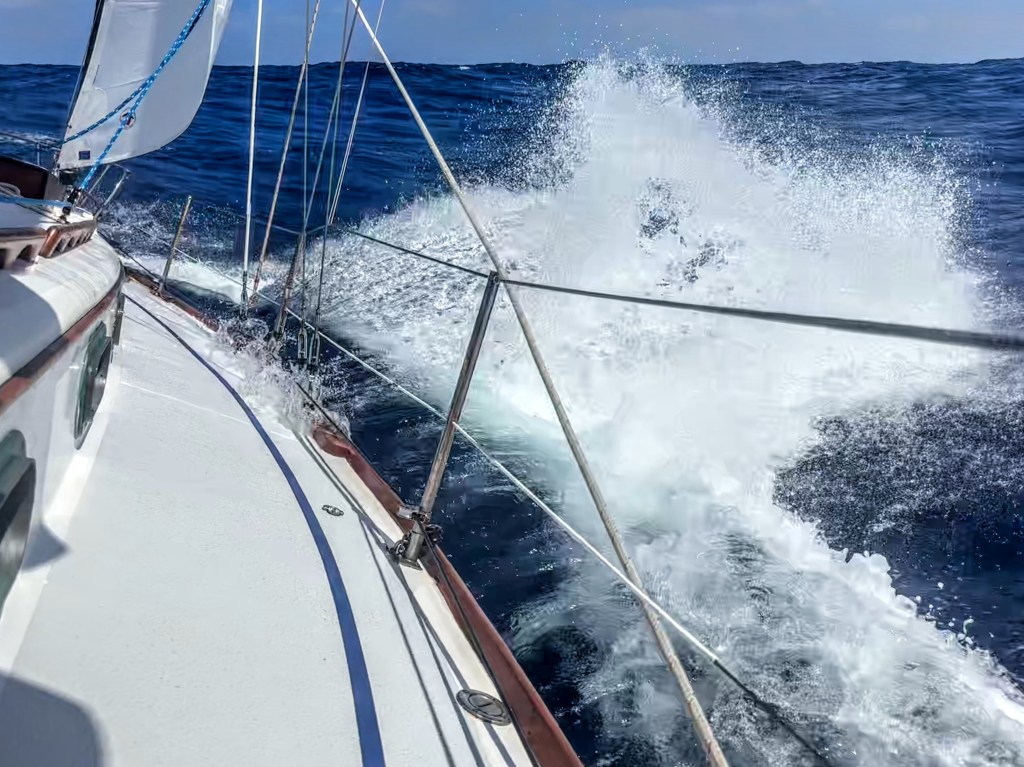
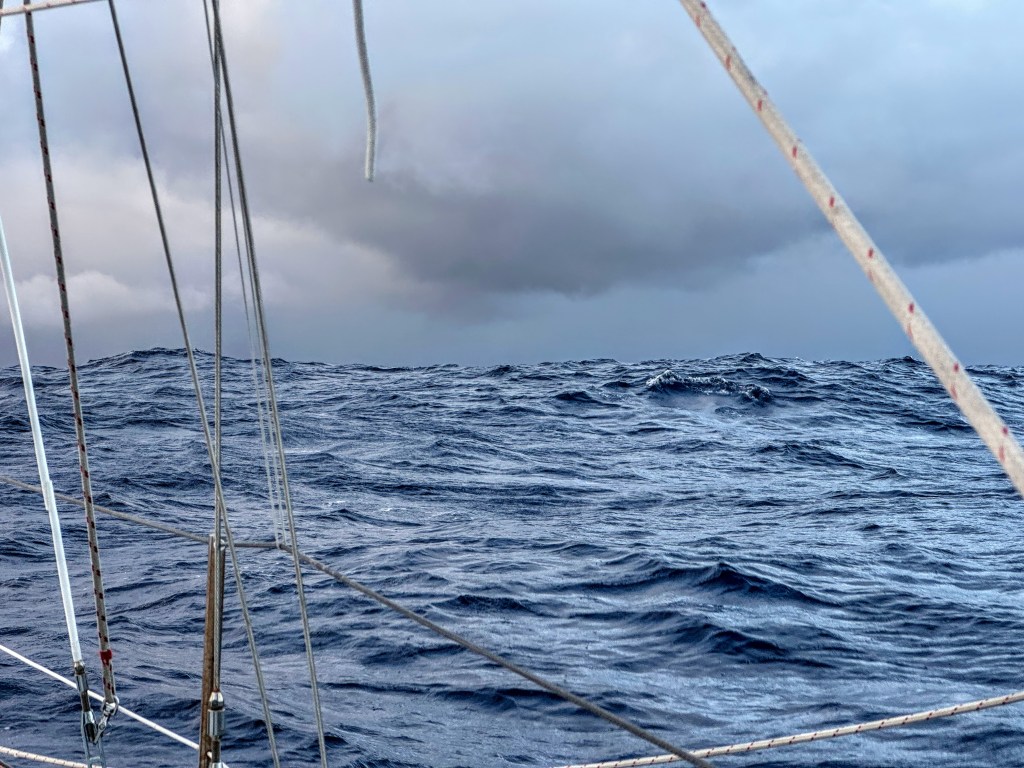
In fact, for the first day, I was hemmed in by the wind and forced to sail close hauled, edging as close as I could go to the wind just to stay on my course. Sailing upwind always intensifies the motion of the boat, and in brisk winds and roiling seas, which is exactly what I was experiencing, it can make for a very intense ride, something like a roller coaster. Expecting strong winds, I had put in a double-reef in the mainsail soon after departing Porto Santo, and I’d also deployed the staysail for heavier winds right from the start. For most of the three-day passage, I was on a port tack with this sail plan, and the main variation was that I would occasionally deploy part or all of the genoa, or furl it back in, to power up or power down as needed with changes in wind strength. Day one was a fast, wild ride, with Swan crashing and bucking through the waves at a blistering speed.
Day two was more of the same, but the wind direction changed slightly in my favor so that I was able to sail on a more comfortable close reach rather than pressed to the limit on a close haul. The other good news was that I was able to sleep well on the first night, which often is not the case for me, and that put me in a good physical and mental state as I shifted focus toward approaching the coastline and wrapping up the short voyage. I had departed on a Thursday morning, and on day three, namely Saturday, I began monitoring my speed against remaining distance to estimate my likely arrival time. My plan and my hope was to arrive during daylight on the next day, Sunday, and if winds held up through Saturday and Saturday night, I calculated that I’d arrive at Agadir marina around 9:00 on Sunday morning. Windy.com forecast sustained winds through the night, which gave me confidence that it would be a smooth and easy finish to the passage.
However, a few factors then conspired against me to make the finish a bit more complicated and interesting. First, the wind died after dark, and I struggled to maintain three knots. Without more speed, I’d end up arriving Sunday night well after dark, and I would not be able to enter the marina. Second, when I was still very far offshore, I strayed into a zone with dense boat traffic that kept me up for the rest of the night. At the front end was a wide channel that cargo ships were using to run north and south along the African coast. This kept me on my toes, but cargo ships are somewhat predictable in their routes, and they generally spot me well in advance on AIS and steer clear by at least a mile or so. For my part, it requires that I stay vigilant, but in almost all cases the cargo ships can be counted on to pass at a safe distance without me having to alter course.
Beyond the cargo-ship channel, however, was an area packed with other vessels that turned out to be local fishing boats, which are always trickier to predict and avoid. Fishing boats sometimes stop completely and otherwise progress on somewhat random courses, heading this way one moment and a completely different direction another, unlike cargo ships, which plow ahead for miles in a straight line. In this case, swarms of fishing boats appeared all around me on the AIS tracker, and most were barely moving. This was helpful to some extent because any boat not on my path was not likely to quickly cross in front of me. However, invariably one of the boats would be sitting squarely on my course line a few miles up, with no signs of moving, which meant I needed to take evasive action. Technically, even though a sailboat under sail is the stand-on vessel in most cases, one exception is when a sailing vessel approaches a commercial fishing vessel engaged in fishing, in which case the sailboat is obligated to divert.
Notwithstanding my own obligation to divert, I had every intention to steer clear, given that these were local vessels in unfamiliar waters at night, and that meant I needed to alter course under sail to pass with enough clearance. When the first fishing vessel was about a mile away, I peered into the darkness to try to get a visual lock on their lights, but I could not pick them out at first. Then I spotted a small flashing pinpoint of light and realized that was him, and that it was all the lighting they had. Keeping an eye on him in the distance, and an eye on my course on the chart plotter, I successfully rounded the first fishing boat with plenty clearance and then repeated this several more times for other boats sitting on my course farther along.
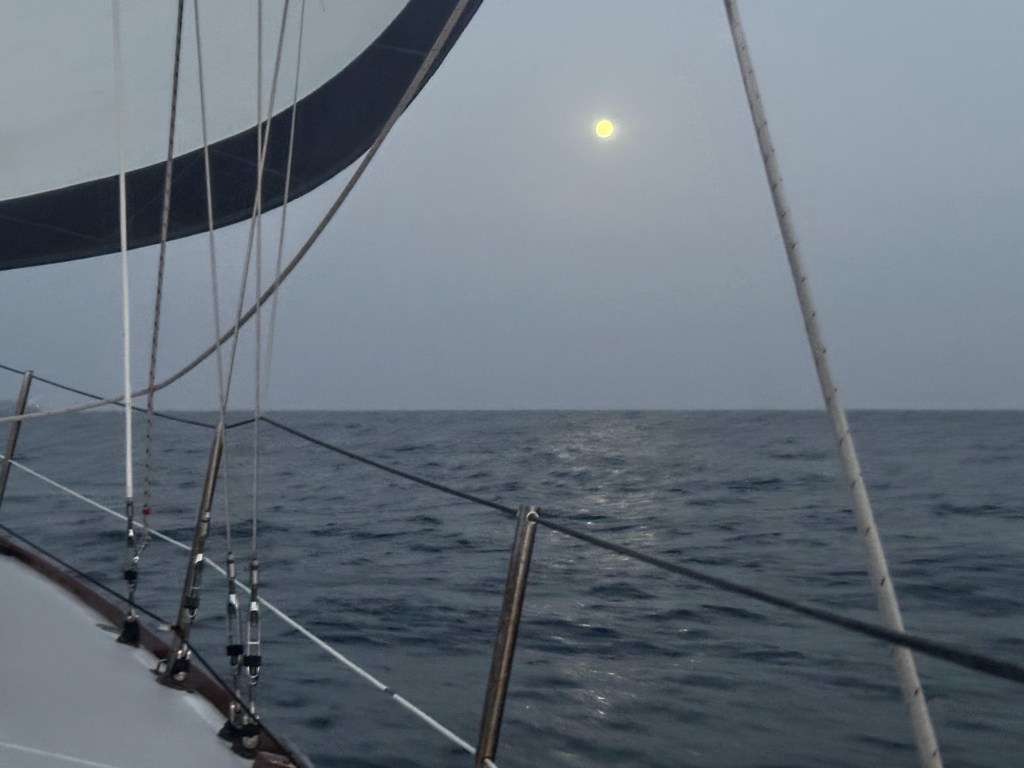
Finally, I passed the last fishing vessel, and soon after a faint glow began spreading across the sky as sunrise approached. Even as the sky began to slowly light up around me, my visibility did not improve, and I realized I was sailing through a dense fog. When the sun did rise into the sky, it appeared as a single white dot penetrating through the thick grey blanket surrounding me on all sides. Fortunately, I encountered no additional boat traffic, and the fog lifted later in the morning. From that point, my main concern was boat speed. Winds finally picked up enough to push me along at four to five knots, which I calculated was enough to get me in before dark. Then I spotted land off to my port and from there I continued to sail parallel to the coast as I approached Agadir. In mid-afternoon, I estimated I’d arrive at around 6:00 pm, so I hailed the marina at 4:00 pm to give them a heads-up about the timing. No one answered, so I waited another thirty minutes and tried again.
I had had trouble contacting them before, and now I was wondering how this was all going to work out with the marina. My fallback was to anchor just outside the marina harbor entrance by the breakwater a few hundred yards off the beach. Finally, someone called me back, and it turned out to be the same person who had confirmed my reservation by phone several days earlier. Unfortunately, after noting it was his day off and he was not at work, he said the marina was full and that I could not come in. After some back and forth, I told him I’d anchor on the outside for the night, and he agreed he’d find me a spot the next day. Fortunately, the approach to the anchorage was very easy, and the location itself was just fine for the night.
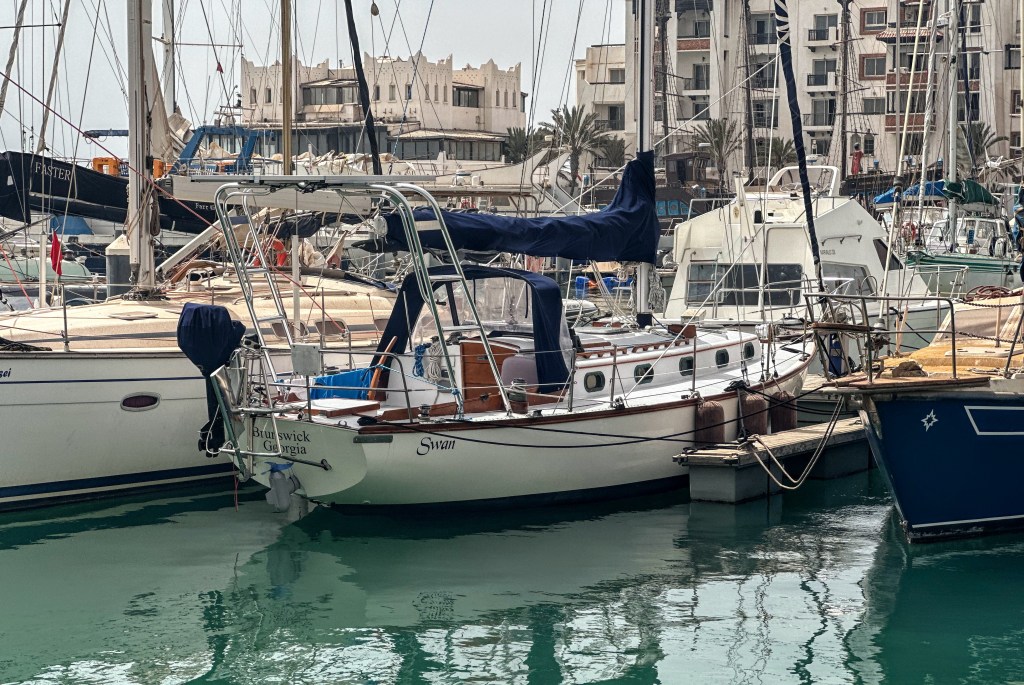
The next morning, I kayaked to the marina early in the morning and was fortunate to spot two staff on the dock as I paddled in. They looked surprised and concerned to hear about my slip reservation, given that they did not have room, but then asked me to tie up the kayak and come with them. By that time, a marina policeman had joined us. I learned later that the two staff were Hassam and Lassam, and they were incredibly helpful. Together we walked the dock and finally found a narrow slip that looked promising. They then pulled the neighboring boat over several feet by tightening up the dock lines, creating ample space for Swan to slot in. I pumped my hands in the air and thanked them profusely, and then it was back to Swan to raise anchor and bring her into the harbor to dock. I had to make a final ninety degree turn in extremely tight space to maneuver Swan into the slip, but it was able to spin her on a dime using the stern thrust and then glided in easily.
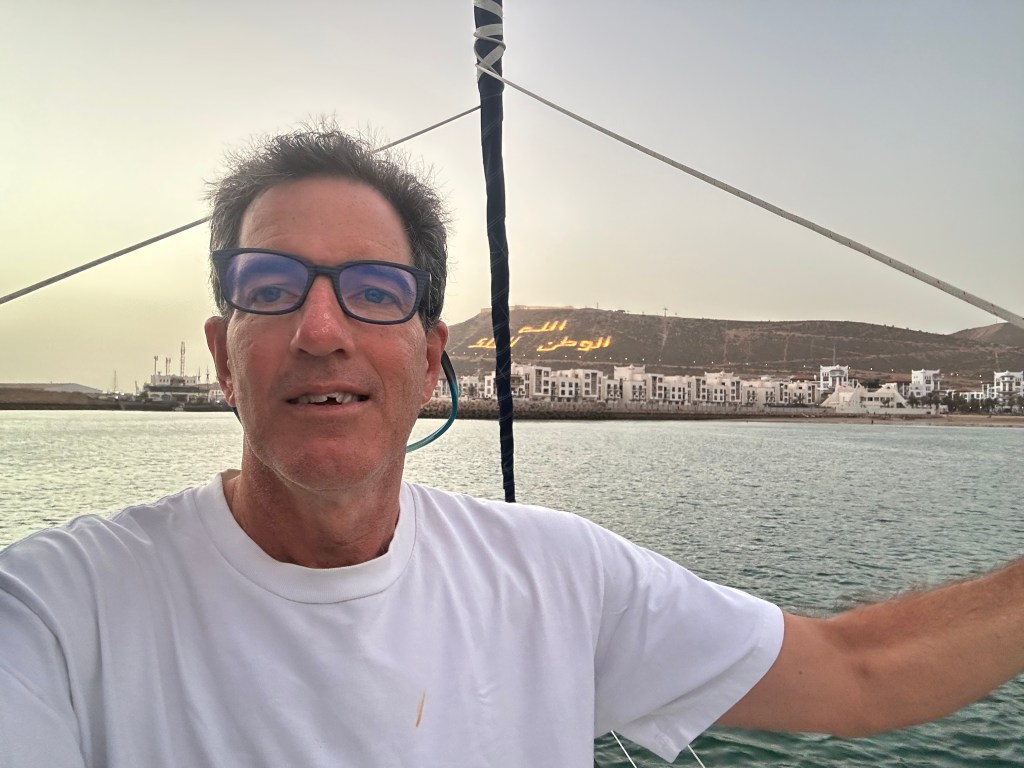
When I set foot on land in Agadir, I officially completed my trans-Atlantic crossing, which is one of my greatest personal achievements. In the few days since then, I’ve explored Agadir on my Brompton bicycle; added additional fenders to protect Swan; made friends with the wonderful staff at Scan Peche, the marine products store down by the commercial docks; passed through the policy checkpoint multiple times to enter the commercial dock area; found a perfect cozy co-work space in town for doing computer work and made friends with Karima and Mohammed, the sister and brother who just launched the business together; made progress updating my website; went for a long meandering run along the two-and-a-half mile waterfront by the beach; took a bike ride out to the Carrefour grocery store; and otherwise started to settle into my new home, where I likely will be for the next month or so. In a week, I will go to see Leah in Oslo.
In the meantime, I’m looking forward to getting to know my new temporary home in Agadir.
11 September 2025 – Five Days in Rough Seas from Praia da Vitoria to Porto Santo
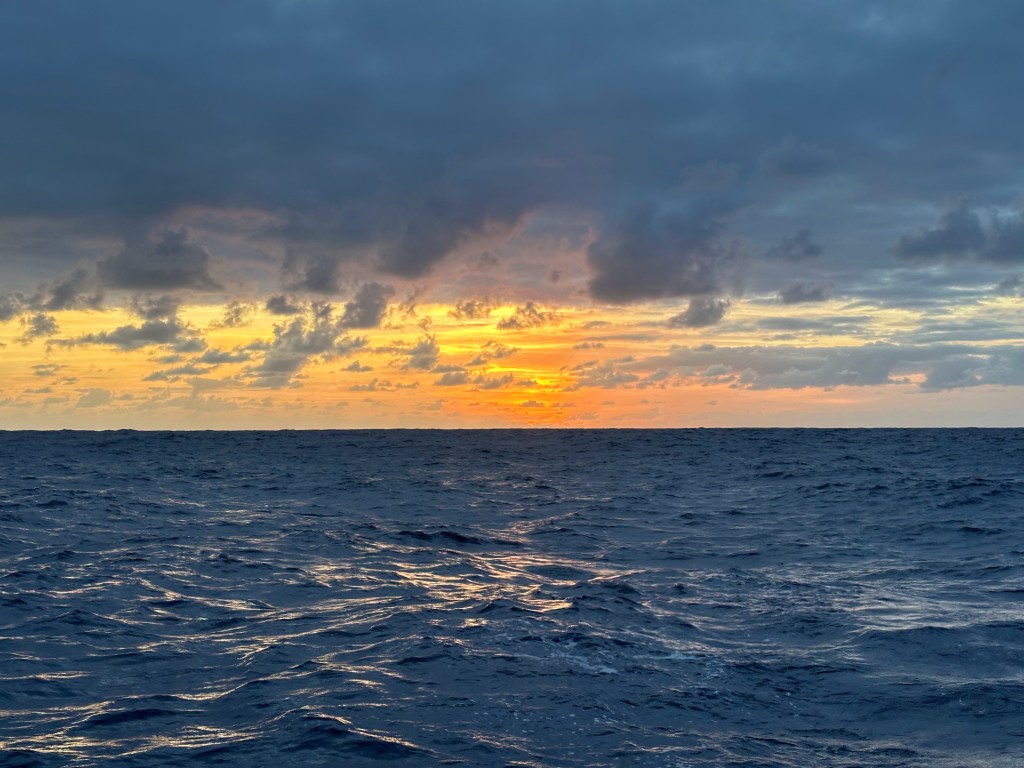
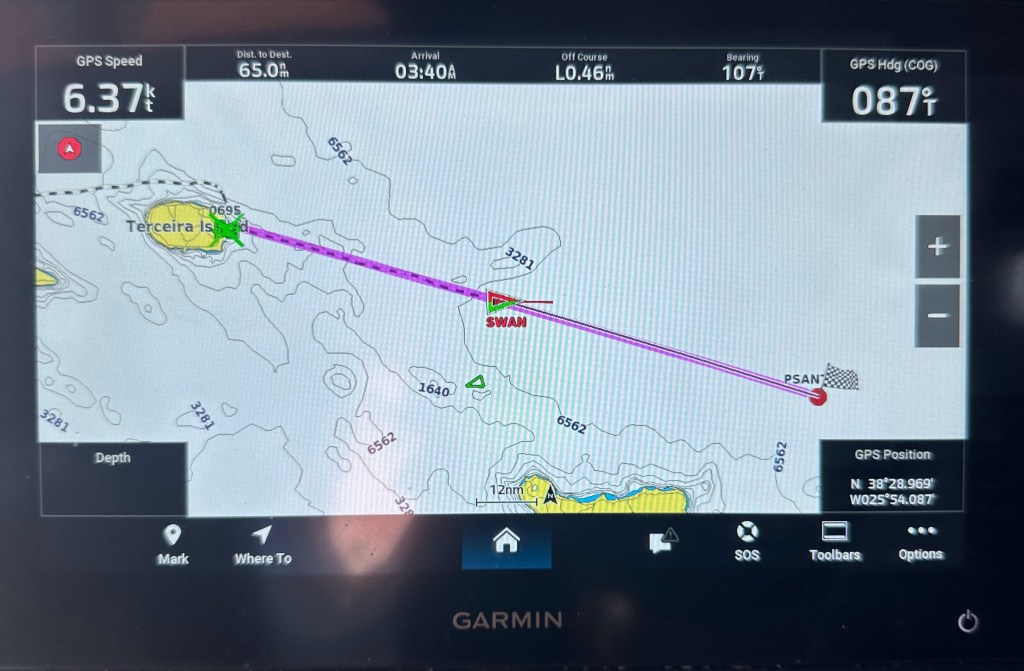
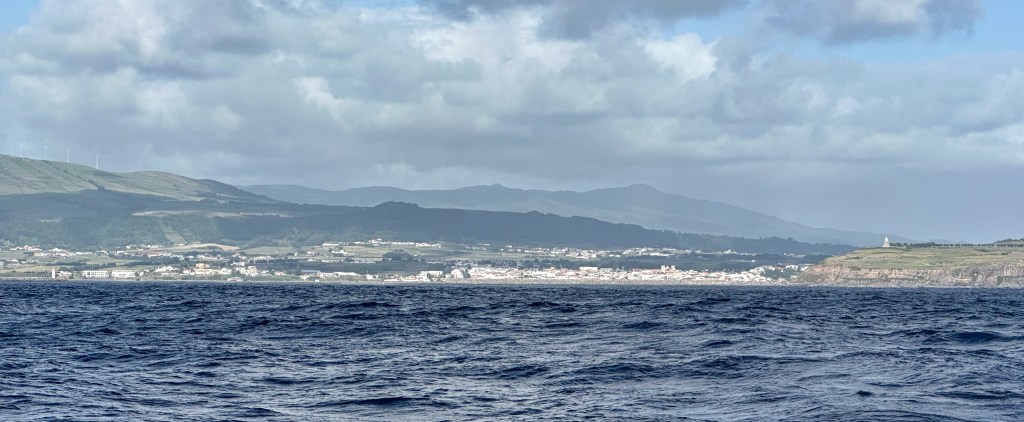
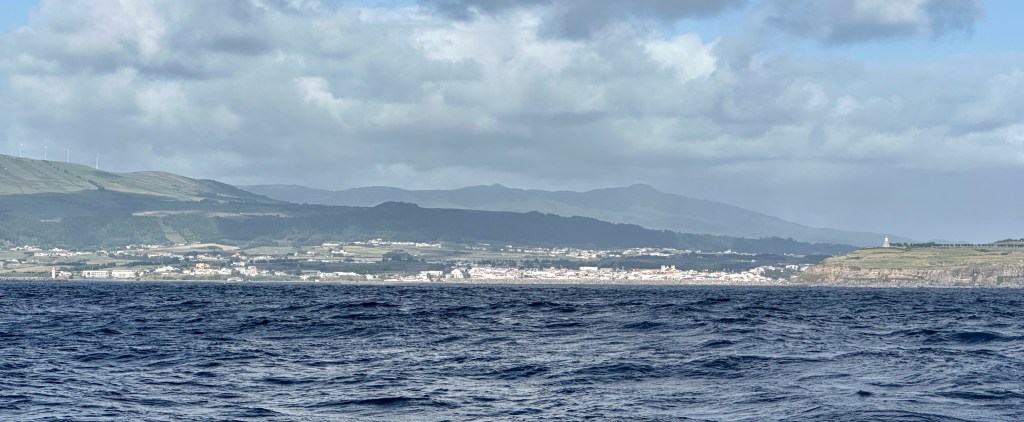
August 25, I raised anchor early in the morning at Praia da Vitoria, a lovely port town on the island of Tereira in the Azores, and set sail for Porto Santo, an island in the Madeira group, some 650 nautical miles to the southeast. I had stayed at Praia da Vitoria for a full two months, having arrived from Horta on June 25, and had enjoyed a relaxed and leisurely extended stay at this magical location, which had become something of a temporary home. On that morning, I glanced across the calm waters in the welcoming harbor and toward the lovely green hills of Terceira for the last time, and when the anchor broke the surface of the water, the long, quiet, easy spell at Praia da Vitoria came to a close. At that moment, I was launched into the next phase of my journey, a short but intense period of activity and transition that has left me both drained and reeling but also exhilarated and inspired. Ultimately, this phase brought me to Agadir, Morocco, but the first step was getting to Porto Santo.
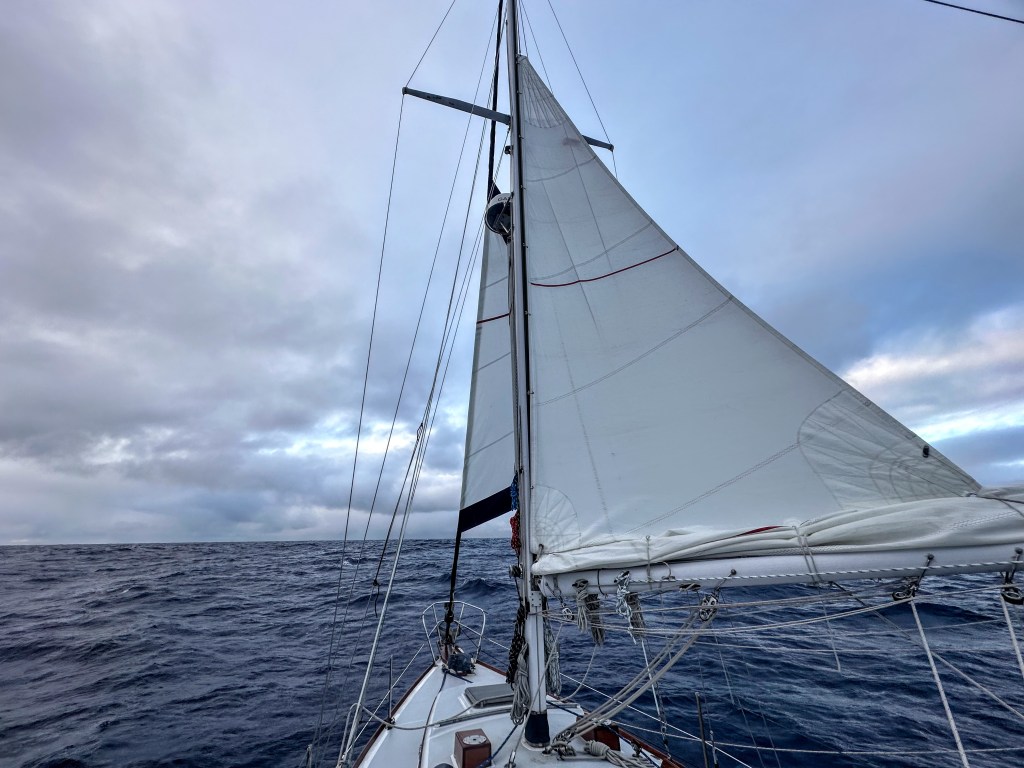
I ghosted off the anchor at Praia da Vitoria with sails alone and no motor, quickly deploying a portion of the genoa to provide some modest boat speed for steerage. This has become my standard practice, and I’ll turn to the motor only if I’m in particularly tight quarters and need to quickly avoid collision with other boats. On that day, while still in the harbor, I then cut briefly upwind and raised the mainsail, then deployed the rest of the genoa. With full main and full genoa deployed on a port tack, I glided out of the harbor between the two massive breakwaters and directly out into the Atlantic. The route from there was straightforward. I needed to sail around the northeast corner of Sao Miguel, the eastern most island in the Azores group, which would put me on a course of 106 degrees true, and from there I would drop down slightly to 121 degrees true for a straight shot to Porto Santo. I left on a Monday and arrived on the following Saturday, so the passage ended up taking five full days, about what I expected.
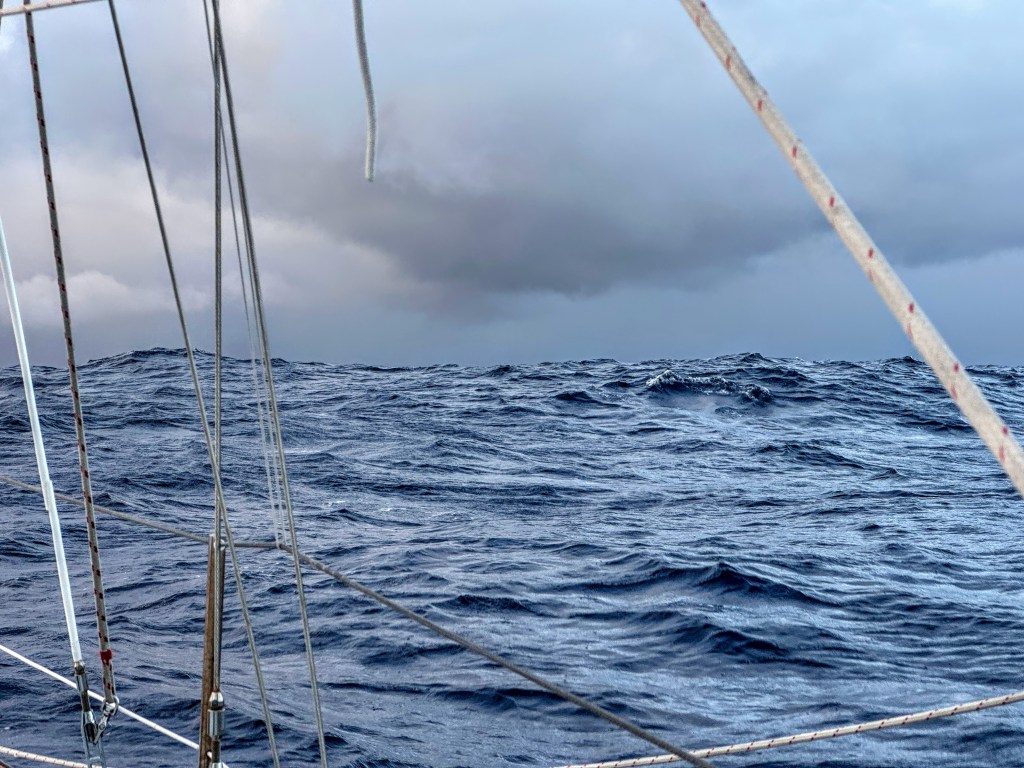
Like most passages, the sailing itself presented many surprises and challenges. As I’ve learned with this new life, nothing is easy. When I departed Praia da Vitoria, Hurricane Erin had been making its way north of the Azores, and while it did not pose any threat, huge swells surged down through the Azores and to their south, which was exactly where I was sailing. From day one of the passage, huge rolling swells passed under the boat from the stern one after another, lifting Swan high up on the peak of one swell and then lowering her down deep into a trough only to get lifted again on the next swell. All the while, Swan was on a beam reach in a brisk wind and tearing along all day at close to seven knots, which is near her top speed. It made for an exhilarating ride, and while the boat was close to being overpowered, I left up the full main and full genoa to sail through the night. It turned out I would not sleep much, partly because I found it difficult to stay on course in those conditions with the Monitor wind vane self-steering system, so the course alarm woke me several times, and because I realized that the boat truly was overpowered, and I needed to reduce sail.
It’s an interesting situation to realize you’re overpowered in the middle of the night. In the dark, the motion of the boat, the feel of the wind on your skin, and the roaring sounds of the wind and waves all seem amplified. On that particular night, it was already loud enough below deck. Still curled up in my berth, the boat felt and sounded like a locomotive at top speed crashing through the seas with the wind singing through the rigging and the water gushing past the hull and creating a low thunderous rumble. When I stepped into the cockpit, the wind hit me hard on my face, and I felt the tingle of spray on my cheeks. The boat was heeled and bouncing in the waves, and I needed to take care with my footing and handholds. My headlamp illuminated the white-water wake streaming fast past the hull, but otherwise, my visual world was cut off. I could hear and sense the swells and waves surrounding me, but it was pitch black in all directions.
It was clear I needed to depower to bring the boat back under control, and I decided to go directly to a second reef in the mainsail. That required that I venture forward to the mast, which in turn required that I equip myself with the proper gear, including offshore personal flotation device (pfd), safety harness to clip onto the boat, headlamp, multi-tool pocketknife, sailing gloves, and sailing shoes. To make the exercise a bit easier, I decided to tack from the port tack beam reach I was sailing to a beam reach on starboard tack, which was a nuisance but would make the reefing work at the mast easier.
Moving to a starboard tack would bring the boom across the boat to the port side, which would allow me to more readily access the reefing lines and winch positioned along the starboard side of the boom. It would also allow me to work from the windward side of the boom while positioning myself securely on top of the coach roof on the center of the boat. Otherwise, if I stayed on the port tack, I would have to balance myself carefully against the leeward toe rail with the water rushing by near my feet and then struggle with reefing lines and winch while excess mainsail fell across them, blocking access and a clear view. During daylight and in moderate conditions, I’ve found that I can easily and quickly manage to reef while staying on a port tack, but in those challenging conditions in the dark, it was the right move to tack first.
Aside from port tack versus starboard tack, the other consideration was point of sail, and to do the reefing, I opted for a beam reach. This is my go-to option, whenever conditions allow, for a couple simple reasons. In the end, it’s a process of elimination. Sailing farther upwind, with the wind anywhere forward of the beam, makes for a rougher ride, and it’s always easiest and safest to moderate the boat motion as much as possible when going to the mast or foredeck. There’s no point in riding a roller coaster while trying to manage reefing lines, winches, halyards, and all the rest up at the mast, which will leave you getting tangled in your safety harness, trying desperately to keep your footing and a secure handhold, and basically hanging on for dear life. The beam reach will always make for a smoother wide and will feel like you’re riding in a luxury sedan rather than an offroad rally car. Sailing farther downwind from a beam reach would make for an even smoother ride, but the problem then becomes the wind in the mainsail. To reef, it’s necessary to luff the main, which means eliminating as much as possible any load from the wind. This means letting it flap in the wind like a shirt on a clothesline rather than catching the wind like a fully opened parachute or kite. Taking the wind out of the sail creates the slack needed to set the reefing lines and mainsail halyard, but it becomes impossible to luff the mainsail and create this slack if sailing downwind. On a beam reach, it’s just possible to create the necessary luff by providing lots of slack in the main sheet and letting the boom creep out to the leeward side. So, on that night, I went for the beam reach.
In the end, the reefing came off smoothly with no hitch, and soon I was back on course after tacking back to a port tack. An additional question then was what to do with the genoa. Now down to a double reef in the main, and still with the genoa fully deployed, I monitored the feel of the boat for any signs she might be out of balance. Normally, the full genoa might be too much headsail with only a double-reefed main, and the solution would be to also reef the genoa by putting some wraps in with the furler. In the end, I opted against this and kept the genoa fully deployed. One reason was that the boat seemed to be handling perfectly fine, and the sail set-up was not creating any obvious problems for the Monitor wind vane to steer easily, which would have been one obvious sign of the boat being out of balance. Swan tends to have lots of weather helm, which means her nose tends to round upwind, and this likely counteracted some of the effect of a larger headsail, which would tend to push her nose downwind. Another reason was that I try to avoid reefing the genoa as much as possible because putting the wraps in creates extra strain on the furler, and I am very sensitive about the risk of equipment failure. Certainly, I will reef the genoa when needed, but I avoid it when possible.
By this time, I’d been up most of the night, and sunlight was fast approaching, so I’d ended up again repeating my unfortunate and debilitating pattern of not getting adequate sleep on the first night of a passage. I struggled through the next day but managed to make the needed course adjustment to 121 degrees at around 7:00 in the morning and then took a sun shot with my sextant at 10:00 am. By 1:00 pm, the wind had eased and my boat speed had dropped, so I shook out the reef at around 1:00 pm. At 3:00 pm, I took a second sun shot and then relaxed a bit below deck. By 7:00 pm, the winds had picked up again, and the boat was consistently exceeding seven knots, and I did not want to repeat a reefing drill in the middle of the night, so I went back to a double-reefed main again before dark.
Despite the challenges during the night of day one, one major highlight was that during my time in the cockpit and on deck in the dark, I saw for the first time the magical bioluminescent plankton that glows in the dark. With my headlamp off, and my eyes fully adjusted, I noticed what looked like swarms of flashing fireflies swimming in Swan’s wake that was flowing quickly past the hull and off to the stern. It was completely magical, like something out of Peter Pan or some other fantasy story. In the pitch black, the water was lit up and glowing with all these light blue points of light flowing past the boat. I was mesmerized and laughed out loud. I forgot my trials with reefing and just settled in and watched quietly for a while.
The next days of the passage were slightly less eventful, but several common themes persisted, including the very active and challenging sea state, marked by large rolling swells from Hurricane Erin layered with choppy and agitated wind waves on top; the resulting difficulty in keeping a straight course line with the Monitor wind vane, sometimes with the bow swinging 30 degrees within seconds, and then swinging back again; the straight-shot rhumb line that kept me on a port tack and beam reach for the whole passage; consistently fast speeds, often exceeding seven knots; and the bioluminescent plankton that I watched in Swan’s wake every night.
Overall, the passage was marked by lots of boat motion. With the choppy waves layered on the large swells, there were several occasions when waves came over the coamings and into the cockpit. It was never a dangerous amount of water, but it would take a minute or so for it all to drain out from the scuppers. I was wise on this passage to cover the windward primary winch in the cockpit to protect it from just such dousing from seawater, which previously fouled and froze up one of the primary winches and required me to disassemble and regrease it while still in Praia da Vitoria.
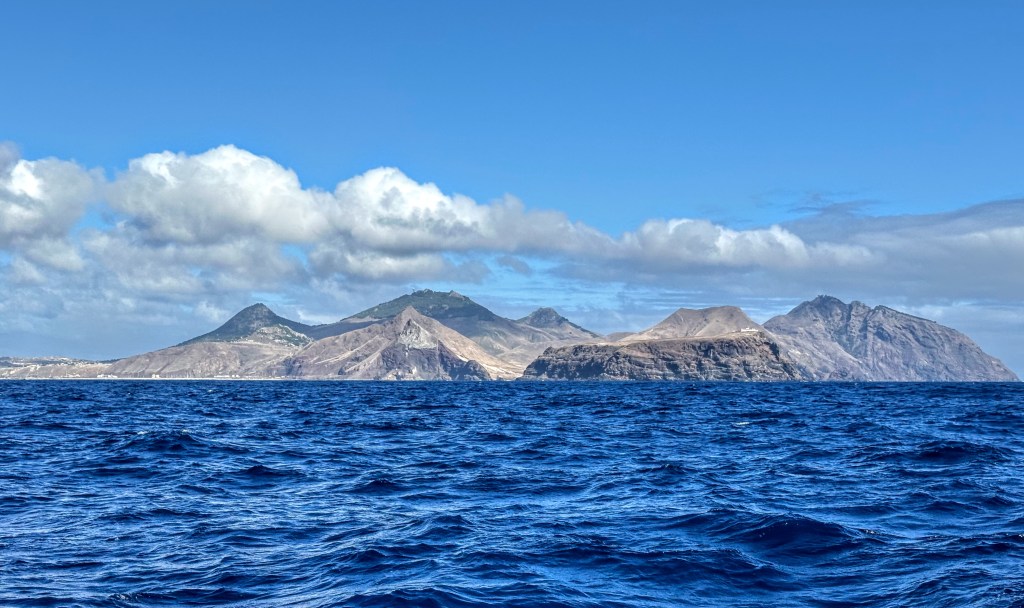
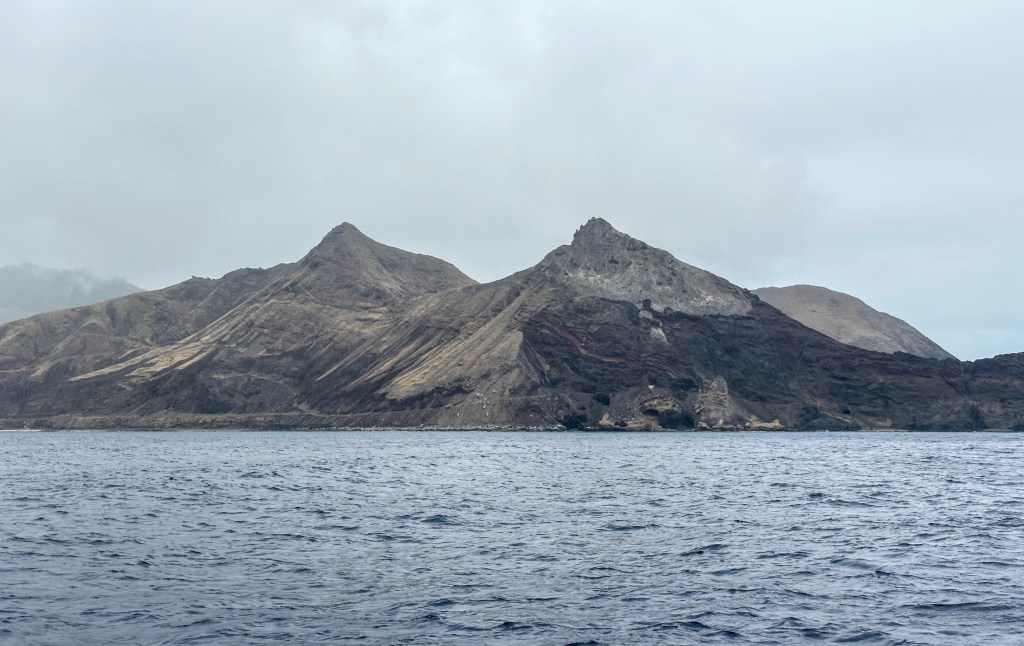
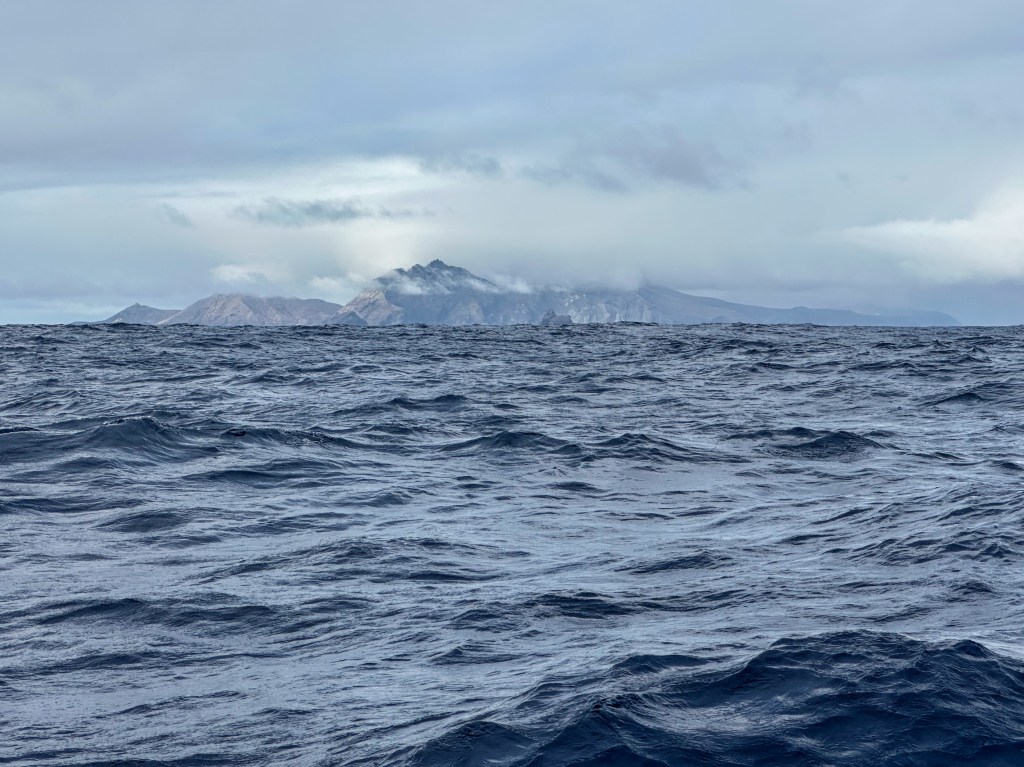
On the morning of August 30, I spotted the silhouette of Porto Santo in the distance, a dramatic line of rugged, sharp peaks protruding up out of the sea. The large swells would loom up and block the island from view for a few seconds before receding to reveal its profile again on the horizon. I finally ducked into the wind shadow behind the eastern end of the island, and the sea state and winds began to calm down. A few miles ahead, I spotted the massive concrete breakwaters that protruded from the shore and wrapped around the small harbor and marina.
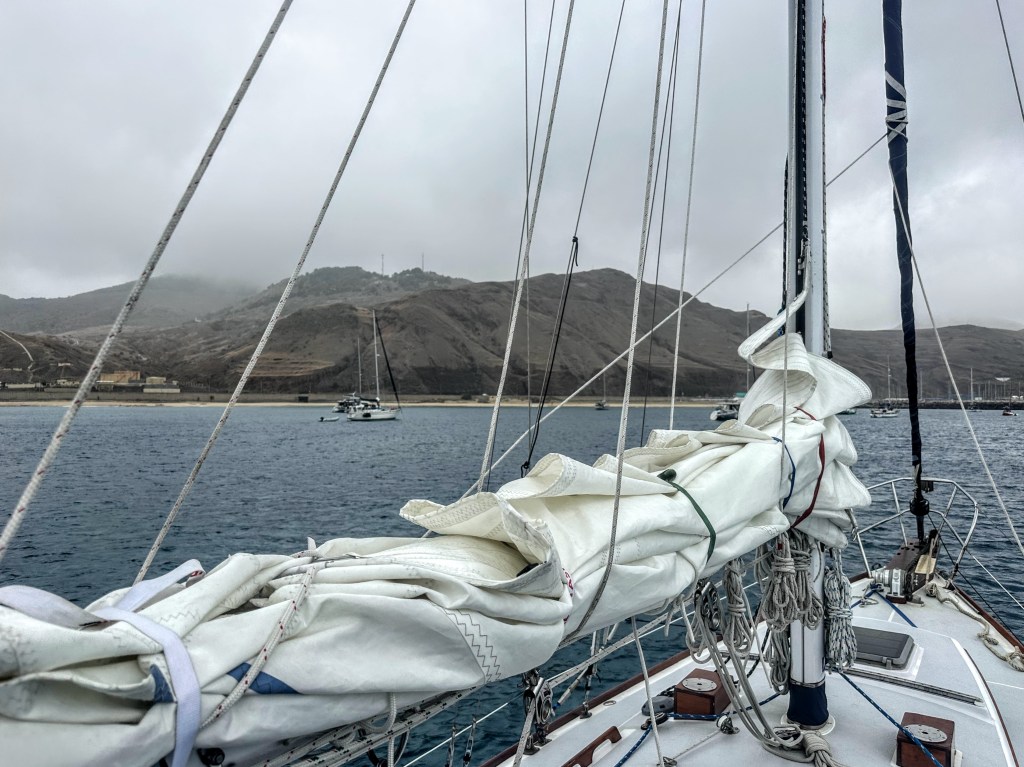
My plan was to sail right up to the entrance with a reefed genoa only, then quickly finish furling it in while switching to the electric motor for propulsion. I’d then use the motor to glide into the protected harbor where I could find a spot in the small anchorage. The first part came off like a charm, but as soon as my nose poked into the harbor, I confirmed what I suspected, namely that the tiny anchorage was already jam packed, and I’d have to anchor outside. On the approach, I’d seen about a dozen boats already anchored outside the harbor adjacent to the breakwater and along the beach, so I suspected the inside anchorage was full.
I turned on a dime and motored back out of the harbor, threaded past some of the other boats, found a spot nearby, lowered the anchor, cleated off the snubber line, took a deep breath as I scanned the island nearby, and raised my arms in celebration of another successfully completed passage.
10 September 2025 – A Magical Layover on the Magical Island of Terceira | Praia da Vitoria, Terceira, Azores
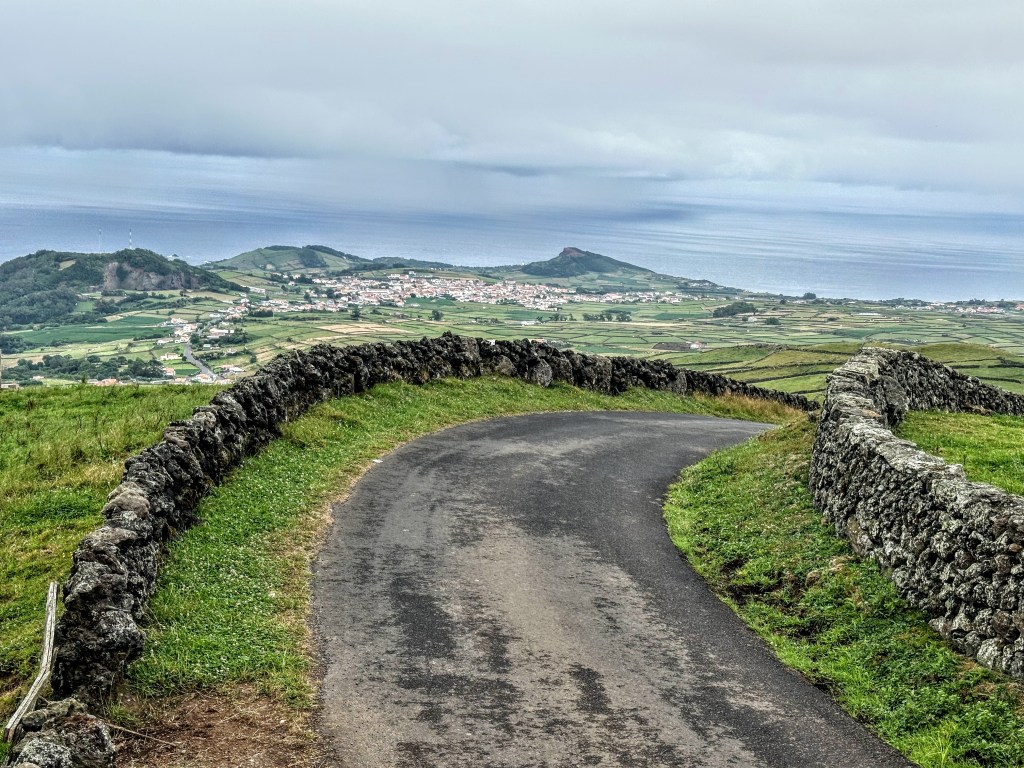
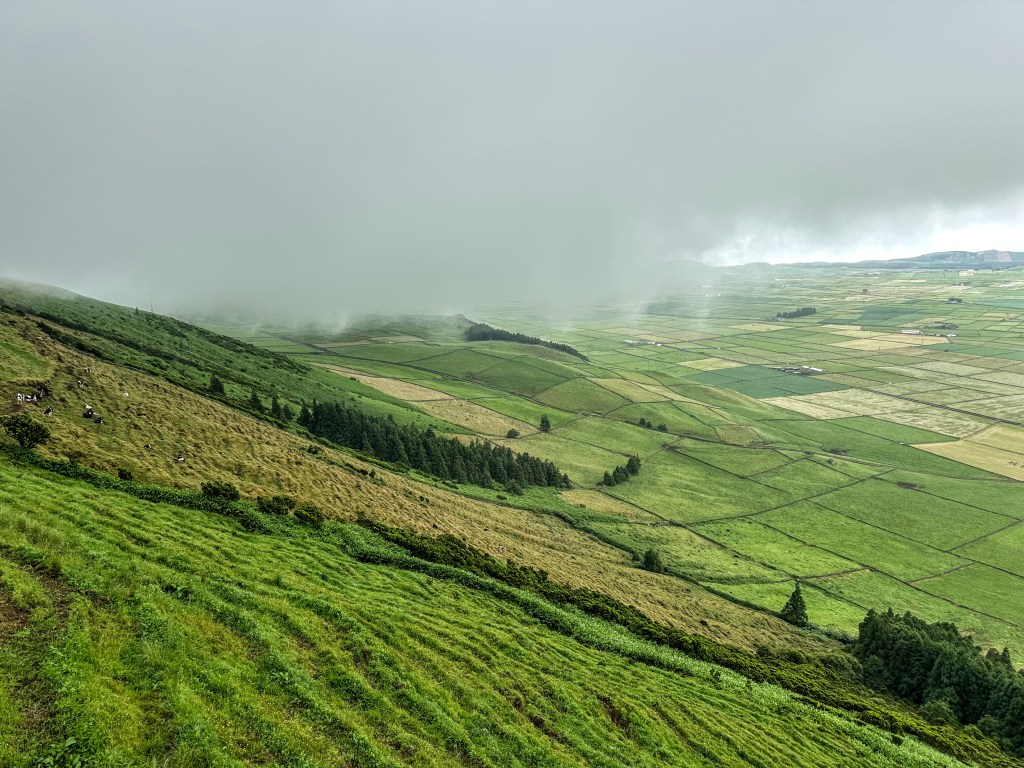
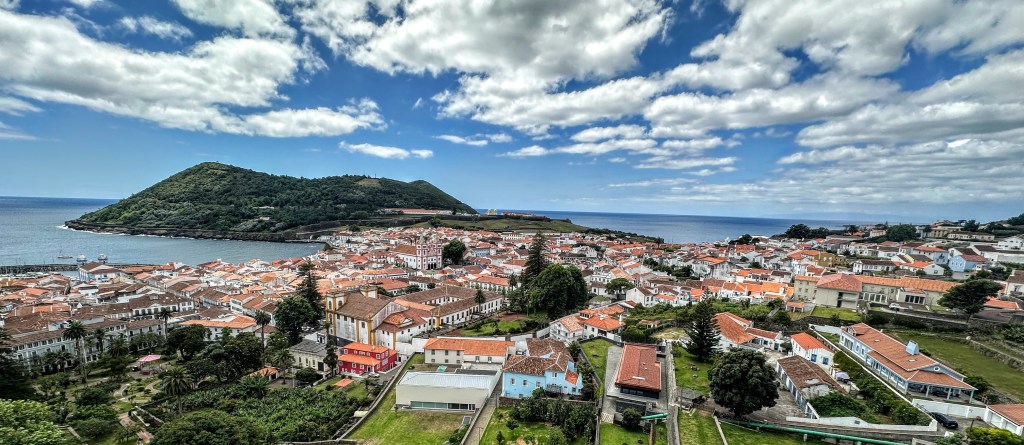
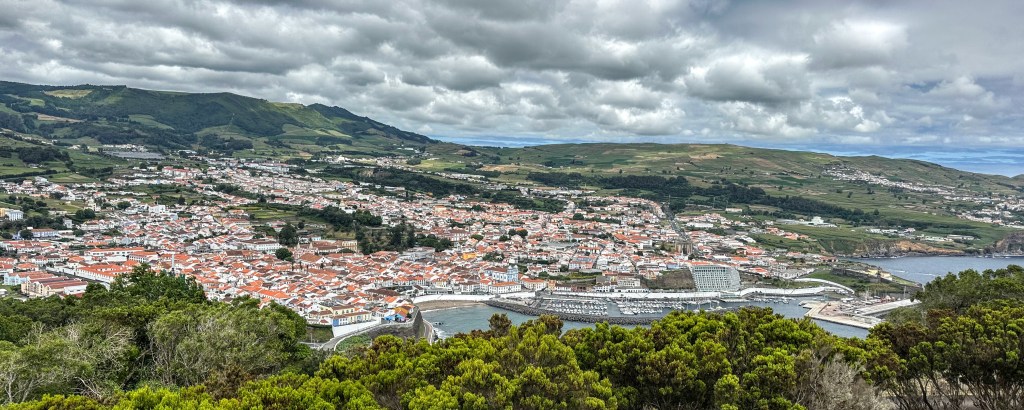
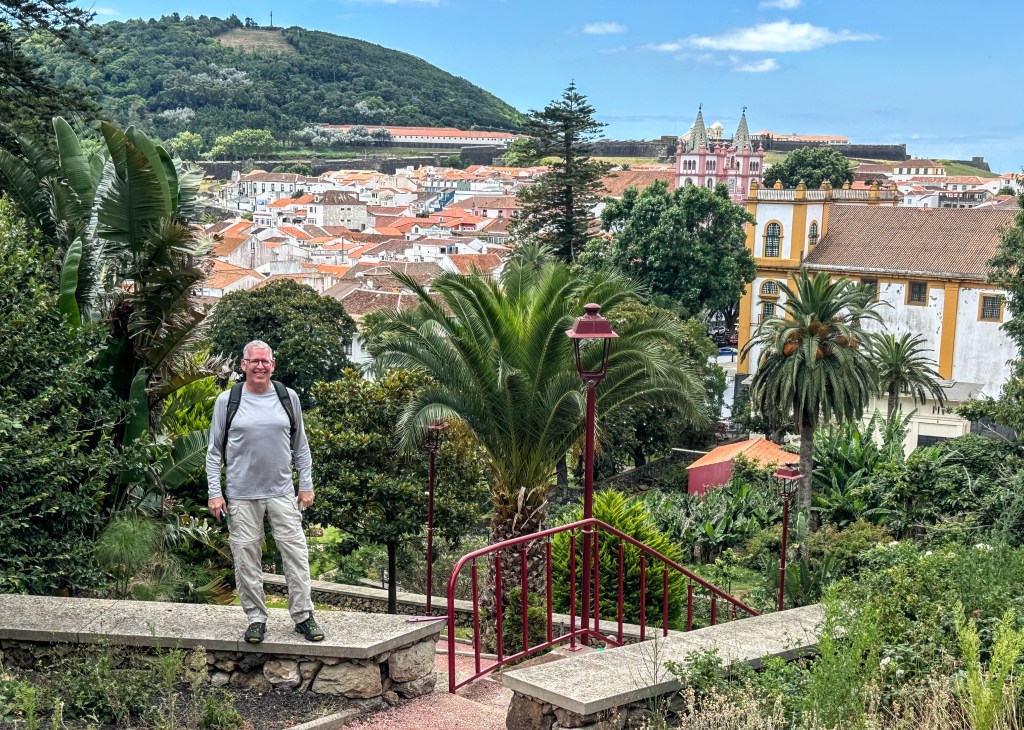
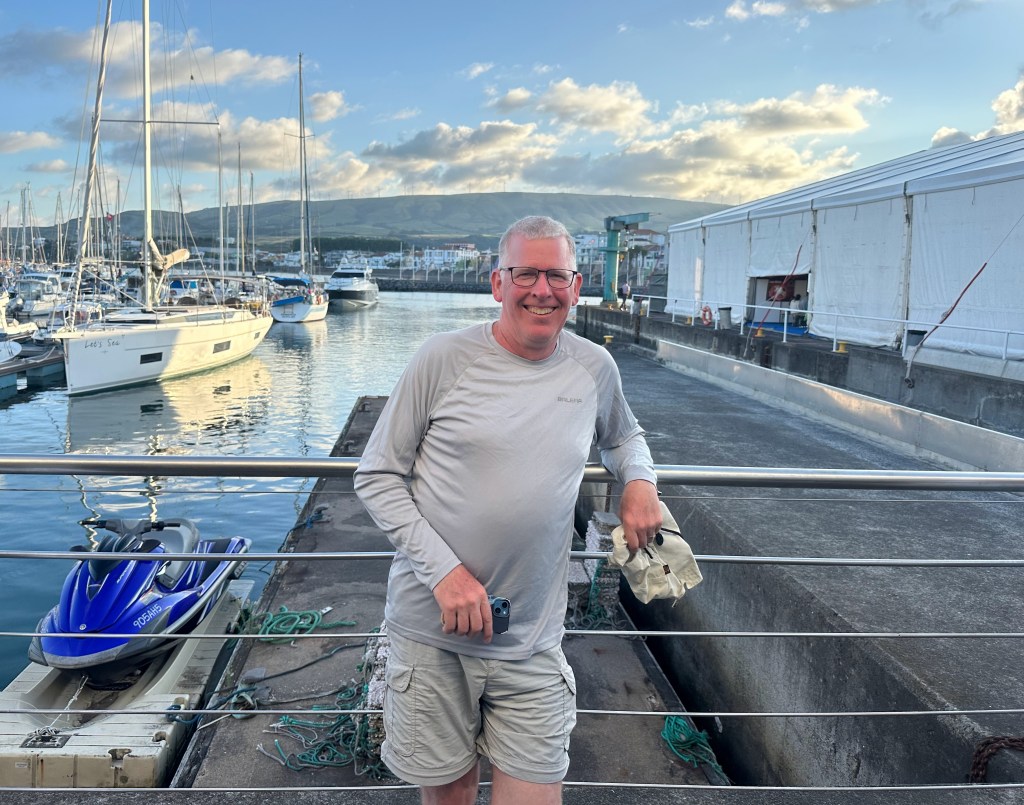
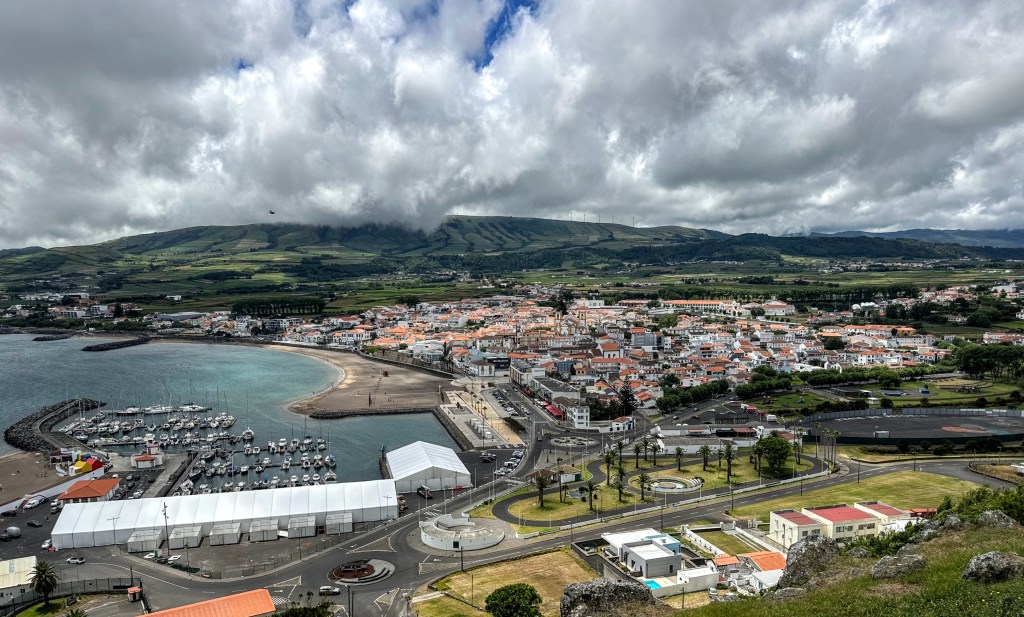
On August 25, I finally cast off from Praia da Vitoria, bringing a close to a long, leisurely and relaxing stay at this wonderful little port town on the magical island of Terceira. I had arrived from Horta all the way back on June 25 and ended up settling in and enjoying some extended time in my newest port. Praia da Vitoria has a huge bay protected by enormous concrete breakwaters, and aside from some occasional swell, which somehow would wrap its way cleverly and mischievously into the anchorage, it was a great place to drop the hook, with plenty room, good depth, good holding, and a quick dinghy ride to the marina. Unlike some other anchorages, there was no fee, and marina facilities were made available at no charge.
From the small marina, tucked back behind yet another breakwater, this one well inside the large, protected harbor, it was a three-minute walk to the waterfront restaurants lined up behind the expansive beach, all with casual outside seating along the sidewalk. The beaches, it turns out, are among the best in the Azores, and they ring a good portion of the entire harbor. They also set the mood and tone for the town, mixing a relaxed beach vibe with the traditional feel of the charming, narrow cobblestone streets and historical buildings. This became my home for a full two months, and there could not have been a better place to rest, recuperate, explore, enjoy, and prep for the next stages.
A highlight was a visit by my brother, John, who stayed the week of August 27 to September 3rd. He had the wisdom to rent a car for the week, which allowed us to explore the entire island of Terceira and finally gave me the opportunity to venture beyond my comfort zone in Praia da Vitoria. Angra do Heroismo, which we discovered was the largest town on the island, exceeded our expectations in every respect, combining the culture and history commensurate with a UN World Heritage site with a gorgeous ocean waterfront, beautiful gardens, a massive coastal fortress built into the coastline, and a labyrinth of interesting streets to explore lined with enticing shops and restaurants. As John put it, if he were to live in the Azores, it definitely would be Angra do Heroismo.
As we drove over, around and through every area of the island, we were mesmerized by the natural beauty, marked by lush green hills interspersed with deep, thick forests, massive calderas from ancient volcanos, dramatic coastlines lined with sharp, heavily pocked, jet black lava fields extending into the rough seas, and small but dramatic mountain peaks shrouded in thick low hanging clouds. Charming cobblestoned villages dotted the shoreline all around the island, and as soon as we ventured slightly inland, we quickly found ourselves among endless vibrant green cow pastures extending as far as the eye could see across gently rolling hills and up the mountain sides, all partitioned into small squares of varying sizes by exquisite hand-made stone walls, together creating a patchwork effect across the countryside. The roads were also tightly lined by these remarkable hand-made stone walls, and John and I estimated that in total Terceira alone must be home to hundreds of miles of them.
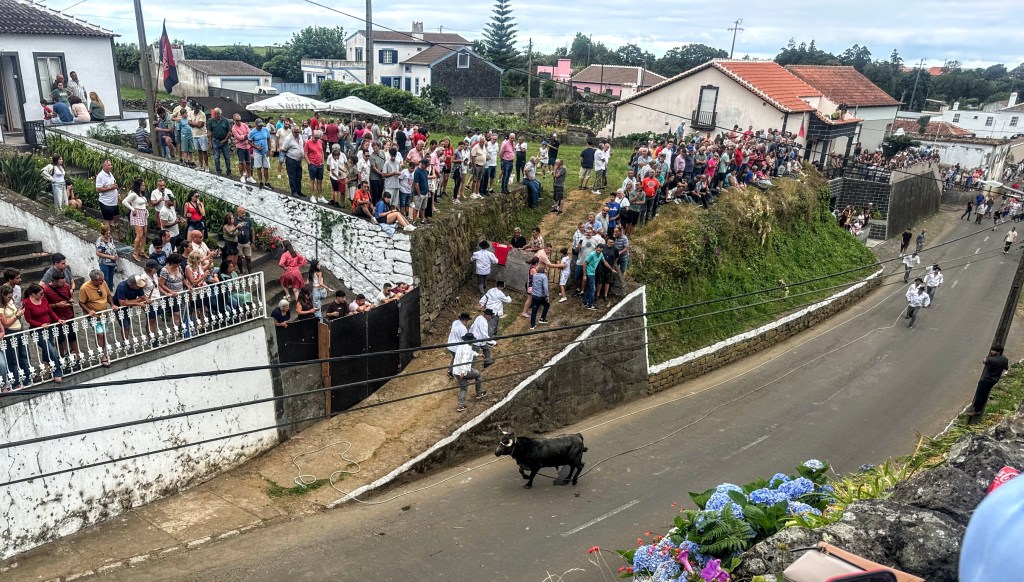
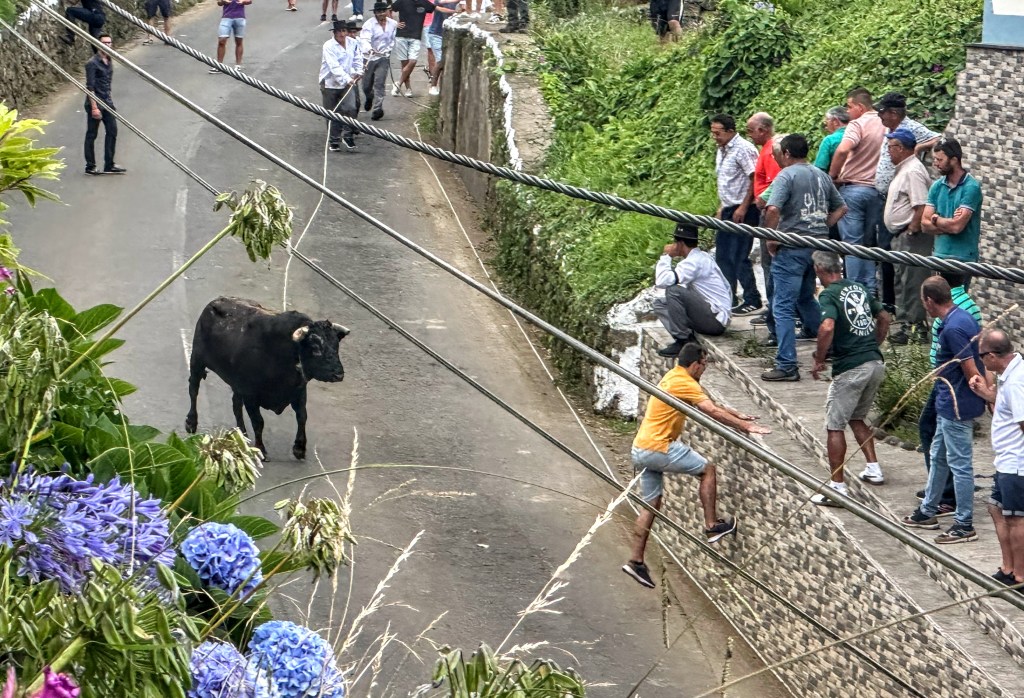
Another highlight of my time in Terceira was the Tourada à corda, or rope bullfighting, which is an Azores tradition somewhat similar to the running of the bulls in Spain. A single bull is released into a large cordoned-off area surrounded by spectators, who taunt the bull from the sidelines or by running around or in directly front of the bull, and the bull is allowed to run freely and to try to chase them down. The entire spectacle is centered around the tension of whether the bull will succeed in catching an unfortunate spectator who was perhaps too daring in the first place or just too slow to get away. The added twist is that if things get too dangerous, which we discovered they often do, about five or six athletic young men pull together on the end of a long rope tied to the bull and thus are given a last-ditch chance to slow or divert the bull just enough to avoid a worst-case scenario for one of these overly confident spectators.
I discovered that Tourada à corda were scheduled at some town or other on Terceira on almost every night during July. John and I picked an evening to go see one such event at the neighboring town of Fontinhas, which I was already familiar with, as I had explored the area previously on my small folding Brompton bicycle. John and I both assumed that with similar events scheduled almost every night, and with the typical venue being some tiny remote village somewhere, the events themselves would be relatively small in scale, perhaps one old bull and one old matador doing a few tricks for a small crowd gathered at the small town square.
Oh, how we were wrong. The event was scheduled to start at 6:30 pm, and John and I arrived in Fontinhas by car a full one hour early. As we approached on the narrow country road, traffic slowed, and we noticed cars parked in nooks and crannies everywhere on both sides. John pulled over, and I jumped out and asked a local gentleman for some guidance, and he kindly suggested where we could still find a small slot somewhere to leave the car, where the bulls would be running, and where we should go to watch. He then looked me square in the eye and said sternly that I should find the highest hill possible overlooking the street where the bulls would run, and that I should not come down for any reason until it was over.
By this time, there were hundreds if not thousands of people slowly making their way toward the event area, and once John and I found a place to leave the car, well outside of the central town area, we joined the slow procession until we made our way into the running zone, where we began to scan each side of the street for a good spot to watch. We picked out a long stretch at the top of a two-story high stone wall immediately adjacent to the street and made our way up, eventually finding an excellent spot where we could look down on the street directly below us, and off to the right and left when the bull ventured in those directions. For several hundred yards, the narrow street was hemmed directly on both sides either by high stone walls, sides of stone houses, or lower concrete walls in front of small homes. People were everywhere grouped in smaller and then larger clusters in every available spot they could find behind or on top of the walls. There was an excited festival mood in the air, and vendors and food trucks sold beer, pork sandwiches and homemade donuts, and John and I sampled it all. Finally, a single fireworks explosion pierced the air, and the first bull was released. Almost immediately, as a US citizen fully steeped in our deeply legalistic culture, I was struck at how unleashed and truly dangerous the event appeared. Spectators would jump into the street and openly taunt the bull, just barely escaping when he tried to chase them down.
Directly to my left, there was a steep, narrow stone stairway that led straight down to the street level, and a large group of older local guys were sitting and standing on the steps to watch. At one point, the bull stopped on the street right below us and was clearly being taunted by some of these men. The next thing I knew, the bull disappeared from my view toward the wall directly below, and in the same instant, the guys that had been packed in on the stairs had turned and were scrambling up toward me with terror in their eyes, but there were too many, and the staircase was too narrow, so they were squeezed in like a cork in a bottle and made little progress. It turns out that the bull had made a run at the bottom of the stairs, which even the locals clearly thought the bull would never attempt to climb, and then he started coming up.
As quickly as it all started, it was over, and everyone around us on the top of the wall were wide-eyed looking at each other and laughing out loud. A local women said to us, chuckling with a wide smile, “That’s not supposed to happen!” Unfortunately, after backing down once, it seems the bull realized he’d made pretty good progress up the stairs, and within a few seconds he tried it again, and the whole process repeated, but this time the old guys clamoring up the stairs had even more terror in their eyes, and some people started screaming. It was becoming a stampede, and John said he saw the bull’s head rounding the last corner of the stairs before it would have a straight, short shot to the top. If he had made it up, it would have been absolute mayhem and carnage, as the bull would have found some hundred or more unprotected spectators in an open grass field.
Fortunately, the bull pulled back and retreated to the street, but not before catching one of the guys on the stairs and flinging him some fifteen feet through the air only to land directly on his head on the street. John, who had a better angle than I, looked down and was convinced that the poor fellow was dead. I edged forward and peering down saw the lifeless body sprawled on the pavement. All around us, people were shocked and concerned for the victim.
In the end, the event was postponed for about forty-five minutes so an ambulance could come in and take away the injured spectator. Clearly, he had survived, and it was everyone’s hope that the damage was not too severe. Once the ambulance left, the single fireworks explosion could be heard again, indicating the release of the next bull. John and I stuck around for another hour or so, and then, before the final bull was released, we waited for the telltale twin fireworks explosions, signaling that the bull currently running had just been taken in and that the street was now temporarily clear and safe. We took that as our cue, headed down to the street, and made our way back to the car.
Aside from the accident, which was tragic and unsettling, and likely is rare, we were blown away by the entire event. It was truly local and truly authentic. If anything, we were the rare and somewhat misplaced tourists, and by no means was it being done for our benefit or for our money. We noticed families, grandparents with grandchildren, groups of high school friends, clusters of old guys who probably knew each other since they were kids, all gathered for this rollicking, crazy, and wildly entertaining town festival that seemed to bring everyone together. John noticed that no one was looking at their phones. Everyone was with someone else and talking and laughing and gesturing and watching and enjoying themselves together. It was a pure old tradition that pulled people together in a pure old traditional way that we often do not see anymore. In some sense, it felt like a microcosm of the Azores overall, where older customs, priorities, and bonds live on, and where the Azoreans seem to have kept at bay the eroding and fragmenting forces of life elsewhere.
11 August 2025 – A Solo Sailor’s First Struggles with Solitude | Praia da Vitoria, Terceira, Azores
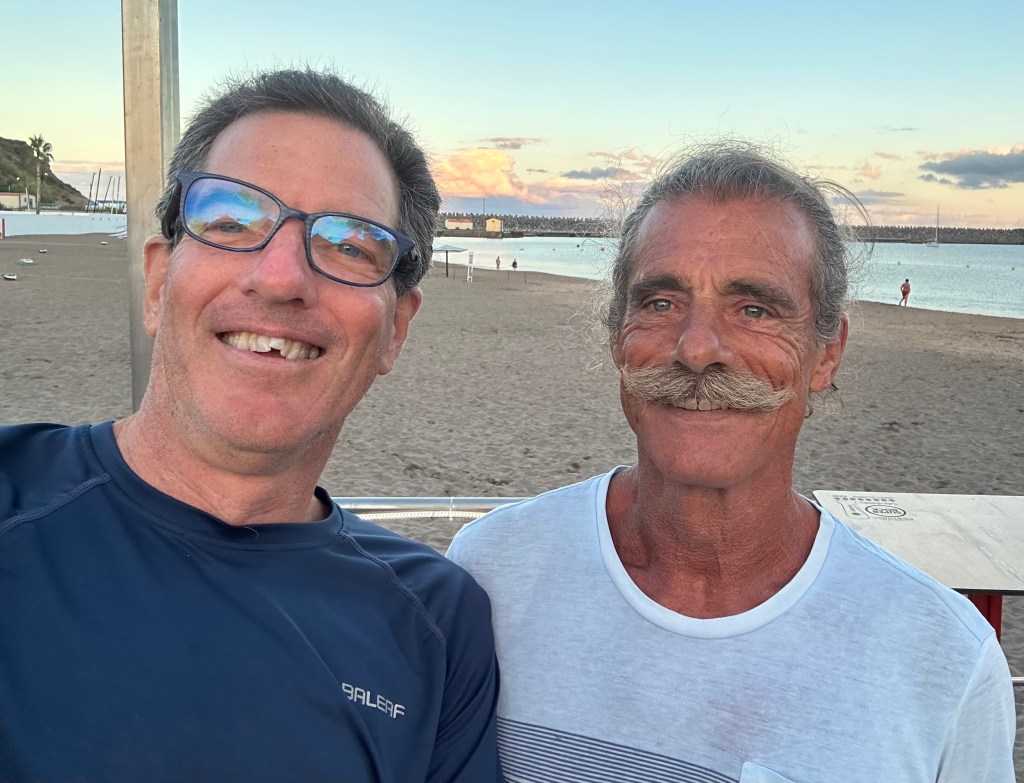
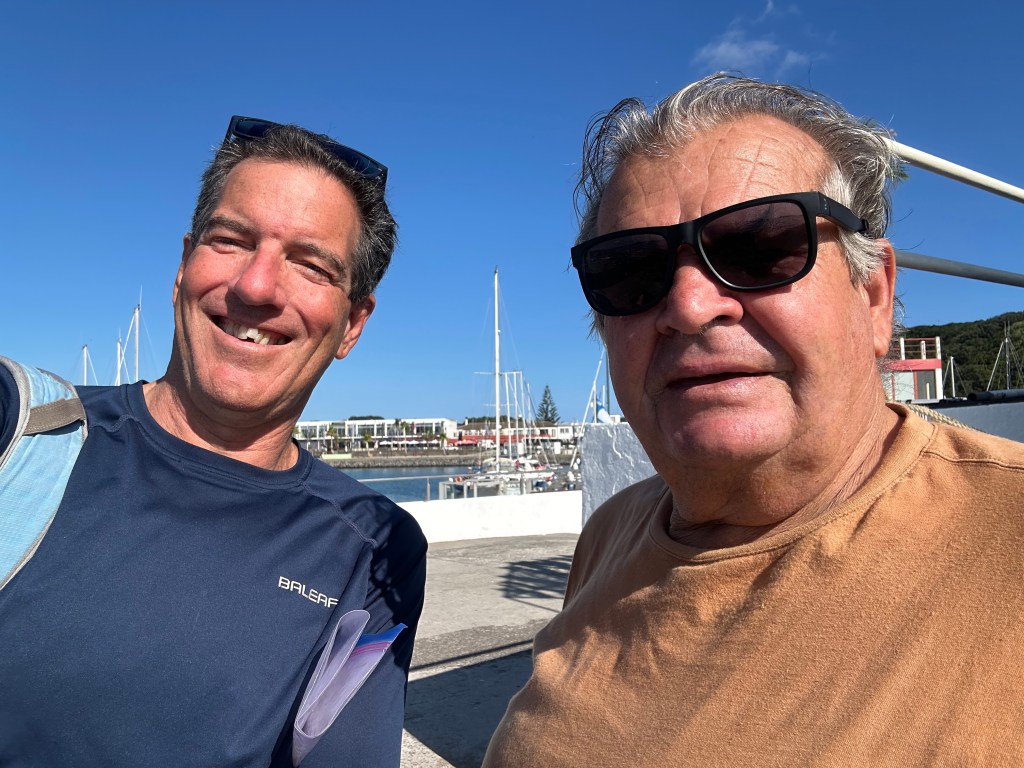
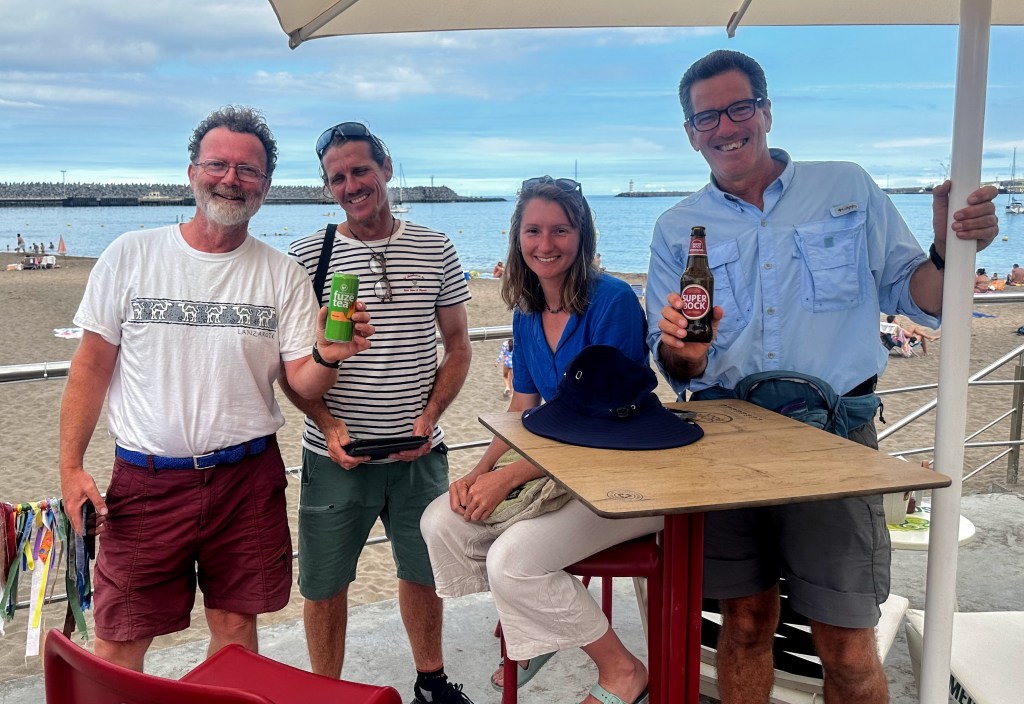
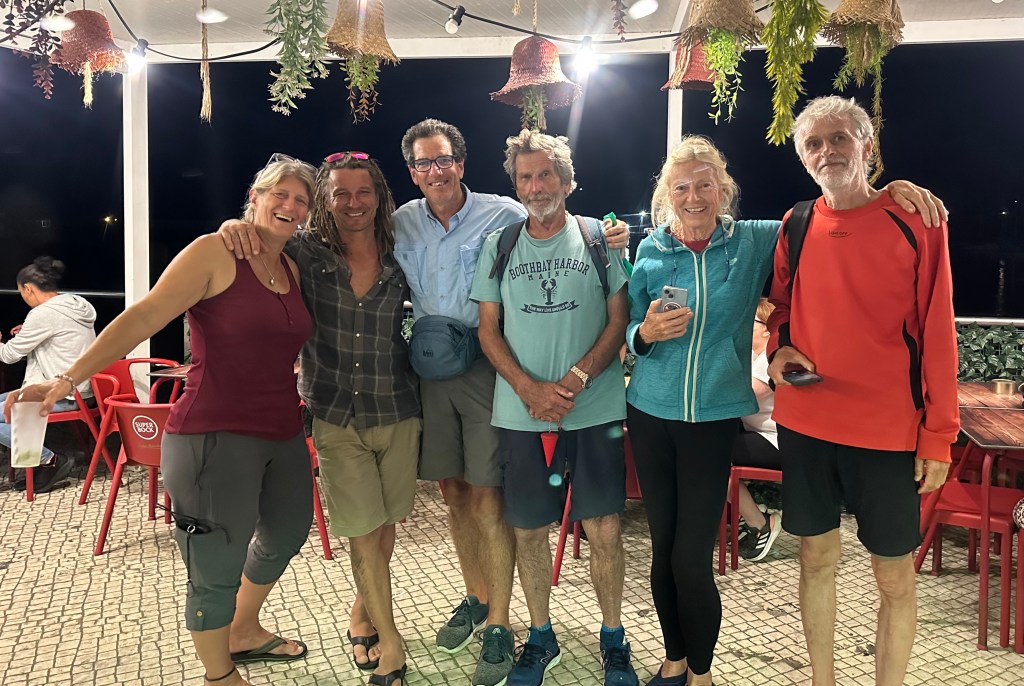
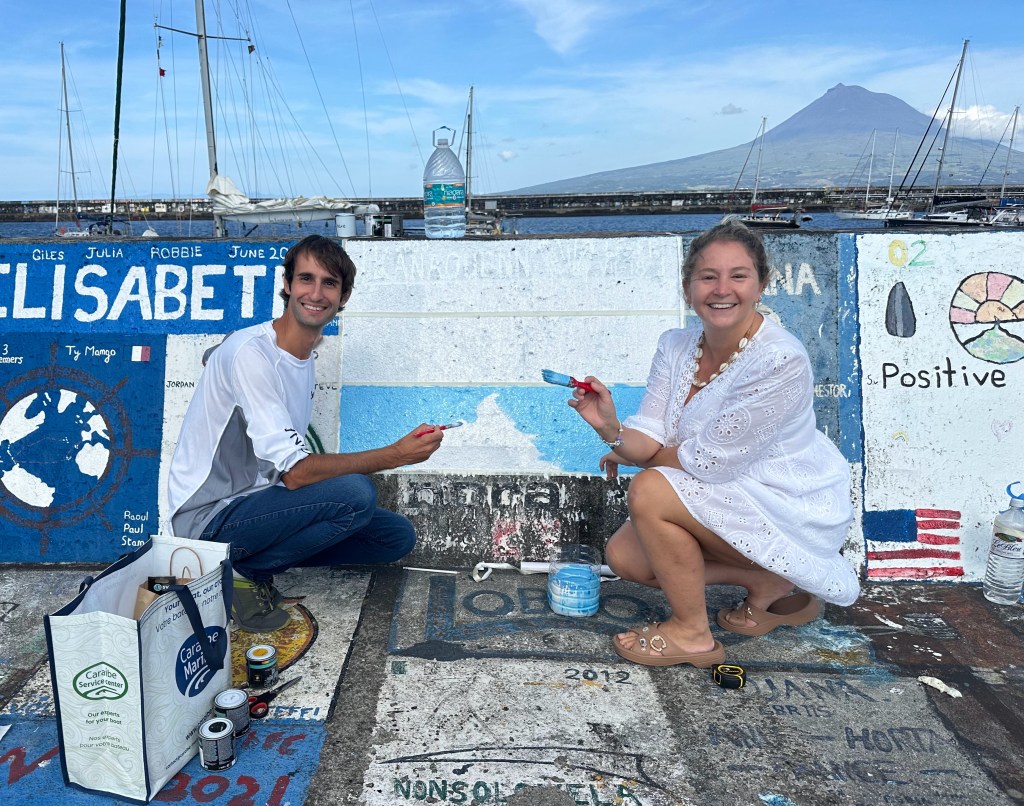
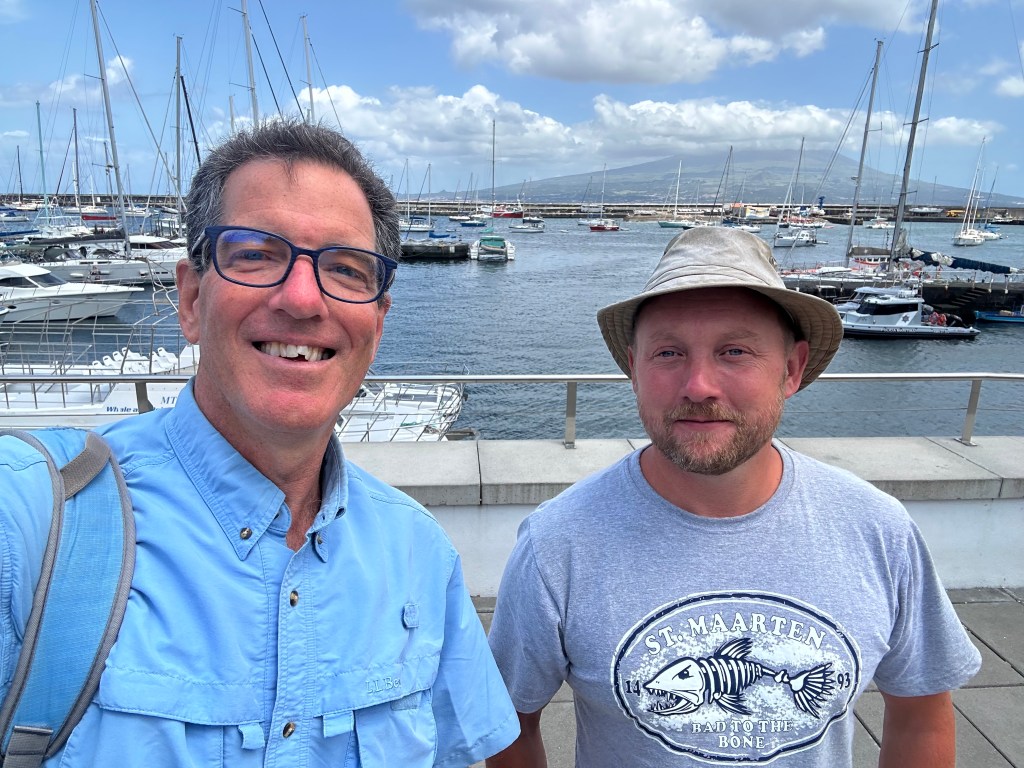
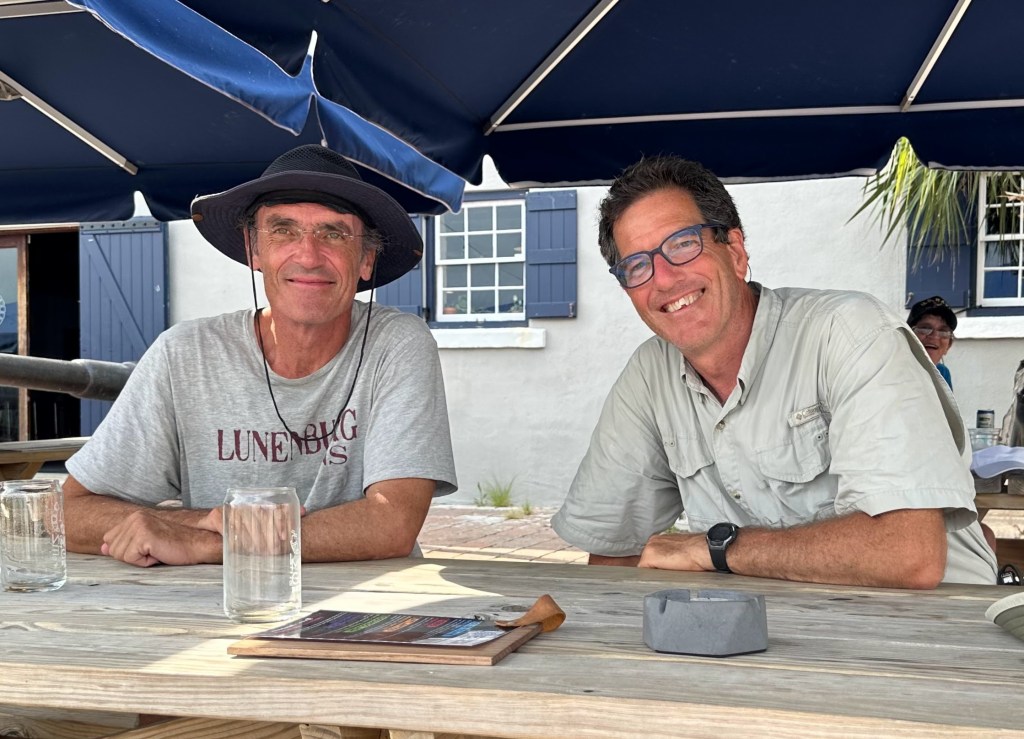
It’s a quiet Monday morning at anchor in the harbor of Praia da Vitoria on the island of Terceira in the Azores. Winds are light, the water is calm, skies are clear and blue, and the air is cool after an early morning shower. I just poked my head out of the companionway hatch in time to spot my friend, Tom, another single-hander from Ireland, heading out to sea on his beautiful blue 32-footer, cutting between the two large breakwaters enroute to Ponta Delgada on the island of Sao Miguel.
Bidding other sailors and new friends farewell has been a common theme lately, partly because I’ve been here in Praia da Vitoria for about six weeks already and have outstayed many of my fellow voyagers in the anchorage. There was David from the Czech Republic, who is beginning a circumnavigation soon and who headed to Portugal where he plans to work for a few months, and his crew Pavel, who will be transitioning back to his own boat shortly; Imke and Uli from Germany, who have been sailing the Atlantic together for twenty years and cast off for Porto Santo in Madeira; Jenny and her boyfriend, Ruri, from Holland who are finishing a one-year circuit of the Atlantic and heading home where they will stay put indefinitely for grad school and work; and Christian and his family, who have been sailing together in the Azores, after Christian completed a circumnavigation, and who sailed back to the European mainland where Christian will return to work in Germany. Prior to my stay in Pria da Vitoria, I wished fair winds to my buddy Shane, another single-hander I met in Bermuda, who cast off for his home in Maine, and another friend, Danny, and Irish single-hander who headed home to work after completing his own one-year circuit of the Atlantic. This is a highly nomadic existence, and my experiences in recent months have brought it home to me more sharply than ever.
I had read and heard directly from other solo sailors that solitude is a defining feature of this lifestyle. In fact, I recall hearing one experienced ocean-going single-hander say that solitude is the biggest challenge for solo sailors. It’s all encompassing, and there is no escape, so it is essential to find a way to manage it and live with it. While I grasped the notion at an intellectual level, it had never hit home directly. I’d never experienced it firsthand. The one-hundred-day circuit through the Bahamas last year was a solo undertaking, but my brother, John, visited me for a week at the half-way point, and in any case, the endpoint was never that far out to begin with. Similarly, the ensuing trip up the East Coast from Georgia to New York took all of one month, as did the return trip in the fall, which was not long enough for a deep sense of solitude to set in.
Now, however, things are different. In Bermuda, I still had the option to turn back to the US and cut the trip short, but once I was well on my way to the Azores, I was committed to the full-year voyage. At that point, prevailing winds would have prevented me from turning back. Now that I am in the Azores, I’m locked in for another six or seven months at a minimum, and I’ve already been underway for three. The scale of the undertaking, in terms of time, is something new and different, and not surprisingly, the sense of solitude, which until recently has been lurking in the shadows and keeping a low profile, has increasingly been making its presence known.
The trip to Bermuda from Georgia was tough. From a sailing standpoint, I faced several days close hauled getting beat up with the wind and seas on my nose and then spent numerous additional days almost becalmed and struggling to scrape out two knots. It was tedious to say the least, and in the end, a trip that in reasonable conditions should have taken seven days ended up taking twelve. Fortunately, there were no major mishaps, and aside from one blustery squall that I sailed through at night, the conditions were manageable and relatively non-threatening. It did become something of an endurance test, however, and what I did not prepare for adequately was the fact that smack in the middle of the trip I would pass the fifth anniversary of my wife Kyoko’s death on May 9th. Two days before the anniversary, it began sneaking up on me subconsciously, and I was pulled slowly into a dark and unpleasant place by the time the 9th rolled around. More than anything, it turned a mild sense of solitude into a searing sense of loneliness, which for me is a bit out of character, because I generally do well on my own. However, the combination of factors including the stresses of solo sailing, being out alone in the middle of the ocean, and the painful reminder of Kyoko’s passing, turned out to be a toxic mix. I kept the boat going just fine and managed finally to pull myself out of the slump, but it was a nasty, sudden, and unexpected taste of the solitude of the solo sailor that I’d only heard about before.
It’s interesting that of all the ocean-going sailors I’ve seen and or met so far, the single-handers are a rare breed. My guess is that we make up ten percent or less of the total, and the most common pattern is for a couple to be sailing together. One reason, no doubt, is that it’s just easier to sail with more hands on deck, and solo offshore sailing can be very demanding. I think another reason is that sailors find it too lonely be out there voyaging alone for months on end. David, the sailor from the Czech Republic I mentioned above, said he used to sail solo but now prefers crew, solely to avoid the solitude. Similarly, the Irish sailor, Tom, who just departed this morning, is on his first major trip, and he said he has struggled with loneliness. In the future, he plans to bring crew onboard. As for me, I prefer single-handing when it comes to the sailing, but it then leaves me squarely with the challenge of dealing with the solitude that comes with it.
In Bermuda, I almost called off the whole trip. In fact, at one point, I told family and friends that I would not continue to the Azores and would instead head north to New York or New England. This would have been a dramatic departure from my plans and preparation and would have immediately begged the question: If not now, then when are you ever going to go? And if you’re not going, then what next? Later, I had a change of heart, and here I sit on Swan in the wonderful anchorage at Praia da Vitoria in the Azores. Nonetheless, it was a difficult period, and the single factor that made me waver was my deep uneasiness about being away from family and friends for a whole year, particularly Leah and Kai, my son and daughter. There was nothing more to it. It was nothing to do with the sailing itself. I’ve since made my decision and moved on, but other big decisions loom ahead, and they likely will hinge on the same thorny issue of solitude and separation from friends and family.
The next major milestone in the trip will be my departure from the Schengen area, a customs and immigration zone that includes the Azores, Madeira, the Canaries, Portugal and Spain – many of my top choice destinations for this voyage. As it turns out, I can only stay a total of ninety days cumulatively in all these locations, including transit time between them, and the upshot is that I need to be out by September 15, when my ninety days expire. I will finally exit Schengen on or around that date when I cast off from Porto Santo in the Madeira group and head for Cape Verde. I will then have a stay of around two months there before returning to the Caribbean to avoid the end of the hurricane season, although another option is to depart early and sail a more southerly route to French Guiana, which is looking increasingly appealing. The upshot is that I should be back on the other side of the Atlantic sometime in December and then will need to consider what I plan to do next.
The logical time to cast off for a new voyage would be around May, and there could be significant advance preparation involved, including applications for visas, securing new boat insurance, and boat repairs and upgrades. That means I need to have a good idea of my next direction sometime in December, and preferably sooner. That is just a few months away. One interesting option is to cross the Atlantic again, but this time with a better visa so that I could stay longer in Europe and perhaps even head to Norway, which would require a multi-year trip. Another option is to head toward the Pacific through the Panama Canal and possibly aim for Japan, which might require some time to secure a residency visa in the event I decide to stay there. A final option is to sail north to Maine for the summer, but that would quickly prompt an additional set of questions about what would follow in the fall after a few months anchored there. I suppose I could just deal with that later.
There also is the option to simply walk away. That is, I could arrive back in the US in the spring, put Swan up for sale, and begin a transition back to life on land. In that case, I would not look back. There is no scenario in which I would keep Swan while permanently living ashore. It just doesn’t make sense, and it makes this option particularly stark and seemingly radical. I would think that my heart would be screaming at me that it’s completely out of bounds, given how much I’ve put into this effort, but that is not happening. In fact, it feels odd how my internal compass is spinning so randomly and failing to provide any direction. It’s disorienting. I’d prefer to feel locked onto one option, even if it were the most daunting, and dig in to find a way to make it happen. Instead, I’m like a cork bobbing around at sea.
Ultimately, time will be my best ally in making this decision, as it was in Bermuda when I opted to press on to the Azores. What is clear, however, is that if I continue sailing, I will need to find a way to manage the solitude that comes with being a single-hander and to spend more time with family and friends. At this point, my compass continues to spin, and I can only hope I can find a solution.
14 July 2025 – Adventures at Anchor in Praia da Vitoria
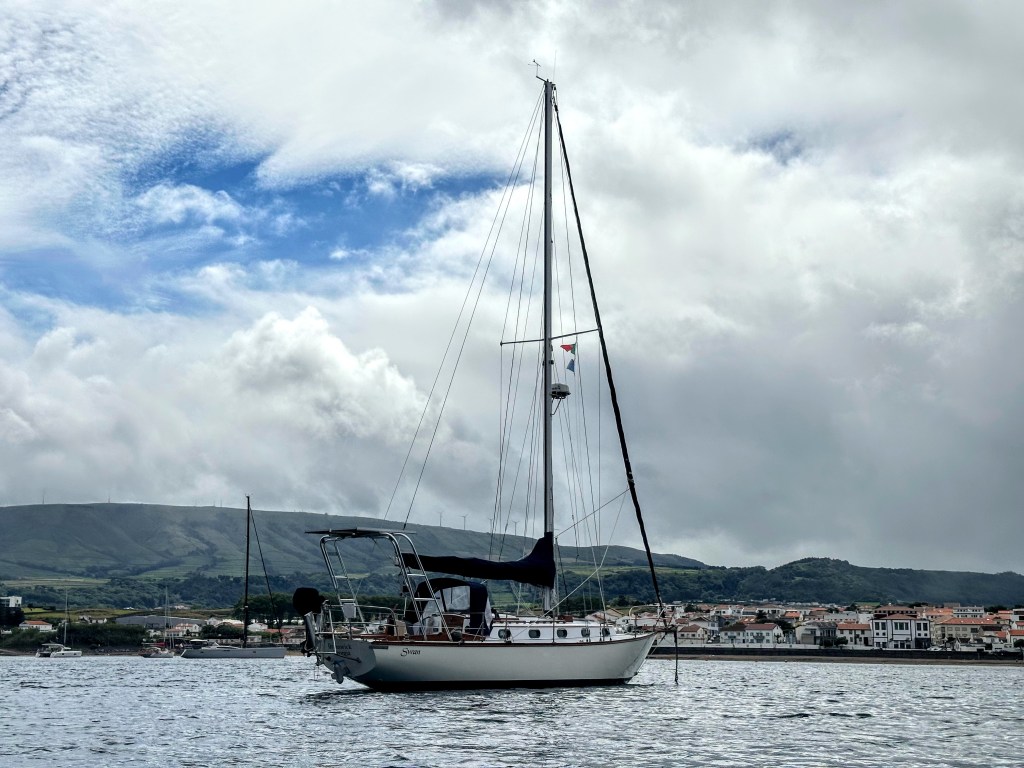
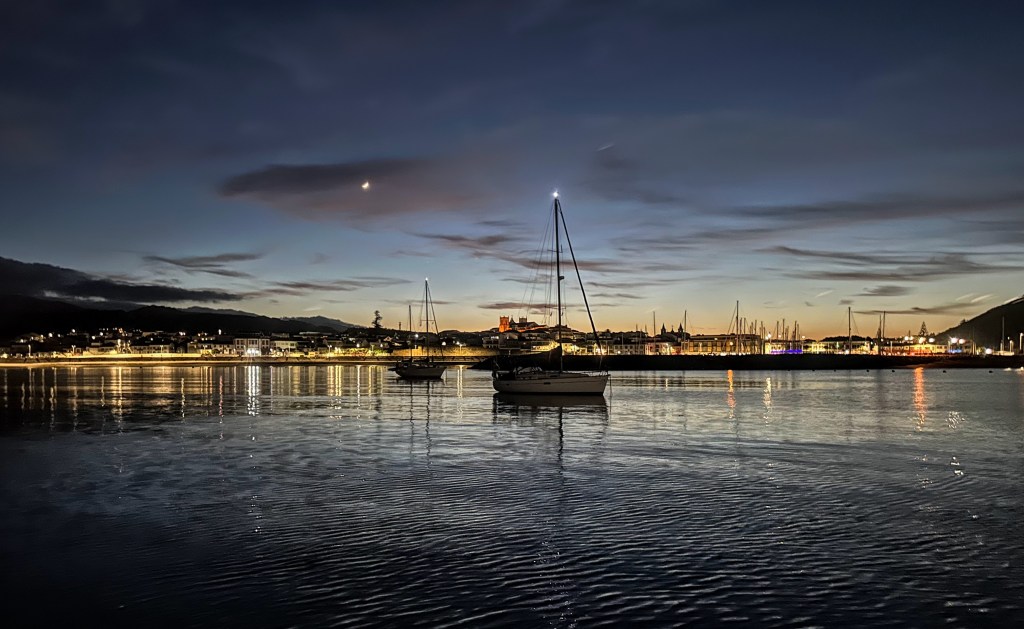
It’s a Monday morning, although the days of the week have less importance to me lately. I’m sitting on my berth below deck on the starboard side of Swan in the main cabin, a term which could make my situation sound somewhat extravagant, as though there were other cabins aside from the main cabin, which there are not, and as though the main cabin were substantially larger than the postage stamp of space it actually occupies. But that’s okay. I’ll take it. Anything I can get. My familiar teak table is fully unfolded, and I’m settled into my little nook where I spend virtually all my time below deck when at anchor. This one spot is a big part of my overall physical comfort zone. It’s where I eat, write, talk to family and friends, do route planning, and just relax.
My anchor alarm was just triggered, so I increased the alarm radius from 200 feet to 250. With a big two-day blow just starting to crank up, I’ve been monitoring my anchor position closely for any dragging, and the 210 feet of rode I put out had me right on the edge of the swing radius set for the alarm. The chart plotter shows the anchor holding well overall, to the extent that there hasn’t been any uncontrolled dragging, and the track that Swan is leaving is tracing a relatively clean arc, indicating the outer length of the rode. Likely, the alarm went off because Swan stretched the 210-foot rode tight, and that allowed her to stray outside the 200-foot radius for the alarm. No need for concern or additional action just yet. I’ll just have to continue monitoring, and if the alarm goes off again, it would mean she strayed another 40 feet, which would indicate some real dragging. Then I’d have to take stock and consider next options.
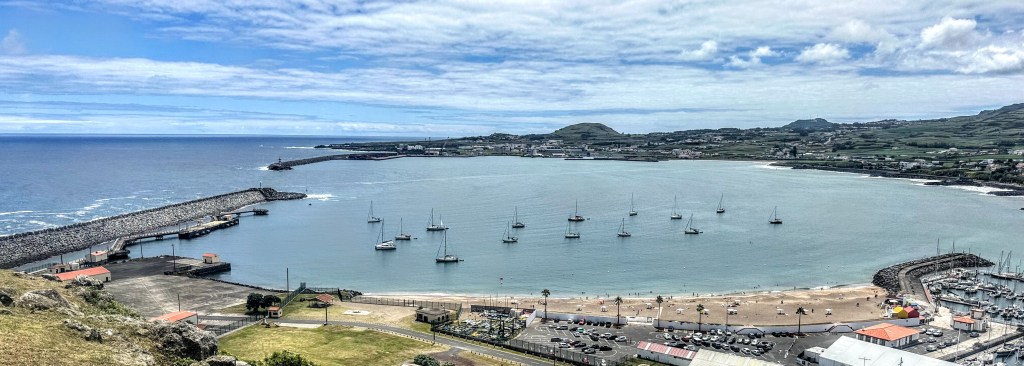
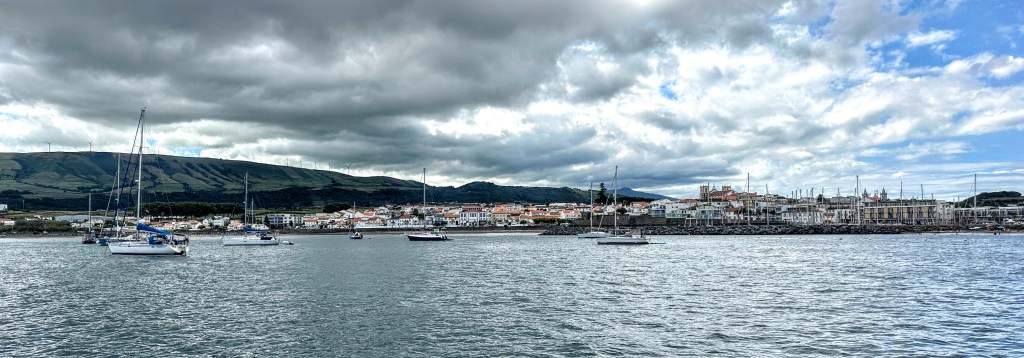
I’m anchored off a beach and breakwater on the south end of the large harbor at Praia da Vitoria, a charming small port town on the island of Terceira in the Azores. Yesterday afternoon, I moved from the main anchorage a mile away on the north side to find better protection from the strong southerly winds expected for the next three days. At the time I made the short excursion across the harbor to my current location, winds were light and overall conditions were calm, making it an easy exercise to raise anchor and drop it again in my new spot. I debated waiting until this morning but am happy I did it yesterday, partly because conditions had already kicked up significantly this morning, which would have made the re-anchoring process more challenging, and also because a number of boats have also relocated to this same small area for the same reasons, and I managed to arrive before it was too crowded, allowing me to pick one of the prime spots still left. In fact, it was a bit of an exodus from the other anchorage. Early yesterday, there was only one boat anchored here on the south side, and now there are a dozen.
I think I’m in good shape for this weather coming through. The primary anchor seems to be holding, and I’ve been generous with the rode, putting out enough for a 7:1 scope. That means roughly that the rode deployed is seven times the depth of water here. More specifically, the 25 feet of water depth plus the additional five feet from the water to the bow roller makes a total of 30 feet, and this multiplied by seven is 210 feet, which is the length of rode I have deployed. Thus, a 7:1 scope. This is very safe and conservative. Other sailors often are surprised when they hear how much rode I put out, but in a blow, it’s better to be safe than sorry, and generally, I tend to err on the side of caution. Another reason I’m sitting pretty at the moment is that I have the whole open harbor behind me, so there are acres of room in the event I were to drag or otherwise my anchor or rode were to fail. There is one other boat anchored behind me, but we have plenty distance between us, and that is the only obstacle for about a mile. A vast expanse of water behind me is all prime anchoring depth, so even if I were to drag, I don’t risk suddenly dragging into deep water where the anchor cannot grab again. To be safe, I’ve readied my second anchor on the foredeck so it can be dropped off the bow at any time. It’s highly unlikely I will need it, but it’s additional insurance.
I’ve learned that you can’t be too careful with anchoring. I was re-reading one of the books James Baldwin wrote about his two circumnavigations, and in one instance, when he came into a new port and dropped anchor, he quickly realized that the tension on the rode seemed abnormally light, and when he pulled in the rode again to check, he discovered that a shackle had failed and that the anchor was gone. Fortunately, he was prepared and was able to deploy a second anchor right away. This underscores the always present risk of equipment failure. In another case of a failed shackle, the sailing school at New Rochelle, New York, where I used to sail on 23-foot Sonars, had a 42-footer they used for charters, and they kept it tied up on a mooring ball in the harbor. One afternoon, a thunderstorm blew through the area, and the next morning, they found the 42-footer grounded on the shore with a big hole punched in the hull. They discovered later that the shackle on the mooring ball had failed, leaving the boat to the mercy of the winds and currents, which drove it onto the rocky shore.
Sometimes the risk with anchoring is not your own gear or choices, but someone else’s, and this is another reason why I’m developing an increasingly stronger aversion to crowded anchorages. In Horta, I was supposed to meet my new buddy, Danny Turnbull, a single-hander from Ireland, for lunch in town. I was hanging out on the waterfront when I got a call from him. “Sorry, Mark. Can’t make it. A boat just dragged into me. Gotta go. Let’s talk later.” Danny had been forced to move from his original anchor spot because the Harbor Control told him he was in the channel for the cargo ships, and as a result, he ended up tucked into a tiny spot in the middle of the most crowded area, and given that it was the overly crowded anchorage of Horta, that meant he was boxed in on all sides. He was lucky that the other boat met him beam on beam and didn’t T-bone him, but it was a dangerous situation given that the other boat was a sixty-footer, likely the largest in the anchorage, and Danny’s boat, Monty, at thirty feet, was probably the smallest.
Just the other day, when I was anchored at the north end of the Praia da Vitoria harbor, I heard a knock on the hull when I was working below deck. I peeked out the companionway hatch to see a 40-footer right on top of me and a French couple who had come to alert me in a dinghy next to Swan. The other boat was dragging, and it was about a half a boat length off the port side of my bow and moving toward my stern. The smallest shift in wind would have put it right into my bow. I immediately prepped Swan to move and then saw that the other boat was going to drag past me with the slimmest of margins. I learned later that the French couple who own the boat, Jean and Laurence, were ashore at another town, Angro do Heroismo, on another part of the island buying parts for their broken diesel engine. After they went ashore, a catamaran that had been anchored uncomfortably close to them raised anchor to leave, and in the process, dislodged Jean and Laurence’s anchor. The catamaran went on its way, but Jean and Laurence’s boat was then left on its own to drag through the crowded anchorage. Good Samaritan sailors from other boats jumped aboard and tried to deploy more rode to reset the anchor, and the other French couple in their dinghy, who I later learned were Eric and Patricia, were warning other boats in the path. The anchor finally grabbed when the boat was about a half a boat length behind Swan, which was far too close, and when I realized that Jean and Laurence would not be able to fix their diesel and move before dark, I raised anchor myself and moved to another safer spot. I was okay there for a while at my new location but then found myself too close to another boat and chose to move again.
As I relocated in the crowded anchorage, I became acutely aware of another risk. When there is limited room, it is often the case that one boat’s anchor is sitting very close to the position of another boat. It’s deceptive because the boats themselves may be well spaced, even though there is not a lot of room between them. Sometimes this happens intentionally when a skipper drops his anchor right off the stern of another boat to allow his own boat to then drift back a distance once the rode is paid out. I use this tactic all the time, generally because there is no alternative. In other cases, once a boat drifts back on its rode from its anchor position, it may unwittingly end up near or over another boat’s anchor, which of course is out of view.
When I first needed to move because of the other boat that almost dragged into me, the bright yellow aluminum boat owned by Eric and Patricia, the kind French couple who had come to warn me in their dinghy, was positioned around 150 feet directly in front of me. There was ample distance between us and no problem at all while we were still both at anchor. However, I realized that once I started pulling in my rode, the gap between us would close, and soon I would be right on his stern. With this in mind, I dinghied over and alerted Eric that I soon would be moving, and he then stayed on deck to help keep an eye on the closing distance between us. For my part, I just wanted to make sure I would not end up hitting him by pulling us too close.
Sure enough, once I was down to about 50 feet of rode still deployed, the gap between us had closed considerably. Once I was at 25 feet, my anchor dislodged, and Swan started drifting toward their boat, which was now very close. I moved from the foredeck quickly back to the cockpit, hit the engine throttle, and then spun the electric outboard in the engine well ninety degrees to give me stern thrust. This immediately moved Swan away from Eric and Patricia’s boat, and then I was safely on my way. I made sure I was clear of any other boats, put on the Pelagic autopilot, and returned to the bow to take in the remaining rode and anchor. When I moved again yesterday to re-anchor Swan on the south side of the harbor, a similar situation developed. With about 50 feet of rode still deployed, I found myself very close to the boat in front of me, and I needed to pull a similar maneuver with the motor when my anchor dislodged.
I’m reminded that anchoring is truly an art. It is not as simple as it appears, and the risks are multiple and should not be overlooked. It is easy but dangerous to become complacent.
Meanwhile, back at Swan, the winds have kicked up further, and white caps are forming on the crests of the waves, even though I am only a few hundred yards from shore and there is not enough room for the wind to build up the seas. Swan’s anchor is holding beautifully, and I am taking a deep breath and enjoying the moment. The sky has turned overcast, and a long thick layer of low cloud is now draped over Serra do Cume, the lush green ridge that lies just inland of Praia da Vitoria, leaving visible only the uneven patchwork of small farms at its foot. With the sun hidden behind the cloud cover, the blue hues of the crystal-clear water and greens of the rural agricultural land are now subtle and subdued. The wind is creating a steady low roar through the rigging. The dinghy, which is my means to get ashore, is lashed to the foredeck to avoid damage, and with the winds expected to increase significantly through tomorrow, I’m settling in for a day or two aboard Swan. All’s well.
18 June 2025 – Landfall in Horta!
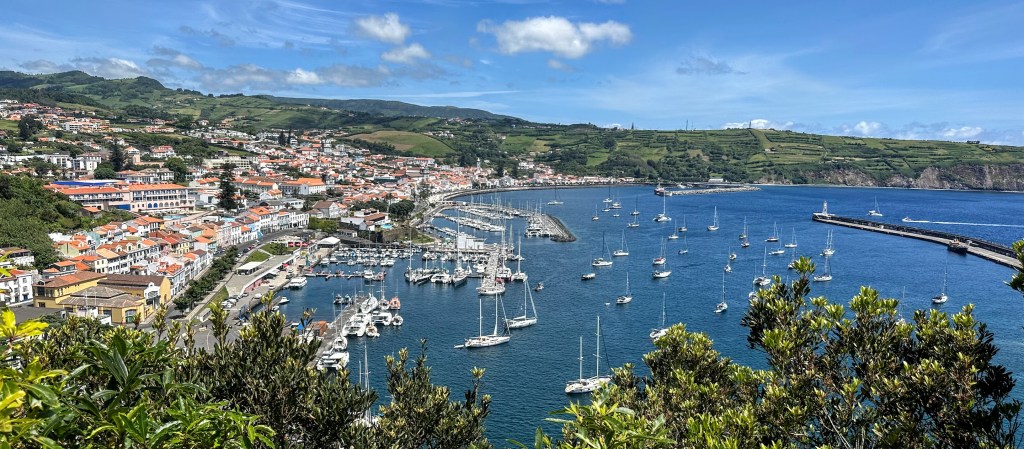
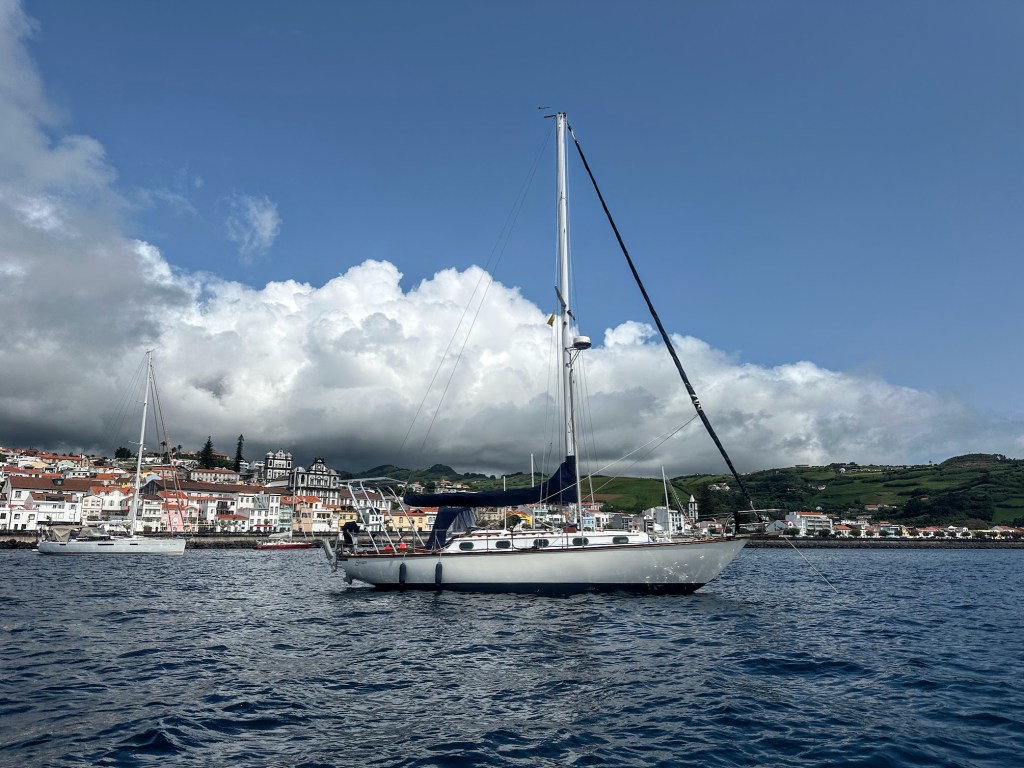
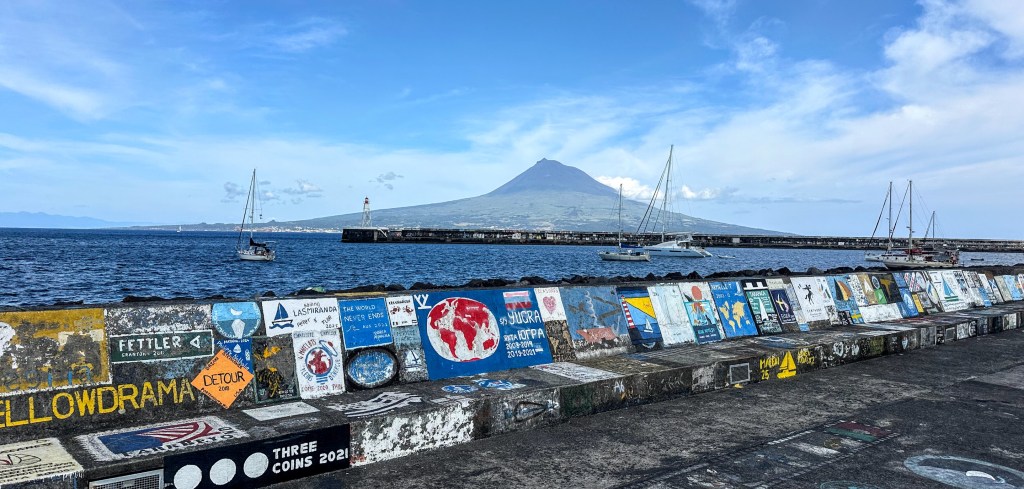
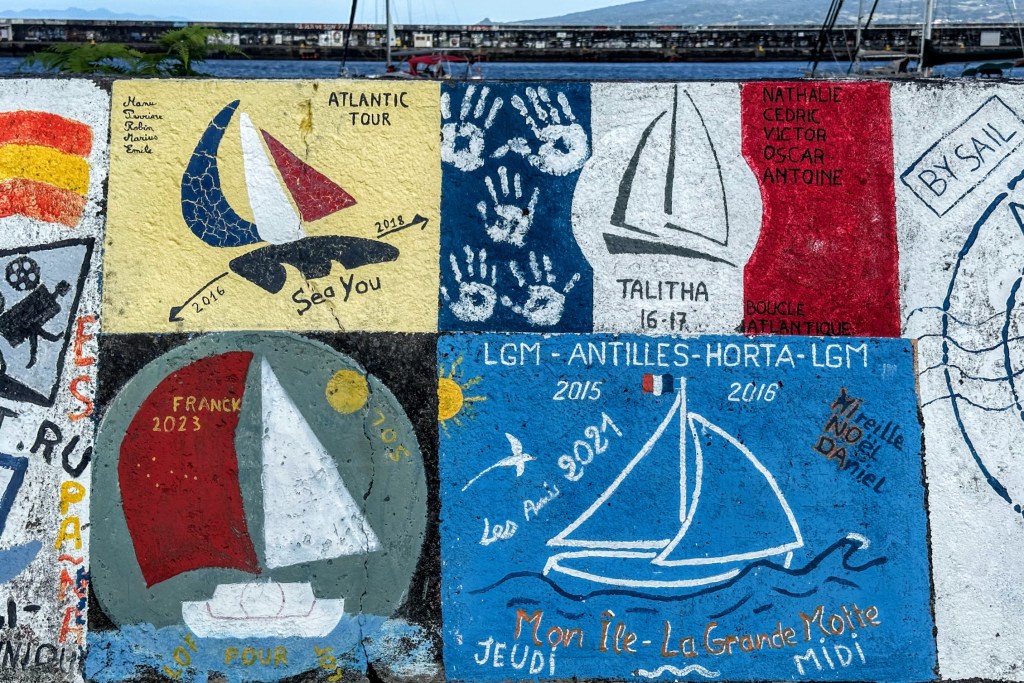
I’m sitting at a study table in the public library in Horta on the island of Faial in the Azores. My mind is still spinning and disoriented, hardly able to grasp where I am and how it is I am here. Six weeks ago, on May 2nd, I cast off in the dark at about 4:00 am from the anchorage off Frederica Yacht Club by St. Simons Island, Georgia, where I had spent the past six months preparing for the voyage. Since then, it has been a blur of intense challenges and life-changing experiences. In the mix was a tough, two-week crossing from St. Simons to Bermuda, a two-week respite at anchor in the Bermuda harbor of St. George’s, another two-week passage, this time from Bermuda to the Azores, and most recently a few initial days decompressing here.
I arrived on Saturday morning on Swan at the break of dawn, ghosting in on glassy seas between the two massive breakwaters that mark the entrance to the harbor. I had been awake more than twenty-four hours after tacking the whole night just offshore, waiting for sunrise, and was exhausted but exhilarated as I glided slowly and without a sound into the iconic little port. Looking left toward the anchorage, I could see sailboats squeezed into every available spot, so I opted for a small opening closer out by the breakwater and dropped anchor after fifteen days at sea. It was my longest solo passage so far both in terms of duration and distance, as I had covered close to 2000 nautical miles.
The depth sounder showed thirty-five feet, and adding another five for the distance from the water to the bowsprit, it meant that I needed to put out at least two hundred feet of rode for a five-to-one scope, which was the bare minimum. After paying out the first one-hundred and fifty feet of chain, I went below and up to the v-berth so I could access the chain locker. This required carving out a path through all the gear and equipment stowed there, in turn requiring that I pull the spinnaker, storm jib, and spare staysail from where they were stowed in the forward-most area out and onto the main cabin sole. Once I had a narrow space to wriggle through, I put on my headlamp and pulled my way up to the chain locker door, swung it open and latched it in place, and then reached deep into the chain locker to untie the lashing that held the extra one hundred feet of rope rode securely against the bulkhead and out of the way of the heavy chain. That cleared the way for me to pay out the extra fifty feet of rope rode so that I would have a total of two hundred feet deployed. I closed the chain locker, shuffled backwards slowly on elbows and knees out of the v-berth, headed back on deck and up to the bow, pulled the chain off the gypsy wheel holding it securely on the windlass, and began paying it out by hand. After a few feet, the rope rode emerged from the deck chain pipe, leading to the chain locker, and I quickly paid out the next fifty feet and cleated it securely to the bow cleat. No need for the rope snubber line, required when chain only is deployed, since some fifty feet of rope was already leading off the bow into the clear water below.
At this point, I was running on fumes. Adrenaline alone was keeping me going. I could have just gone below and fallen into my berth to catch up on my sleep. However, after two weeks at sea, various lines lay about the cockpit and deck like spaghetti and other gear cluttered the cockpit, including winch handles, binoculars, offshore life vest and harness, headlamp, autopilot, and wind vane. The mainsail was lashed with sail ties but still exposed on the boom, and the jack lines still ran the length of the boat forward to aft on the port and starboard side-decks. While approaching the harbor, I’d managed to lash the sail ties on the mainsail and stow the lazy jacks and mainsail halyard, but there was still much to do to clean up. I took a deep breath, took a long gaze all around my new surrounds as the darkness of the night gave way to the first sunlight, and then dug in to clean up the boat. After an hour, she was shipshape again, at least with everything stowed and in order for life at anchor. It was still only about 8:00 am, so I fell into the berth and took a short nap, which helped take the edge off my lack of sleep.
Next up, clearing in with customs and immigration. This presented another major task, namely deployment of the dinghy, which required hoisting the two large duffel bags out from the v-berth and onto the foredeck, rolling out the deflated dinghy and inflating it, and installing the various parts at the right time, including the inflatable sole and the transom. By now, I was rather adept at hoisting the dinghy with the spinnaker halyard and dropping it over the side into the water, and this previously tricky step went quickly and smoothly. While cleaning up the boat, I’d been charging up the battery for the dinghy motor, and the blue light showed she was fully charged. I shaved, put on a decent shirt, put my documents into my knapsack, dropped into the dinghy, and headed for shore.
It was about a five-minute dinghy ride that took me through a maze of other ocean-going sailboats at anchor. Some were new and expensive-looking modern yachts, others were more modest in size, condition and appearance, and a few looked older, more worn, but invariably with more character and likely more interesting stories. The common thread was that any boat here was an ocean-going vessel that had travelled hundreds if not thousands of miles across open sea to arrive here and were soon bound for another port again hundreds if not thousands of miles across the sea. Horta is a small port but massive in the imagination of ocean-going sailors as one of the iconic trans-Atlantic stopover points over the centuries. That vibe was evident just from the short dinghy ride among the various other sailing vessels at anchor.
Customs was closed for lunch when I arrived, so I strolled the waterfront, found a small local pizzeria, and enjoyed my first hot meal away from the boat. Pizza never tasted so good. I was in heaven. I sank into my hard plastic chair, soaked up the vibe of the place with the Benfica soccer scarves hanging on the wall, and savored every bit. From there, back to customs, which required a half-an-hour wait, due to other sailors being in line in front of me, but which then went very smoothly. Two big takeaways: First, I am relieved to have been so insistent about finding boat insurance, as I discovered that the customs officials, in turn, insisted on my having it. Without it, I’m not sure what would have happened, but likely I would have been expelled from Horta. It was clear this was something on which they had zero appetite for compromise. Second, the ninety-day limit is also a point on which they have no flexibility. I was hoping I could be pleasantly surprised to find some loophole that would allow me to extend my stay, but alas, they made it crystal clear that it would be ninety days and then out.
Day two in Horta consisted of a careful assessment of my anchoring situation, disposing of trash, doing laundry at a local laundromat, and going for a long meandering walk up on the hill behind the town. The next day, Monday, I went for a short run along the waterfront, which was much shorter than my usual distance but hugely refreshing, and replenished my water supply. Also on Monday, I met up with Donny on Monty Solo, the 30-foot yawl I was anchored next to at St. George’s in Bermuda. He left Bermuda a day ahead of me, but I passed him on the way and arrived here a few days before him. Then, on Tuesday, came to the public library in the morning and then took a walk to the grocery store on the outskirts of the other side of town. Back at the boat, I spent some time taking care of some financial issues, including a couple unpaid invoices from Brunswick.
Happy to be in Horta after another eventful but successful passage!
8 March 2025 – Life Outside the Box
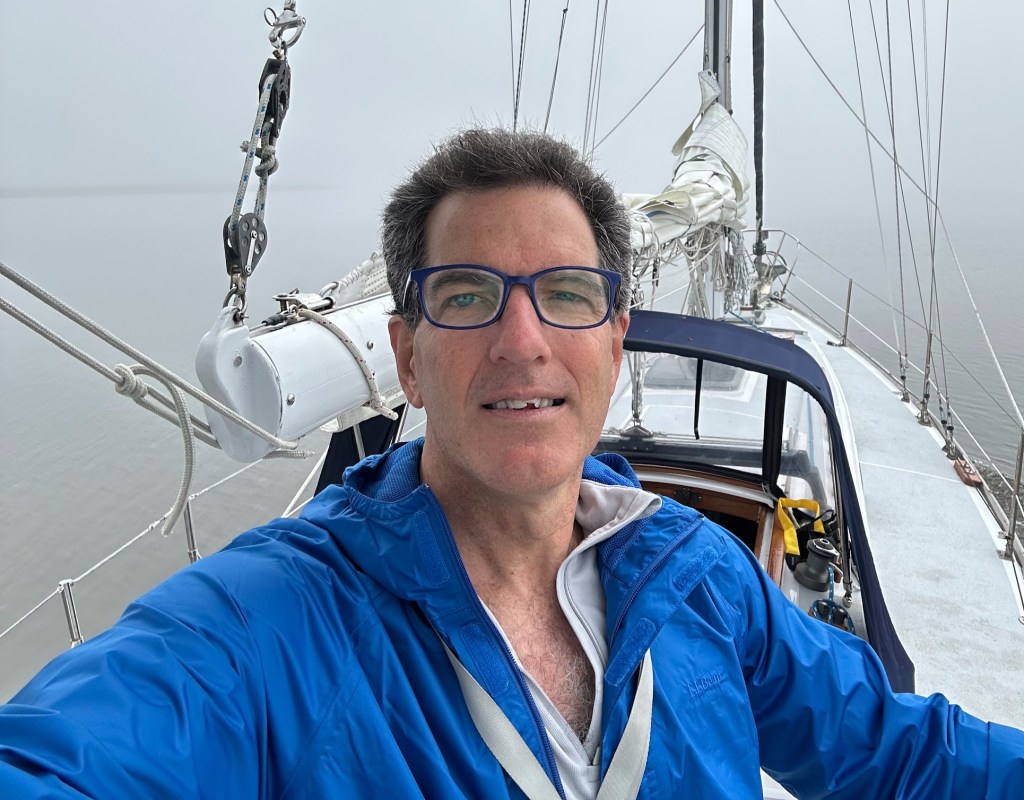
Up until three years ago, I was living in a nice house in New Rochelle, New York, a comfortable suburb in the bed-town community of Westchester County just north of New York City. I commuted each day to and from Manhattan on the Metro North New Haven Line that catered to the bankers, lawyers and other professionals that lived in Westchester and worked in the City. It was a pleasant fifteen-minute walk to New Rochelle Station, an easy and comfortable thirty-five-minute ride from there to my stop at Grand Central – a magical, elegant cathedral of a station in the heart of Midtown – and another ten-minute walk through Grand Central over to Park Avenue to the North American headquarters of Sumitomo-Mitsui Banking Corporation, where I worked. In the hustle and bustle of the morning Manhattan rush, I looked the part, with polished soft leather briefcase slung over my shoulder, slacks and classy dress shoes, nicely pressed navy sport coat, and a splash of understated color from one of the ties I’d picked out at the Metropolitan Museum of Art. A pretty dark blue Subaru Outback was parked in the driveway at home and provided transportation around Westchester on the weekends. My wife, Kyoko, worked as Music Director at the Presbyterian Church in Katonah, a picturesque little town straight out of Norman Rockwell and located another thirty-five minutes north of us in the bucolic New York countryside.
Until Kyoko died in 2020, this was our life. We led a comfortable but fast-paced and almost frenetic lifestyle that many people around us were also leading. It’s almost a norm among professionals in the major US urban areas: high intensity, high stress, long hours, but some degree of positive trade-off on the upside. Of course, we knew we were blessed. I had been the victim of a corporate lay-off, which was a terrifying white-knuckle experience, especially with my son just starting college, but miraculously, I was able to bounce back quickly and find another position without too much disruption. On balance, we counted ourselves lucky, especially given the dire straits faced by many of our fellow citizens in the US these days. Our existence was unique in its own ways, as is the case for everyone, but in a broader sense it was still very much “inside-the-box” in terms of overall lifestyle. We were hardly mavericks in this sense.
Fast-forward to my new life on this small sailboat currently anchored in a narrow coastal inlet on the coast of Georgia. I am sitting on the starboard berth on SV Swan tapping away on my laptop perched on my compact folding table. The incessant howl of the wind outside is overlayed with the splashing and gurgling sound of the waves against the hull, and the boat itself is bouncing and rocking with the frequent gusts. I’ve been hunkered down at anchor just off St. Simons Island, sitting out a fierce weather system that’s been battering me for the past three days. Yesterday, winds averaged thirty-five to forty knots throughout the day, and one gust pushed Swan over on her side and flipped the dinghy, which was tied up off the stern. I have two anchors out and have been monitoring the rope rodes closely to make sure they don’t chafe through or get tangled as the boat swings around in the roaring wind and waves. The cabin is cluttered but roughly organized with various shopping bags, each filled with tools and materials for a separate project that’s underway. The lee cloth on the port berth is secured in place and keeping other gear temporarily thrown there from falling onto the cabin sole. I’m cooped up in the tiny cabin with all hatches closed. Total available floor space is about the same as a walk-in closet, the main difference being that it’s not stationary and keeps bouncing around. Last night, dinner was hot dogs and baked beans. I haven’t showered or shaved in three days. I’m getting a bit stir crazy and need some exercise. Almost out of paper towels. I need to empty the toilet, which consists of a bottle and a bucket.
This is my new life. It is not “inside-the-box.” One of my son Kai’s teachers in middle school once commented to him that his thinking was “outside-the-box,” to which his friend immediately responded, “No, no, you don’t understand. For Kai, there is no ‘box’.” In some respects, my life is a bit like this now. I’m not sure if it is outside-the-box, or perhaps if there is no box at all. Either way, it’s not in any way normal on conventional, and it sure isn’t what life used to be like. Even within the sailing community, I’m realizing that Swan and I are outliers. To be sure, there are other liveaboards, and there are other sailors who make long trips on their boats, but the combination of solo plus liveaboard plus voyager is rare indeed. Even among the solo liveaboard voyagers, who are hard enough to find, I have discovered that those who venture across oceans and to foreign shores, like my mentor, James Baldwin, are even more striking in their rarity, like an exotic endangered bird spotted through the leaves in a tropical rainforest. Add to this the fact that Swan and I have no diesel engine aboard, which blatantly violates the gospel of the modern motor-sailor, the fact that I avoid marinas and generally stay at anchor, and the fact that I will be employing celestial navigation, and the air gets even thinner.
There are good reasons why more people are not doing this. Some would say it’s just crazy. Whatever you call it, I’ve realized that based on the usual standards and metrics of what we take to be normal, or sane, or within reason, or prudent, or advisable, or even remotely tolerable, this lifestyle is extreme and completely outside the realm of the conventional. Taken at face-value, I live in a tiny capsule on the water, often just tethered by a single thin chain or line tied to a hunk of metal thrown overboard that I hope will stick to the bottom, and I bumble back and forth to shore in a mini inflatable boat not much bigger than a bathtub to do laundry, buy groceries, and pick up mail at a temporary mailbox I’m renting. My shower is my cockpit, which means it’s outside, of course, and which is something passing boaters find amusing when I’m in bathing mode.
I cook on an alcohol stove, much like a camping stove, and my refrigerator, which has no freezer, is basically a compact plastic cooler with a small refrigeration element attached. My toilet, as I mentioned, consists of a bucket and a bottle, which work fine, given that there are not a lot of moving parts, but which absolutely need to be emptied at the right times. I have no car, so my ground transport for extended outings ashore is a small folding bike behind which I tow a small folding canvas wagon to put my shopping items. The other day, a friend told me he saw this tall gangly guy riding this circus bicycle with tiny wheels and dragging a little blue wagon behind him overflowing with groceries, and he thought it was ridiculously funny. Well, that was me, witnessed in full glory in of one of my regular routines.
Downsizing does not begin to describe the material paring-down that’s been required for this new lifestyle. Given all the gear, tools, and provisions aboard, and the extremely limited space, there is almost zero space for personal items. Even what we may think of as “necessary” gets pared down severely. There can be no extra clothing, no extra shoes, no extra books, no extra cups or plates or silverware, no extra anything, except spare critical parts and components needed for emergencies. Think of what astronauts are allowed to carry in their space capsules, and it’s probably not far off. Then, of course, comes the voyaging itself, and this is extreme in its own way, especially doing it alone and for the first time. “Intense” barely begins to describe the challenges involved in solo offshore sailing. The layers of quirky and odd features of my new existence are endless, and it is difficult to convey the truly crazy and extreme nature of the experience.
I sometimes think that a journey should be measured not only by the destination, but also by the departure point. Only when both are accounted for can the real scale of the undertaking be understood. In my case, my departure point was my prior life living in the suburbs in Westchester County working in the corporate world in Midtown Manhattan. From that perspective, I am sometimes stunned at how far I’ve come in just these past three years. I also know that I could never go back to that life. This is an odd existence, to be sure, and I don’t know how long it will continue nor where and how it will end. Fortunately, I am finding my new life to be very fulfilling, despite the many challenges. It is the very definition of extreme, but somehow, despite the daily struggles, of every imaginable kind, the rewards are keeping me grounded and engaged and feeling very alive.
So, for a while yet anyway, this extreme and crazy new life continues.
13 February 2025 – A Day in the Life of Swan Anchored off St. Simons Island, Georgia
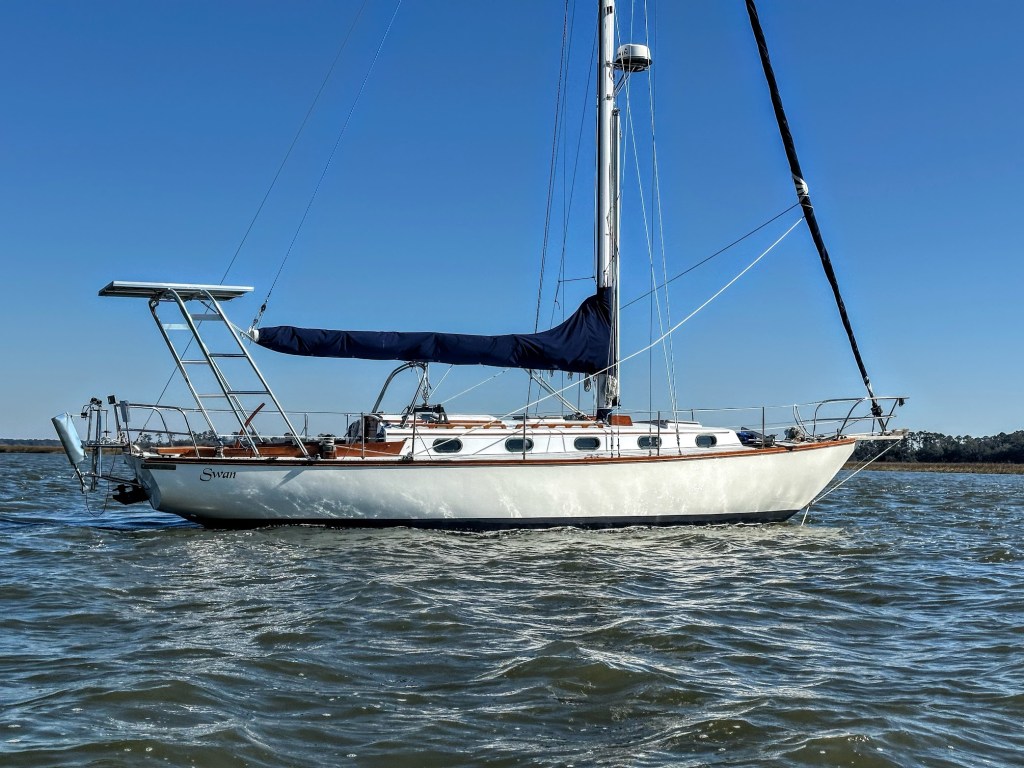
I woke up around 7:00 am. As usual, I slept on the starboard berth where I generally keep the backrest folded up and held in place with a barrel bolt to make more room to sleep. My body was slow to get going, and after stumbling into the head, I made my way to the galley to put some water on for my obligatory pot of Paris tea. Still groggy, I straightened up the pillows on the berth, dropped a zabuton on the mattress, then plunked myself down to savor my warm brew. Finally, the cobwebs started clearing out of my brain, and I began contemplating the plan for the day. Rain was forecast from noon through to late afternoon, so that ruled out trying to do any more work on the deck teak. I’ve put down two coats of Cetol on the starboard toe rail, but the work was interrupted repeatedly by fog and other bad weather, and yesterday, I finally pulled off all the masking tape, which had already been on there about five days. Feeling a bit stir crazy, and not having exercised for a few days, I decided to go for a morning run before the rain arrived. I also needed to get back and have lunch before my 2:30 performance-coaching session with Tim Herzog of Reaching Ahead.
I passed on any serious breakfast and instead quickly had two bananas so I could get going. The battery for the dinghy needed some top-off charging, so I plugged it in right away, and sure enough, the red indicator confirmed that it did not yet have a full charge. I figured I’d stop at the shower at nearby Morningstar Marina after the run, so I packed a set of clothes in one soft bag and my towel, shampoo, and other toiletries in another, which by now is a standardized routine. After putting on my running clothes, I put the kill switch for the Spirit 1.0 motor in my pocket and prepped the dinghy for departure. Once the battery was charged, I mounted it on the motor, checked that I had everything needed onboard, and made sure the companionway hatch on Swan was closed and sealed. By now it was about 8:45.
On the way over to the Frederica docks in the dinghy, I passed Skookum Lady, Jim Hammond’s boat, which is anchored not far from me. He happened to be on deck, so I swung over and chatted with him a few minutes and then was on my way again. I ghosted into Brett’s slip where his boat, Starting Over, is tied up. After securing the dinghy lines and motor, and unloading the dinghy, I was on my way down the docks by foot to the entrance gate. I dropped my two bags in a corner in the laundry room at Morningstar and then headed over to the bike trail at the entrance to the marina. After setting my stopwatch, I was off, albeit at my usual slow place. Today felt better than my recent runs, however, and I had a decent pace for the first half, only to fall off the pace from there. Still, it felt refreshing.
Back at Morningstar, I bumped into Bryce and chatted a few minutes about the new trawler he’s aiming to buy. I then retrieved my bags from the laundry room and headed up to the shower. Once there, I peeled off my sweaty clothes, shaved, showered, and then headed back toward Frederica. Winds were expected to pick up this afternoon and are forecast to really blow from tomorrow morning, so I decided to get back to Swan as quickly as possible to let out some additional anchor rode to avoid dragging. I was back by about 11:30, and after tying up the dinghy along the port side of Swan, I went below and carved a path through all the gear and equipment in the v-berth up to the chain locker. I opened the chain locker door and secured it, then untied the lashing holding the extra rope rode up against the bulkhead.
Then, it was back out of the v-berth, out the companionway and up to the bow, where I retrieved the snubber line first and then started letting out the remaining chain rode, feeding it up from the chain locker through the deck chain pipe. Almost at the end of the chain rode, however, it bound up from below, so I secured it again on deck with the windlass and went back below and up to the chain locker to sort out the kinks. Once the chain and the rope looked free to run up through the smaller opening to the deck, I retreated again from the v-berth and headed back up to the bow, where I again released the chain from the windlass and began feeding it out again by hand. The winds and current were mild at the time, so I was able to manage it all fairly easily. The splice between the chain and the rope then came up through the deck chain pipe, and then I let out another fifty feet, for a total of two hundred feet of rode. At about twenty feet of depth at high tide, plus another five feet from water level to the bow sprit, the two hundred feet of rode provided me a scope of about eight to one, which was more than sufficient. This meant that I’d be able to ride out the weather coming tomorrow without much concern about dragging.
I also cut corners on lunch today and settled for a big bowl of Muesli. At that point, the post-run fatigue started settling in, so I lied down and closed my eyes for about half an hour to rest and recharge. At 2:30, my session with Tim started, and it was an interesting conversation. When done at 3:30, I put on some music and focused on cleaning up the boat, which had become very cluttered in recent days. I stowed all the cooking utensils and pots and pans and plates in the galley, reorganized the stowage in the quarter berth, cleaned up the clutter on the navigation table, sorted out all the loose clothes scattered on the port berth. Then, it was time for another short nap.
For dinner, it was another quick meal, this time a couple hot dogs. From about 6:30, I reviewed kanji on my kanji app. At 7:30, the Shansi Townhall started on Zoom, and I was happy to have been able to join. I’m hoping to rekindle the connection and perhaps do a project with them in Japan.
It’s now 9:30, which is my normal bedtime, so it’s time for lights out.
8 February 2025 – Climbing the Steep Learning Curve as a Newcomer to the World of Single-Handed Ocean Sailing
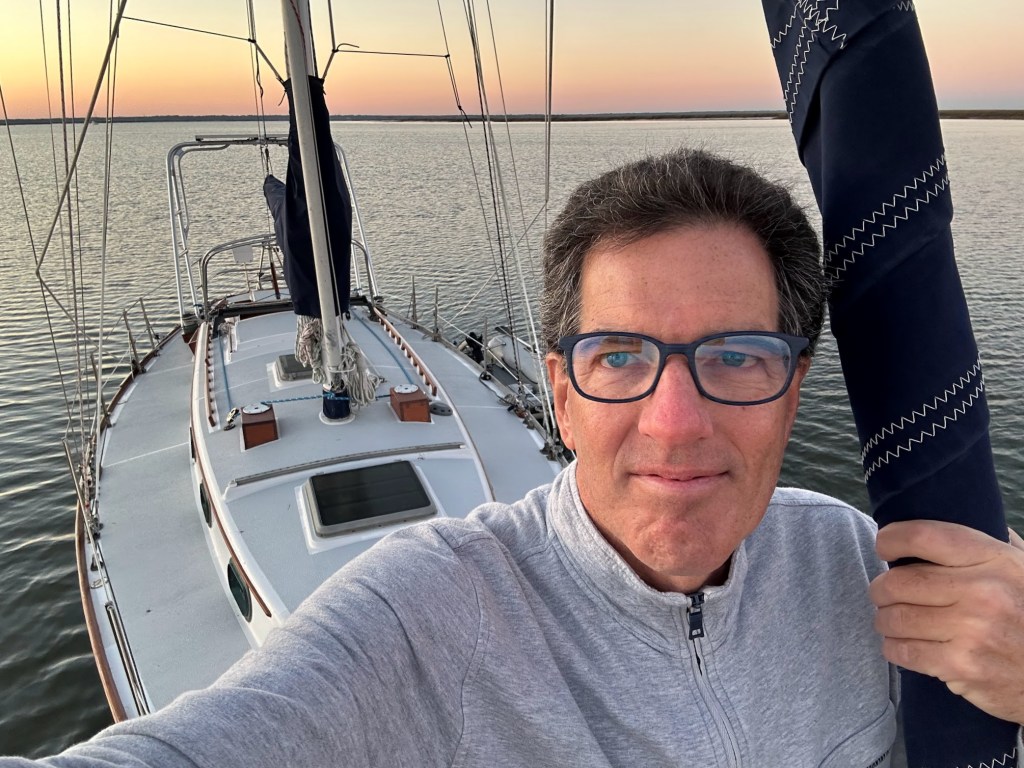
From my many photos of stunning sunsets and pretty sailboats, I could hardly blame friendly observers for concluding that my new life is nothing but relaxation and tranquility and to imagine me sitting out here on Swan drinking rum punches all day with not a care in the world. That perception, however reasonable as seen from the outside, is wildly off the mark, if for no other reason that alcohol is not allowed on SV Swan. Beyond that, the reality is that this entire undertaking has been difficult from day one, and I am constantly tested to my very core. Never in my life have I been pushed to my limit so thoroughly and forced to live so far outside of my comfort zone. This is not limited to when I have been sailing solo offshore and have had to face those specific challenges. It also includes the extended periods when I have been in port at anchor or tied up at a dock somewhere.
Other experienced sailors might read this and accuse me of exaggeration. The reason that it is not, in my case, is rooted in where I started all of this and where I am at this point in the journey. To my mentor, James Baldwin, for example, a particular challenge that might consume my attention would barely register on his radar, and he likely would glide past it on autopilot without a care or concern. He is guided by a deep reservoir of experience, having lived on his boat for decades and circumnavigated the globe twice alone. Being a solo voyager is spliced into his very DNA, and this allows him to respond instinctively and intuitively to almost any situation. He is many oceans beyond me in the journey, and the breadth and depth of his experience provides him this keen situational awareness, which also brings peace of mind. I, however, have been a liveaboard for only one and-a-half years, and while I have two extended solo voyages under my belt now, it’s still been a relatively short period timewise. I have not yet crossed any seas. I’m still at the beginning of the journey.
I once commented to James, before I’d made any significant solo outings, that I was firm in my direction, in wanting to voyage solo offshore on Swan, but I really did not know what to expect, because I had not experienced it yet. My point was that I knew where I was heading, and where I wanted to go, but it was still such a wild unknown to me, and as such, it felt like I was trying to look inside a black box. As a result, I could not even know how I would react to it all once I got underway. James’ reply was interesting. He did not mince words. He said that it would be extremely hard and extremely challenging for me at first. He said I would be severely tested. But then, he said, if were able to stick with it and persist through the initial difficult period, one day I would wake up and find that things would feel a bit easier and a bit more comfortable. And then, with more experience, that comfort and confidence would deepen, and everything would become easier, more natural, and more fulfilling. His wife, Mei, then added: “Do you know what comes next? Freedom! Because you can go anywhere!”
For the last three years, if I include the refit work, I have been climbing a radically steep learning curve as fast as I possibly can. As one of my friends once said during his finals in law school, “Learning is not easy, and sometimes it can be downright painful,” and this is what I have been living every day, it seems. However, now at last, I am getting a taste of the reality James described that lies beyond the initial intense and painful phase of learning. I’m not there just yet, but I’m progressing, and it is a relief.
Interestingly, and somewhat surprisingly, I’m constantly forced to see the whole adventure in a holistic way, which puts a different spin on what it means to be difficult or challenging. By no means is the journey limited to the sailing itself, which could be a natural conclusion when seen from the outside. It also includes the extended periods of time at anchor, when it is equally important to manage the solitude and other challenges of the solo liveaboard.
It would be very easy, for example, after days on end anchored alone in some port, cooped up in the tiny, bare cabin on Swan, and staring at a long list of tasks to get done, to start second-guessing the larger life decisions that brought me here. As my doctor once noted when I was struggling with insomnia while working my high-stress corporate job, the human brain is very mischievous, and it will go off into different directions on its own, and sometimes in ways that are not particularly healthy or welcomed. I’ve been asked several times by other solo sailors if I talk to myself, which seems to be a topic of conversation in this unusual little community, and this reflects the solitary existence in which we find ourselves, and the potentially mischievous brain my doctor warned me about. The upshot is that challenges involved in this lifestyle come from many sources and in many forms. Some are obvious, and some are less so, and it requires regular and conscious attention to one’s well-being, both mental and physical.
At the prodding of my daughter, Leah, I have started working with a mental performance coach who has worked extensively with sailors. In our last conversation, he asked me various questions about the voices I hear in my head when I’m alone and what they are saying. The premise was that it is very normal for people to hear voices, especially when alone for extended periods, and understanding these voices can provide a good view into a person’s state of mind. It was an interesting exchange, and a big take-away for me was that lately I have been hearing a new, refreshing and completely distinct voice. In a word, the voice can be summed up as Defiance. It is a curt, deadpan, unemotional voice that cuts in abruptly when I am feeling stress – currently, perhaps, about my progress in preparing for an upcoming Atlantic circle voyage – and it simply shuts down the high-pitched OCD project manager voice that I otherwise commonly might be hearing. The voice, if it has any emotion at all, may sound mildly exasperated, and the basic message and orientation is to reject stress. It is not a dialogue. It is a directive. When the other voice buzzes around in its high pitch and high tension and pokes and prods me and entices me to get stressed, the new voice simply says: “I Refuse. I don’t care what is happening. I refuse to get stressed. Go away. End of discussion.” This is a new and welcomed twist.
When I joked about my OCD personality to my friend, Jim Hammond, a fellow solo voyager who is currently anchored next to me on his Cascade 36, he rightly responded: “OCD will keep you alive.” His point was that OCD forces you to pay attention, and paying attention leads to good preparation. This is the truth, to be sure. In my case, however, it’s a matter of keeping a healthy balance so the OCD genes in me don’t kill me in another way, namely, by souring the whole experience and destroying my mental health in the process. And to that end, I’m developing a nice rapport with my new voice of Defiance.
It is 9:45 in the morning. It’s a beautiful day. I’m waiting for the dew to burn off the freshly sanded teak on deck so I can put on a first coat of Cetol. Tonight, I’m treating James and Mei out at New Fortune, our favorite little Chinese place on St. Simons Island.
Life is good.
31 January 2025 – A Long Layover at St. Simons Island, Georgia Prepping for the Atlantic Circle Voyage
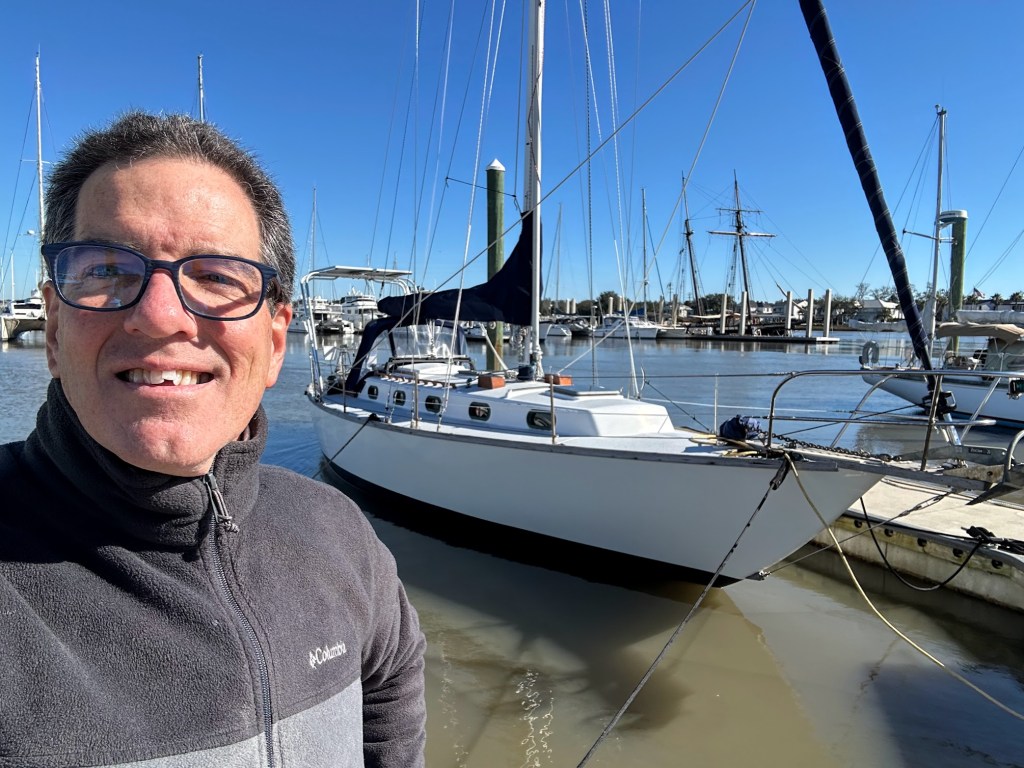
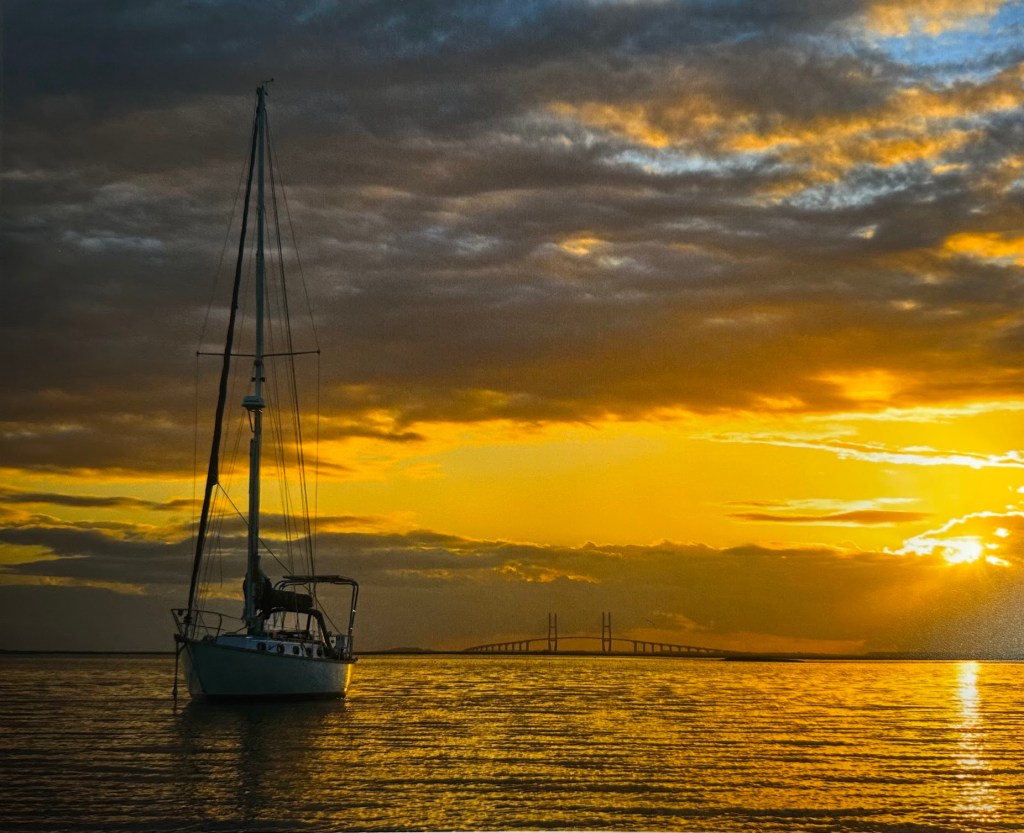
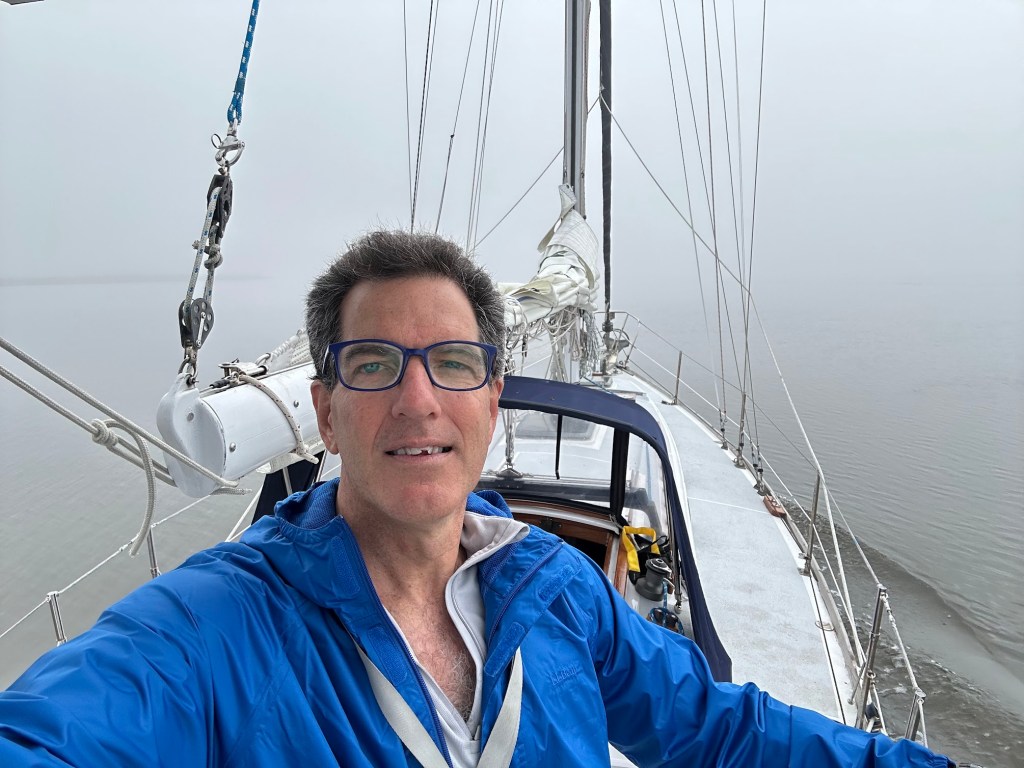
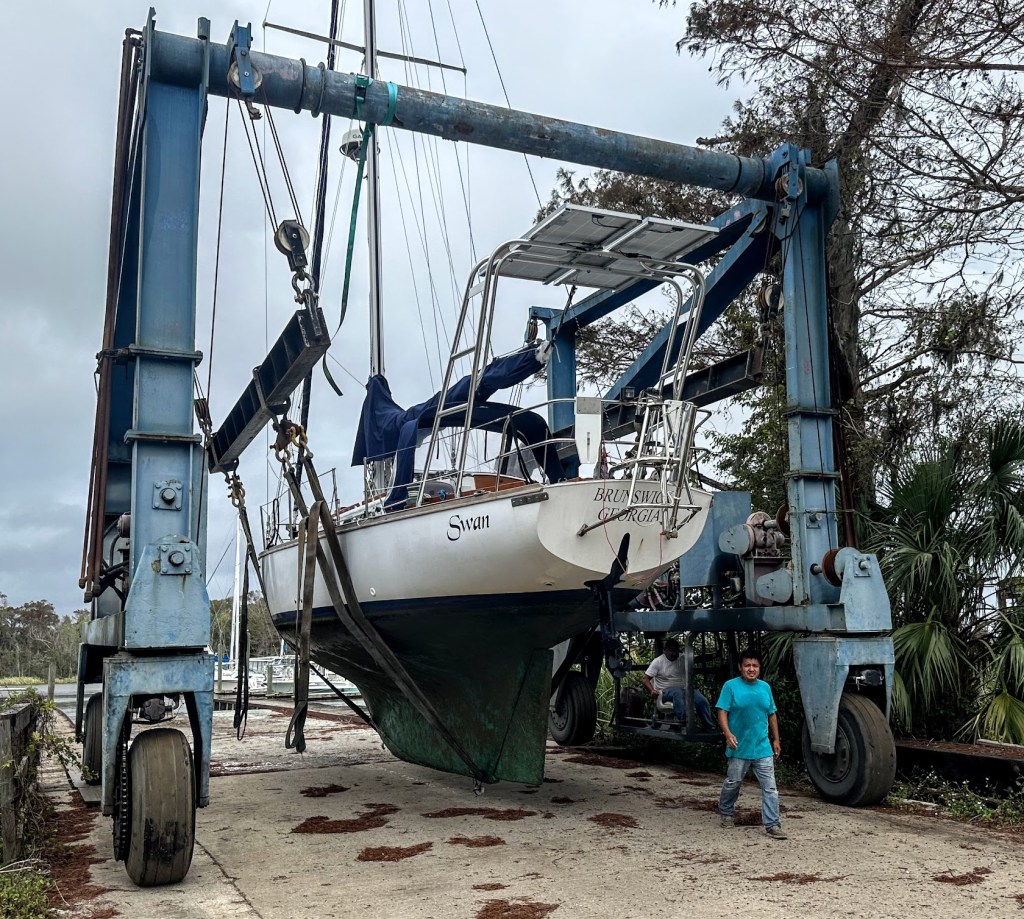
James has noted to me several times that sailboats, even those that are actively voyaging, and not just those bobbing at their lines and rotting away from neglect and lack of use, which is often the case, invariably spend most of their time at anchor. The point is that life at anchor is as integral a part of the voyaging life as is the offshore sailing from one distant destination to another. It’s the time for exploring new sites, finally taking care of those many boat repairs, stocking up on depleted provisions, and catching up with friends and family.
Currently, I’m in one such phase of my new life as a live-aboard voyager. My extended layover here at St. Simons Island can be cleanly broken down into three main chapters. The first was the period after I returned from Long Island, on October 24 last year, up to my departure for Japan to visit the Tagami family on December 28. The focus of this first chapter was hauling out Swan at Two-Way Boatyard and finishing some critical repairs with James. The second chapter was the two-week trip to Japan, starting at the end of December and extending to January 13. This was a much-needed time of reconnecting with Japan and with the Tagami family after a two-year absence. And the third chapter, in which I am now thoroughly consumed, extends from my return from Japan to my planned departure on the Atlantic circle voyage at the beginning of May. The focus here is summed up in one word: Preparation.
So first, chapter one. From the time I arrived back at St. Simons from Long Island on October 24 until November 6, a period of about two weeks or so, I was at anchor off Frederica Yacht Club. During that time, I met another interesting solo live-aboard, Jim Hammond, who was anchored on his Cascade 36 in the same area as Swan. He ghosted into the anchorage a few days after I arrived, and a couple days later he dinghied over to Swan and we got to chatting. He’s a photographer, among other things, and we’ve been in touch since then. He’s a competent, independent, do-it-yourself sailor with a friendly, down-to-earth personality and seems to be cut from the same cloth as James.
Then on November 6, I motored the eighteen miles up the narrow, winding Intra-Coastal Waterway (ICW) to Two-Way Boatyard, located in Darien, Georgia, and had Swan hauled for some repairs. It was a four-hour trip motoring at about four to five knots, and aside from the continuous background drone of the motor, it was a relaxing expedition gliding up the meandering channels though the marsh grass. Most of the time, I relied on the Pelagic autopilot to handle the steering, which allowed me at times to enjoy the ride up on the foredeck.
Once I arrived, it was a tricky docking approach. I had to make a ninety degree turn into the small marina and then thread my way between two short adjacent docks crammed with boats. After I made the turn, the tide was running briskly from port to starboard right on my beam, so I had to crab my way slowly through this narrow channel to offset the current. Dead ahead and perpendicular to my course was the dock. This required that I make another hard ninety degree turn in tight space to line up the boat with limited room to make course adjustments. The tidal current on my stern would not help matters because coming from behind it would reduce my ability to steer and control the boat. And sure enough, while my overall approach was not bad, the long full keel did get caught at the wrong angle by the current, requiring a bit of a struggle with the lines to pull Swan flush with the dock. But no harm was done, and Swan very quickly was tied up safe and secure.
David and the boatyard team then pulled Swan around into the well for hoisting and began lining up the two large straps across the bottom of the keel. Then things got interesting. The whole hoisting process is remarkable to see, if not unnerving. A strange sci-fi looking vehicle called a travel lift is the key to the whole process. It’s a massive cubical frame made of steel beams with the front end and back end open so that a boat can slip inside it. Each corner rests on a huge bulbous tire, and the driver maneuvers the massive unwieldy contraption through the boatyard from a tiny open cockpit tucked into one side of the superstructure. Two long thick hoisting straps hang down from the top of the open steel cube, and a diesel engine is tucked in there somewhere. When hoisting a boat, the driver maneuvers the travel lift over a special hoisting well where the boat is tied up, the straps are run from port to starboard across the keel, with one strap forward and one aft, and then the driver hoists slowly, and the boat is slowly lifted out of the water with the straps. Once fully above the ground level, the driver can then navigate the lift slowly into the boatyard while the boat is hanging freely by the two straps, sometimes swinging around a bit if the travel lift hits a bump.
In the case of Swan, she is 36 feet long, has a 45-foot mast, and weights about 17,000 pounds. In addition, she has a long full keel, which can make it tricky to place the straps, especially on the front. The main issue for the stern strap is to make sure it lays over the keel only and does not overlap onto the rudder, which could cause serious damage. For the front strap, the trick is that in the area where the strap needs to be placed, the keel is raked at a hard angle, which can cause the strap to slip. The team at Two-Way Boatyard does this every day, and I already had Swan hauled once before there, so despite my nerves, I trusted that all would be okay. However, the evil underside of experience is complacency, and right after Swan was hoisted and carried the short distance over the adjacent concrete ground, the front strap slipped. A safety strap to keep the main forward strap in place had snapped due to the load, and the forward end of Swan came crashing down onto the concrete. Fortunately, the distance she dropped was only about a foot or so, and there was no apparent damage. From there, it was a bit of an exercise to get her hoisted securely again, but finally, they managed to move her safely to her spot in the boatyard and transfer her to the jackstands.
From there, the immediately task at hand was for James and me to complete a multi-day repair of the seal on the rudder shaft. My rudder shaft has a type of seal called a stuffing box, which is not a box at all but rather a hefty bronze fitting that wraps around the rudder shaft and blocks any serious leakage with a compressed flax material. The fitting also requires a large diameter hose made of a very thick and robust rubber material that the rudder shaft runs through just below the stuffing box. The shaft had had a slow leak from some time ago, but it was not a real concern at the time, since I could quickly and easily drain any water accumulated in the bilge with my bilge pump. However, while sailing the past year, the leak gradually got worse, and while it never presented an immediate threat to the boat, since the rudder shaft is enclosed in a watertight compartment, it became inconvenient for me to leave the boat for any length of time because there would be constant water ingress. James agreed to help me make the repair, and that is what brought me back to St. Simons. It was a four-day job, exactly as James predicted, and in addition to installing a new stuffing box and hose, the key components for the seal, we also raised the stuffing box about four inches, which had the effect of raising it above the water-level. This provided additional assurance against any future leaks, and having had the boat back in the water now for a couple months, I’ve been pleased to see the bilge area bone dry every day, meaning an end to any leakage.
Aside from the rudder shaft repair, I asked the Two-Way team to refresh the bottom paint, and this time, instead of the previous green, I requested jet black and asked that they bring the paint all the way up over the boot stripe. This is a decorative stripe from bow to stern about a foot high and right at the water level. In my case, the navy-colored boot stripe had become increasing fouled by barnacles and moss, and the edges were beginning to chip, so following James’ advice, I decided to ditch it and cover it over with the anti-fouling black bottom paint. I then made another big decision. The topside paint was inferior to begin with, and James had warned that it was a matter of time before it would deteriorate. Early on, we had so much other work to do, and I had my own constraints with my budget, so we pushed it off and struck it from the project list. James advised me to just go sailing, and when it got bad enough, I could deal with it then. After just a year, however, somehow it had already seriously deteriorated, and I realized that with the boat already in the boatyard, it was my best chance to bite the bullet and get it done. There were two other boats at the boatyard that had been painted by David and his team, and they looked great. In addition, they gave me a decent price, so I decided to go for it. It put a huge dent in my finances, given that I was not expecting that kind of expense, even though the price was not bad. Still, I have been able to thread the needle financially, and the boat looks beautiful. I’m very glad I had it done, and James told me it should last at least fifteen years, so it likely will not be an issue I’ll have to revisit.
Once the boat was hauled, on November 6, I lost my living space, so James offered that I stay at his guest house for a very reasonable price. He also let me rent his SUV any time I needed it, also for a reasonable price, and this arrangement ended up working out very well for me. I ended stay there some five weeks until December 17, when the boat was put back in the water and I was able to bring it back down the ICW to the anchorage off Frederica Yacht Club. It was a nice and interesting little chapter for me staying at James and Mei’s guest house. They invited me over for dinner about a half dozen times, and it was always a wonderful break and a delicious meal from Mei’s kitchen. It also gave me a chance to get to know them a bit better in a setting away from the boat work. The guest house was right next to their own home, and it felt a bit nostalgic at times, because much of my old furniture that I’d given to James and Mei was now nestled into different rooms in the house.
Meanwhile, I’d hoped the topside painting would be completed before Thanksgiving, but weather caused some delays, so I decided to go visit Mary Betz in Tennessee for the Thanksgiving break while Swan was still in the boatyard. As always, it was a wonderful and relaxing stay there, almost like being at home with family. This time, I flew out from the tiny Brunswick Airport, instead of driving with a rental car, so the trip there and back was very easy. I stayed a leisurely five days, and when I returned to Georgia, it was a quick turnaround before Swan was back in the water, down the ICW, and anchored again off Frederica Yacht Club by St. Simons Island.
The second chapter of my layover after the Long Island voyage started on December 28 when I boarded a plane to head for Japan. About a week before leaving, I coasted into Brett’s slip at Frederic Yacht Club and tied up Swan securely there. Brett knew I planned to be traveling, and he had his own plans for an extended sailing trip through the Bahamas, so he offered me his slip to use during my absence. It was a great help, as I did not want to leave Swan at anchor for the two weeks I’d be in Japan. When I settled into my seat on the plane from Savannah, I had peace of mind that Swan was safe and secure. The first leg of the trip took me from Savannah to New York City, where I stayed the night at Kai and Carol’s apartment on Fulton Street in Brooklyn. It was a nice way to break up the long trip, and the next morning, I headed back to JFK Airport to catch my flight to Haneda in Tokyo.
I arrived on December 30 and had hoped to meet Leah at airport. She was supposed to arrive from Stockholm at about the same time, around 2:30 pm, but I then learned that her flight had been cancelled, and she did not make it to Haneda for another twenty-four hours. That left me to head off on my own by bus to Tokyo Station, where I met Kai and Carol at the Yaesu Central entrance. They had arrived several days earlier and enjoyed the time together exploring Yokohama and Tokyo. We found each other, and from there hopped on a Shinkansen and headed to Oyama. Kai and Carol stayed at a hotel next to Tochigi Station, so they took a taxi directly there from Oyama Station to check in.
On the 31st, Takahiro drove me to downtown Tochigi, where we met up with Kai and Carol at their hotel. From there, we went down to Yamato-cho and walked around the old neighborhood, stopping by the old house and strolling down Uzuma-gawa, the small river that runs through the center of the town. That evening everyone convened at Hinokuchi-machi for New Year’s Eve, and Leah also finally arrived after an exhausting forty-eight-hour trip. New Year’s Day was a quiet day at Hinokuchi-machi, and on the 2nd, Satoru led a trip he organized for us up to Nikko, where we stopped at an onsen, had lunch in the main town near Toshogu, and ventured up Irohazaka to Chuzenjiko. Kai, Carol, Leah, Nozomu, Jun, Haruka and Daichi also joined. It was a great outing and lots of fun.
The next day, Kai and Carol bid farewell to Hinokuchi-machi and headed to Tokyo for a couple days before departing for New York from Haneda. Leah and I also said goodbye to Hinokuchi-machi and caught a shinkansen from Oyama to Sendai, where we stayed with Makiko and Shin for two nights. We explored Sendai, and they also took us north to the town of Matsushima, which was another fun expedition. On the 5th, Leah and I headed south on the shinkansen again and this time were bound for Ofuna, where we stayed with Takahiro-san and Kaori. The next day, Kaori, Leah and I took a daytrip to Kamakura where we spent our time strolling and shopping along Komachi-dori, which is a bit touristy these days, but is still a special spot for me. Leah and I met Shoma in Tokyo on the 6th, and the next day, I took the train with her to Haneda and saw her off for her return trip to Stockholm.
I had reservations at an AirBnB in Yokohama for the four nights from January 8 until my departure, but I accepted Kaori and Takahiro’s kind offer to stay with them for the duration. They gave me a spare key, and I was free to come and go while they were at work during the day. One night, I treated them to dinner at a wonderful little Spanish restaurant in their neighborhood, and on another night, I met up with Tabe-san in Nihonbashi where we had dinner together. On another day, I went alone to Yokohama in my work workout clothes and ran the five-miles from Yokohama Station all along the waterfront to Motomachi and then up the hill and over to the old apartment at GS Heimu. On my last day, I met Satoru and his family at Tokyo Station at the Kitte building where we all had an Italian dinner together. Toward the end, Makiko and Non-chan, who were shopping in the area, stopped by to say hello.
On the 12th, I loaded my suitcase into Takahiro-san’s car, and on the way to the station, we stopped at one of his favorite Chinese restaurants, and I was able to have my obligatory tan-tan-men and gyoza for lunch. From there, he dropped me off at the station, and I was on my way by train to Haneda. I had tried unsuccessfully to upgrade to premium economy, which I had done for the trip to Japan, so the return trip was to be something of an experiment as to whether I could survive the long trip at my age in the standard economy seating. Somehow, I did manage, and when I arrived at JFK, I went straight to Kai and Carol’s, where I spend the night. The next day, I was on a poison early flight back to Savannah, and by noon, I was back at Swan at Frederica Yacht Club.
I’m now three weeks into chapter three, the preparation phase. It’s been intense. I feel like an athlete in training. My joke is that I’m like an astronaut preparing for a challenging expedition in space, with the main difference being that the astronauts generally don’t have to do all the maintenance and repairs on their rocket and space capsule. In my case, on the other hand, even though I do sometimes look over my shoulder for someone to help, there is no NASA behind me. It’s just me to do everything, and fortunately, I would say it’s going well so far.
We had a full week of unusual freezing temperatures, so I had to delay the outside teak work, and instead I focused on a long list of logistical and administrative tasks, which included securing health insurance, boat insurance, telemedicine support, search and rescue insurance, and a back-up marine weather forecasting service, most of which I’ve been able to complete. In that period, I also confirmed and checked the extended marine weather forecasts I can receive through my Garmin Inreach and investigated the possibility of setting up Starlink on the boat, an option I ended up rejecting once again. Additional tasks I clicked off the list included an annual physical, which provided me a clean bill of health, and a dental check-up, which resulted in another appointment at the end of the month to get a cavity filled, something I’m not thrilled about but which I’m glad I caught before my departure. I also found a performance coach, Tim Herzog, and have started sessions with him, which was a strong condition placed on my Leah, who for the first time expressed concern about my upcoming trip.
Last Saturday, about four days ago, I moved Swan back out to anchor to make room for Brett to return from his solo trip on Starting Over. A period of nice weather, aside from dense morning fog, has allowed me to make some progress finally on the teak work. The starboard toe rail and eyebrow are now sanded, and once I patch some holes with thickened epoxy and do a final light pass with 120-grit sandpaper, I’ll be ready to put on the first coat of Cetol.
It’s a busy period with a firm drop-dead deadline of May 1 to finish all the prep work. This is now where all my energy is focused. I should have enough time to finish everything, and my aim from day to day is to just keep pressing forward and making progress. My goal is to be as prepared and confident as possible when I cast off. We’ll see. When I’m feeling pressed and overwhelmed by the whole daunting undertaking, I recall Cole Brauer’s two words when people doubted her ability to sail solo non-stop around the world: “Watch me.”
29 January 2025 – An Intense Period Preparing for the Atlantic Circle Voyage
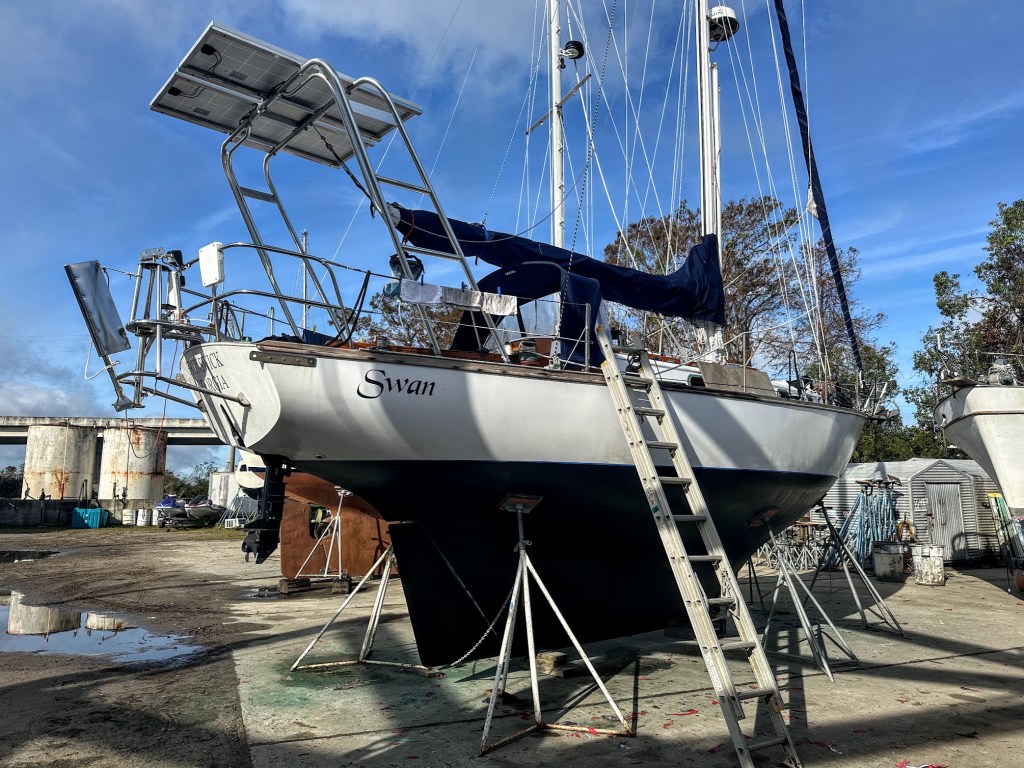
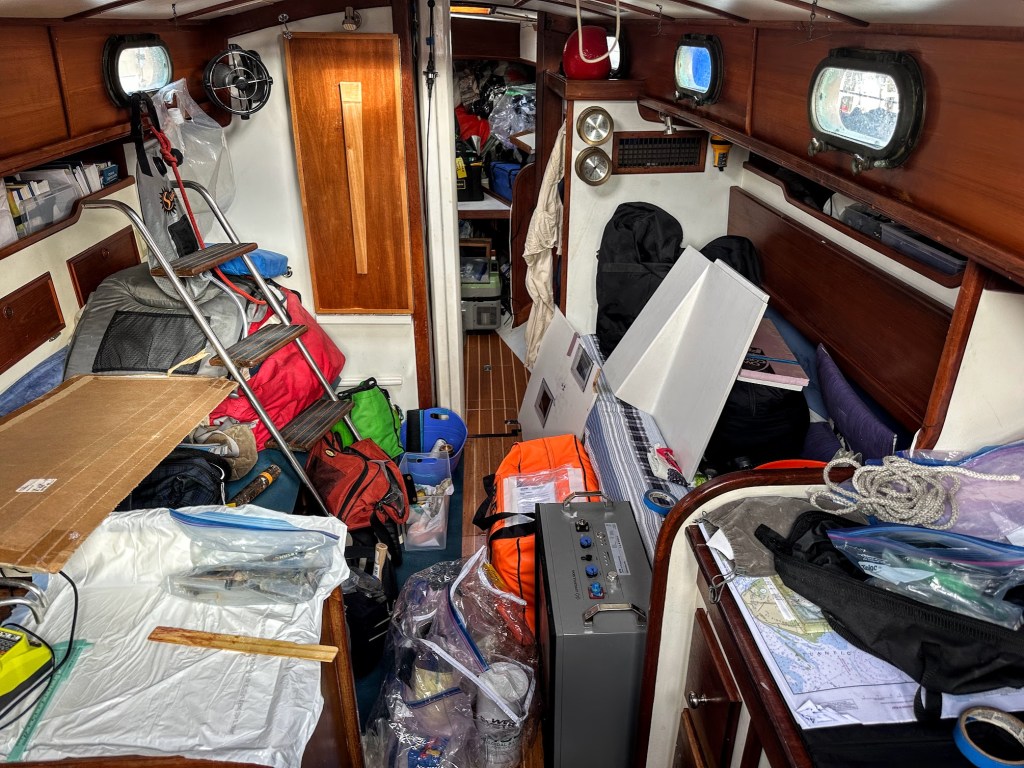
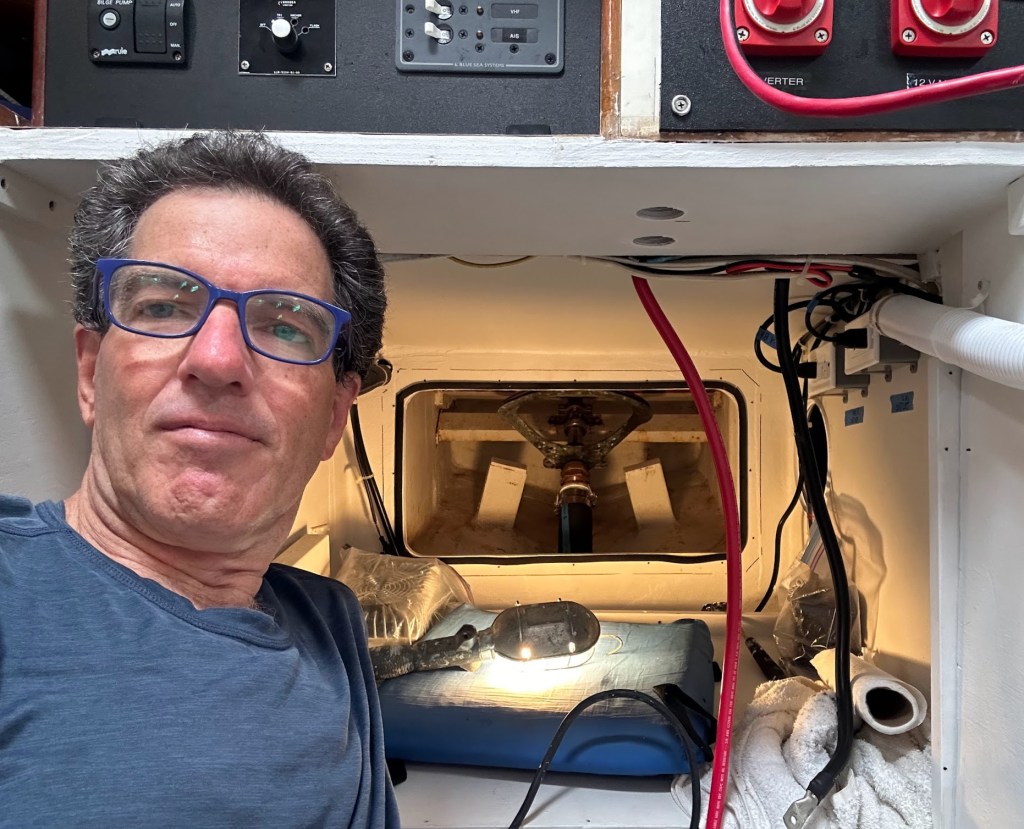
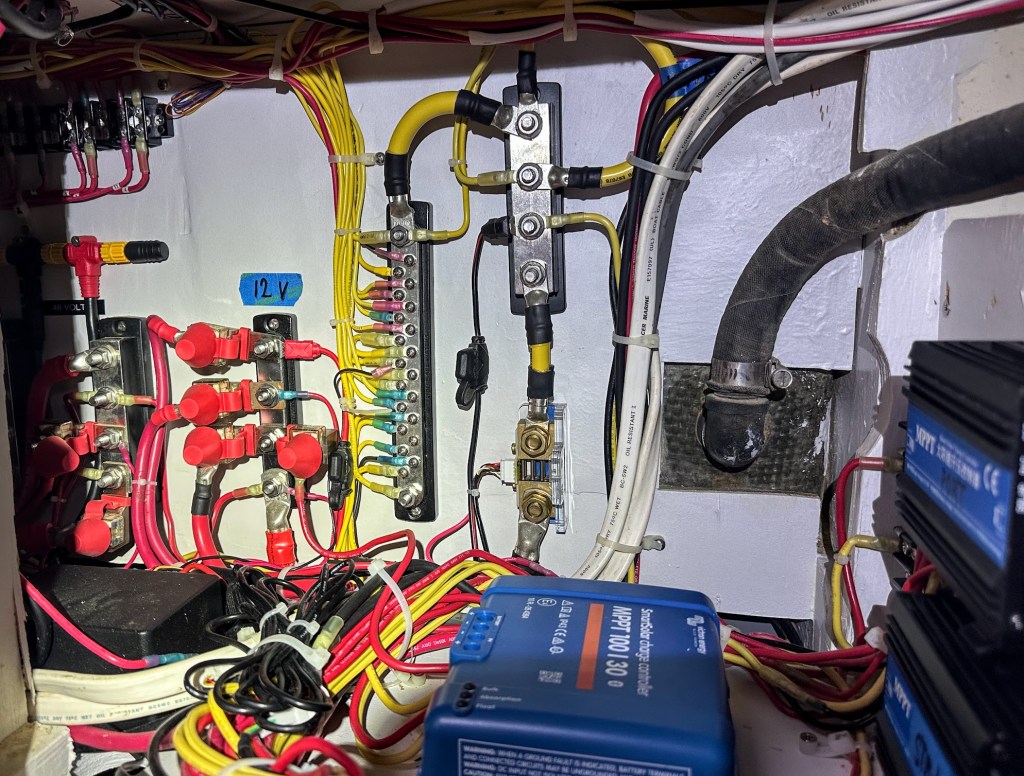
It’s been an interesting and busy period in my life with SV Swan. Since October 24 of last year, when I arrived back at St. Simons Island, Georgia after completing my return voyage from Port Washington on Long Island Sound, Swan has alternately been at anchor, in a slip, or in the boatyard. It’s now been three months with no significant sailing outings other than motoring her the eighteen nautical miles up the narrow, winding ICW to Two-Way Boatyard in November and then back again in December. It’s been one of those extended periods between offshore passages, really without any sailing at all, when Swan and I have stayed put, and the focus has been on boat maintenance and repairs, catching up with family and friends, and preparing for the next voyage.
James has noted to me several times that even with the most active sailors, voyaging sailboats end up spending most of their time at anchor or tied up, rather than out at sea. And this is exactly one of those periods. In the end, Swan and I will spend about six months this time holed up at St. Simons Island, assuming I stick to my current plan and set sail again at the start of May. So, I’m three months in and have three months to go. And, as James noted, this kind of layover is not an anomaly but rather is part and parcel of life as a liveaboard voyager. Learning to handle, and enjoy, these periods is as much a part of this life as making dramatic offshore passages to distant harbors.
So, here I am. It’s 5:45 am. I woke up at around 4:00 and have been putzing around, making a nice pot of hot tea, and warming up my engine – not the boat engine, but my own engine – for the day ahead. I went for a leisurely five-mile run yesterday afternoon, tracing my usual route from Frederica Yacht Club, along the bike path to the intersection by the lighthouse, and then back. After a nice workout, I generally sleep well, as I did last night, but I often also wake up poison early for some reason, and I followed that pattern again today. I’m doing my best to stick to a regular workout regimen, consisting of a three-day cycle with a five-mile run on day one, a strength workout on day two, and a rest day on day three. The cycle often gets broken due to weather or other reasons, but overall, I’m not far off track.
James came out to the boat at around 11:00 am yesterday to help out with a number of projects. Most important was the genoa. The day before yesterday, we’d repaired a serious chafe point on the luff of the genoa, running a few stitches to secure some frayed threads and torn Sunbrella material and then stitching on a large Sunbrella patch to provide new protection. In was an interesting exercise, with the acres of genoa sail material spilled all over the dock next to Swan, as James and I carefully wrestling the chafed area under the needle of the sewing machine, which was perched on one of the locker boxes on the dock. While making the repairs, we discovered that the genoa halyard had a serious chafe point about 30 inches from the top shackle, which could not be ignored. So yesterday, with the genoa now hoisted again and furled around the forestay, I climbed to the top of the mast to try to determine the cause of the chafing. I discovered that the chafe was occurring inside the mast about 16 inches down from the top, and sure enough, right at that location was the bolt for the upper shrouds that ran from port to starboard straight through the mast. It was clear that the genoa halyard was running on the wrong side of this bolt inside the mast, causing it to chafe at that point. The good news was that we quickly identified the problem, and we also came up with a game plan to fix it, requiring that we take out the halyard completely, remove the chafe point, and carefully rerun the halyard, this time on the correct side of the bolt. We also determined that I could get by using a halyard knot to tie the halyard to the top shackle instead of splicing it, which would have been much more time-consuming. Once I descended from the top of the mast and was back on deck, James and I tied off the knot, and now I just need to put in a few stitches to keep it secure. Tomorrow, James will come back out to the boat, and I’ll go back up the mast to rerun the halyard correctly this time.
Other projects I’m working on include: designing and making a new bimini; wiring a new auxiliary bilge pump to use with a 12V socket in an emergency; preparing a spare tiller; adjusting the attachment point for the removable staysail stay; repairing a chafe point on the dodger; reattaching the rub rail on the dinghy; repairing a latch on the cabin floorboard over the water tanks; repairing gaskets on the cockpit locker covers that I had to cut out when installing new nuts and bolts for the hinges; setting up a sheet-to-tiller system; and sanding the deck teak and then applying Cetol finish. I also hope to make some progress repainting the deck in the areas where there is no Kiwigrip non-skid paint. These are all moving ahead, and I think I’ll be able to wrap them up in the next month or so. This follows some extensive work at the end of last year in the boatyard. James and I fixed a leaking rudder shaft by replacing the stuffing box and hose and positioning the hose several inches higher to move it above the water line. I also had the bottom painted, and biting the bullet, I also had the topsides painted, which was desperately needed. With the new topside paint, Swan is looking beautiful, and she’ll be glowing once the teak is done.
It’s a very serious voyage coming up, so I’m also taking the preparation particularly seriously. It’s not that I was casual about it for my prior voyages, but this is a level up, for sure, so I’m stepping up the prep as well. It boils down to a rather simple picture: I need to prepare the boat, myself, and the route, and then complete another bucket of logistical tasks, like securing health insurance and boat insurance. Most of the last week, I was cooped up on the boat enduring an unusual period of freezing weather here in Georgia, and I took advantage of that time to focus on some of the tasks I could plow through just with computer and phone. These included: identifying a health care provider and policy; securing a quote for a boat insurance policy, and making progress on a second quote; identifying a weather forecasting and routing service to back up James and John; confirming the Garmin marine weather forecasting function available through Inreach; finding a marine telemedicine service that can support me enroute using the Inreach; signing up for an online marine medical training course; signing up with a performance coach and counselor; confirming search and rescue service and insurance; investigating Starlink as a satellite communications option and also the option of sticking with my Inreach and supplementing it with a spare Inreach device for redundancy. I also placed orders online for various supplies, including a cruising guide for the Atlantic circle voyage, and made progress in confirming the entry and immigration requirements for the countries I plan to visit.
I am making progress, but it’s been rather intense. Even though I’m not sailing, I’m pressing hard every day to keep moving through my long task list, which I maintain and track carefully every day on a ridiculously detailed Excel spreadsheet. The work cut out for the next three months is clear, and I know that if I can complete the preparations that I’ve laid out for myself, I can be very confident when I cast off. That is my goal, and recognizing that time can quickly slip away, I am keeping at it every day.
The trick is not to be consumed by my project manager mentality from my prior life and end up sucking all the enjoyment out of everything. Like a good captain, a good project manager must insist on always seeing the glass as half empty. There is no room for complacency, and the requirement, really, is for an almost aggressive ongoing attack on any assumptions that all is going well. This makes for good project management, because oversights and gaps and mistakes tend to be caught more frequently, and it tends to ensure greater thoroughness and quality in execution and outcomes. However, the challenge is to keep it all at arm’s length to avoid being consumed by stress in the process. In my current situation, that is my key focus. I’m trying to click through the things that need to get done while still enjoying it and not boiling the entire thing down to task-oriented drudgery and deadline-driven stress that can swallow up project managers, and that I experienced first-hand in my prior corporate life. Enough of that! There has to be a better way, and I’m doing my best to find it.
30 October 2024 – A Successful Voyage but Lingering Questions about the Physical and Mental Demands
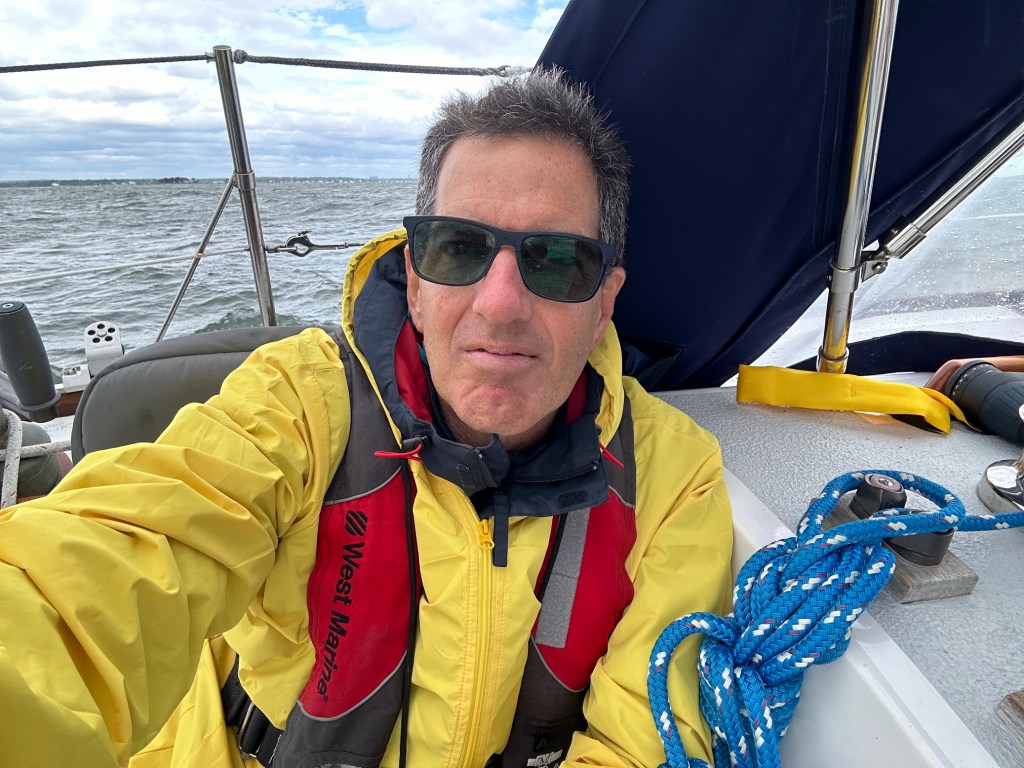
At this moment, I’m relaxing on my berth on Swan, tucked into the little anchorage just off Frederica Yacht Club by St. Simons Island, Georgia. It’s a calm and beautiful morning, and I’m continuing to rest and recover in my familiar home port after a demanding one-month journey from Long Island Sound. Conditions required breaking it into multiple legs, largely due to dicey weather offshore that forced me to duck into different ports along the way or divert into the IntraCoastal Waterway (ICW).
The first leg consisted of a series of day sails in the range of about 30 nautical miles to move from Port Washington, my starting point deep in Long Island Sound, out to a point closer to the entrance to the Sound where I could start the voyage into the Atlantic. I ended up making overnight stops at anchorages in Northport Harbor, Port Jefferson, Duck Island, and then Long Beach out at the end of the north fork of Long Island near Orient Point. Each hop was a day sail because as a solo sailor it would not have been possible to sleep at night underway in Long Island Sound, and there was no point in beating myself up pulling all-nighters just to sail after dark.
Once at Long Beach, the next leg was a direct shot into the Atlantic around Montauk Point and then down to Cape May, New Jersey. I would have preferred to continue sailing all the way to St. Simons Island in Georgia, but threatening weather forced me to stop. Due to a quick improvement in the forecast I was able to continue on from Cape May after staying only one night. From there, I was hoping to make it all the way down to Georgia offshore without stopping again, but once again weather forced me ashore, this time to Norfolk, Virginia, where I anchored in Willoughby Bay next to the huge US naval base. After several days there waiting for a weather window to continue offshore around Cape Hatteras, and with no sign of improved conditions in the week ahead, I decided to divert inland and head to Beaufort, North Carolina via the IntraCoastal Waterway (ICW).
The ICW is a continuous waterway down the US East Coast consisting of a patchwork of rivers, creeks, canals and bays, and punctuated throughout with drawbridges, lift bridges, swing bridges and every other kind of bridge you could imagine, and even a lock. At points, it requires transiting miles of narrow, shallow creeks and canals, and waiting for bridges to open, so generally it’s necessary to motor through. In my case, it took me eight days, including six underway and two at anchor waiting for unfavorable winds to pass. On one of those days underway, I was blessed with perfect conditions and was able to sail the full forty nautical miles from Belhaven to Oriental, North Carolina, including threading my way through tight canals and slipping quietly under bridges. Once through the ICW, I anchored just off Sugar Loaf Island by Morehead City and again ended up waiting a few days for a weather window to make the final offshore jump to St. Simons Island. I finally arrived at my destination some thirty-one days after casting off in Manhasset Bay, New York.
The trip went well overall to the extent that there were no major mishaps or crises along the way, and I was able to deal with a wide range of sailing conditions and challenges. The big take-away for me this time is summed up in two words: strength and stamina. There were times I felt I was being pushed to my limit, and I started to wonder about my durability for longer and even more challenging voyages. On the upside, I feel better about the boat than ever, in terms of her seaworthiness. I also feel more and more comfortable managing the boat in terms of my sailing skills. Tacking, jibing, reefing, furling, anchoring, docking, and all the other tasks are becoming routine, as they should be. However, as I mentioned, the kicker this time was that I felt stretched thin in terms of my physical durability. This was particularly true on the last leg from Beaufort, North Carolina to St. Simons Island, Georgia. I left at 7:00 am with the first morning light on Monday, October 21 and dropped anchor just off Frederica Yacht Club by St. Simons Island at 7:00 pm with the last remnants of fading daylight on Thursday, October 24. So, in total, I was underway for some eighty-four hours.
That in itself was no problem. However, the conditions were challenging. By afternoon of day one, winds were up to 20 knots and seas had built up significantly. I was sailing deep downwind with the seas coming from behind. Huge swells would loom up off the stern, and the boat would surf down the watery slope into the trough. My speed was changing in seconds between 7.5 knots and 4 knots depending on where I was in that constantly repeating cycle. In addition to the forward-aft motion, there was intense motion starboard to port as the boat rocked and then steadied herself on the backs of the swells. The combination of all of this was hours and hours and hours of intense motion – like being on a carnival ride. The angle of the boat was constantly shifting with the swells, and thrown into the mix were unpredictable jolts and jerks due to waves smacking the hull from different directions. A major focus of my attention was just making sure my body was always secure and I could not be thrown or injured.
Sleeping was another matter altogether. Next to my berth, I have a lee clothe that runs the full length and prevents me from being thrown onto the cabin sole. That’s all fine and good, but once in the berth, I was still bouncing around considerably, and I found I needed to lie on my back with my legs and arms braced against the mattress so I would not continuously get rolled around by the incessant motion. And layered onto this motion was the deafening mix of sounds, including the rushing water and the loud bangs of waves against the hull, wind and gusts through the rigging, sheets and lines smacking the deck or mast, the headsail snapping in the wind, and seemingly every item below deck shifting and sliding and bouncing around in the storage lockers. It was like handing out noise makers to a kindergarten class and letting them have at it.
The first night, in addition to the intense motion and sound, the boat was tending to stray slowly off course once I set the self-steering, and this resulted in the off-course alarm going off every couple hours or so, which also kept me awake. Each time, I’d have to check the situation and then climb into the cockpit with my headlamp and reset the wind vane to make the course correction. I tend not to sleep well on my first night out on an offshore passage, but the upshot of all of this was that I barely slept at all that first night. This really set me back, and I ended up trying to catch up on my sleep during the daylight hours the next day. Meanwhile, the overall conditions were not yet improved, so it was a challenge.
On the last night, I realized at 1:00 am that I would have to make a major change in the sail plan. The good news was that the intense winds were finally easing. However, this meant that I needed to shake out the reef in the mainsail, drop and stow the staysail and staysail stay, and deploy the genoa. I was exhausted at that moment and just wanted to go below and sleep, but with the easing winds, I was only making 2.5 knots with the double-reefed mainsail and staysail, so I knew I needed to make the change. I went ahead with it and managed it in the dark just fine, but it was another example of feeling pushed to my physical limits.
It goes with the territory as an offshore sailor that things can get tough, and this is particularly true as a solo offshore sailor. However, I remember thinking that I’d just turned sixty and that those physical reserves I had in my twenties, or thirties, or fourties, or even fifties, seemed like a distant memory, and the lingering question for me was whether I still have what it takes to do this in a more serious way. So far, I’ve been able to manage everything that’s been thrown at me, but I’m still just getting started, and there’s much more out there I haven’t experienced yet. The next voyage I have planned is an Atlantic circuit. I still have several months before departure, and I need to make sure before then that I feel up to it.
Maybe if I wait a little bit longer, I’ll get younger and stronger. We’ll see.
28 August 2024 – An Emotional Dry Spell… And Looking for Inspiration
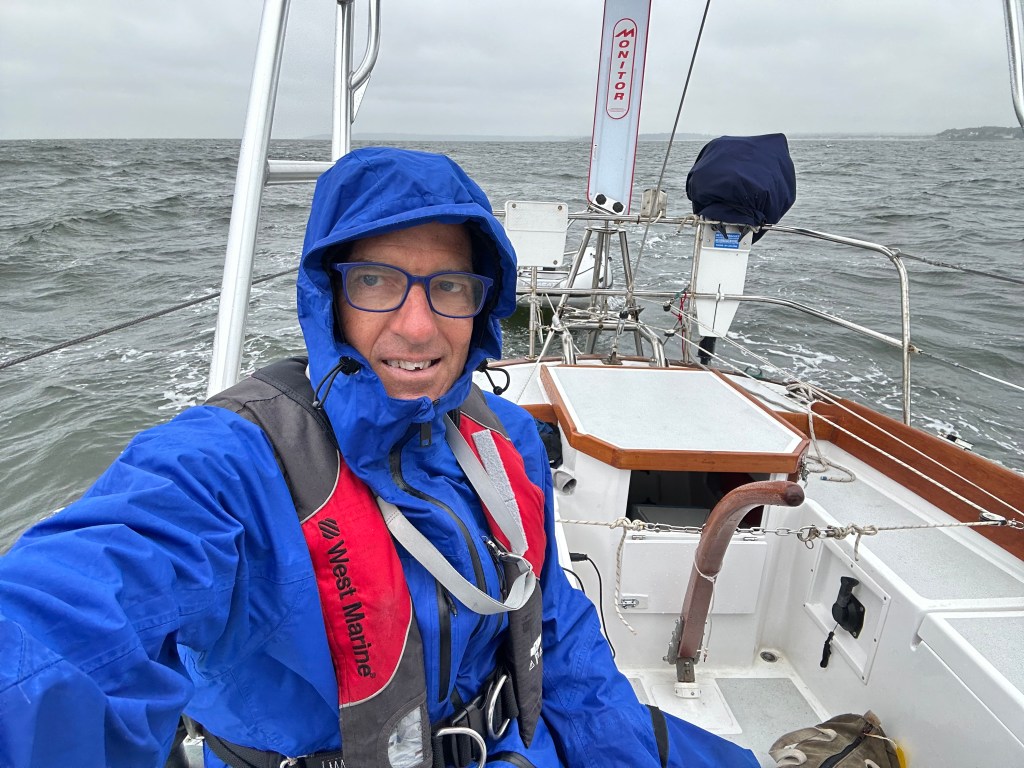
At this moment, I’m settled into an Amtrak window seat on my way from Penn Station, New York to Union Station in Washington, DC. It’s somewhat nostalgic since it’s the same trip I made every week during the first six months of 2013 when I relocated to New York from Japan with Itochu, my employer at the time. Kyoko and Kai, my wife and son, were still living in the rented townhouse at Coral Grove Terrace in Gaithersburg, Maryland so Kai could finish the last semester of his senior year at Poolesville High School. During the interim when we were still separated, and before Kyo and Kai finally joined me in New York in June, I travelled every weekend from New York to Maryland so I could be with them. Soon, I was following a regular routine of leaving the company on Friday afternoons and walking the twenty-five minutes or so from the headquarters building at 355 Madison Avenue, next to Grand Central Station, to Penn Station where the southbound Amtrak trains departed, and from there hopping the next train to Union Station in Washington. From Union Station, I’d switch to the Metro Red Line north and ride to Shady Grove, the end of the line, where Kyo would pick me up. Then, on Sunday afternoons, I’d reverse the process so I could be back at my tiny studio apartment on West 50th & 8th Avenue by a reasonable hour to resume work the next morning.
So, here I am, making the same trip south some eleven years later. However, much has changed since then. Kyo is no longer here in body but is with me always in spirit. Kai is now five years out of college and working in Manhattan. And for my part, I have been living on Swan for almost one year now, and this morning, I left her at anchor in Manhassat Bay near Port Washington on Long Island.
I arrived at Port Washington on my birthday, August 7th, so I’ve been anchored there now exactly three weeks. For some reason, the time I’ve spent in Long Island Sound this summer, beginning July 19th when I first arrived from St. Simons Island, Georgia, has been challenging, including this most recent stretch at Port Washington. Part of it at the start was the tricky weather and sailing conditions I encountered in the Sound and the patience required to sail one leg at a time from the Montauk area, on the far end of Long Island, to Manhassat Bay, at times necessitating days at anchor waiting for decent weather. The sailing itself kept me constantly on my toes, with thick fog, doldrums, heavy gusts, shifty and finicky winds, tacking in tight quarters, and strong tidal currents. At one point, the mix of wind and current conditions led me to run down my electric motor battery and forced me to use the gas-powered generator for the first time to charge the batteries and run the motor simultaneously. Overall, I was tested in some new ways, which only further developed my confidence and sailing skills, so while it was taxing at times, I shouldn’t complain. It did confirm my motto, “Nothing is easy,” and the corollary, “Eternally humble.”
Once at Port Washington, a different kind of challenge emerged. Now I was safely settled into a protected anchorage with no plans or need to move again anytime soon. I’d been looking forward to this as a kind of break from the month-long adrenaline rush that started when I cast off from St. Simons Island on July 5th. However, quite suddenly I was flipping a switch and trying to transition from the solo sailor underway at sea to the live-aboard nestled into a comfortable port. The overall sensation was like the air coming out of a balloon. I did enjoy my trips ashore, exploring the town, spending time in the beautiful public library, and stopping in the Mediterranean deli. However, the loss of structure and urgency sapped my energy and enthusiasm to do anything more than drift randomly and slowly through each day. I found it difficult to find any motivation, especially when it came to working on the boat or planning for the next passage. I’d hit a low in my daily level of interest and engagement.
Fortunately, I was able to recognize this change in my state of mind, and I started to tune in to it to understand what was going on. After a couple more weeks of mentally bobbing along like a cork, I realized it was linked to my sense of inspiration. I’ve known for a while now that inspiration is the key that can transform my attitude and outlook from a state of bland disconnectedness to one of energy and motivation.
I’m an avid soccer fan, and I’ve heard commentators from the Premier League describe underdogs as “playing with their tails up” after they score. I love this expression. It describes the phenomenon when the players immediately show a new spring in their step that completely alters the match and sometimes propels them to victory. Of course, it’s all in the mind, and it boils down to confidence and belief. I’ve seen matches like this, and it’s a simple but striking example of human psychology at work. It’s the power of inspiration in the raw.
In my own case, I generally feel comfortable that I can meet the different challenging situations my new sailing life can present, in terms of the basic physical and mental toolkit required. There’s nothing particularly special about this, as many other sailors meet these same challenges every day. It’s just about having some core level of confidence. Beyond that, the critical variable in my case is inspiration. Feeling inspired I’m convinced improves everything – my focus, my energy, my attitude. I can do more, do it better, and enjoy it all much more in the process. Lacking inspiration slows me down and turns everything into a chore, which can undermine the quality of everything I do. Without inspiration, it’s like running through mud.
The good news is that I’ve recognized this again and am zeroing in on ways to nurture my sense of inspiration. My daughter, Leah, calls it “inspiration gardening.” It’s odd, but being aware and intentionally focused on how to foster that feeling of inspiration can really help. It’s so much better than just ignoring it if you’re in a slump.
Flying ace Porco Rosso had it right. At one point, Fio, the young aeronautical engineer designing his new plane asked him, “Tell me, what’s the most important requirement to be a good pilot? Is it experience?”
Porco’s reply: “No, no. It’s inspiration.”
So, with that pearl of wisdom, I’m doing my best to live life with my tail up.
9 August 2024 – A Long Day at Anchor in Port Washington with 50 Knot Gusts and a Dragging Anchor
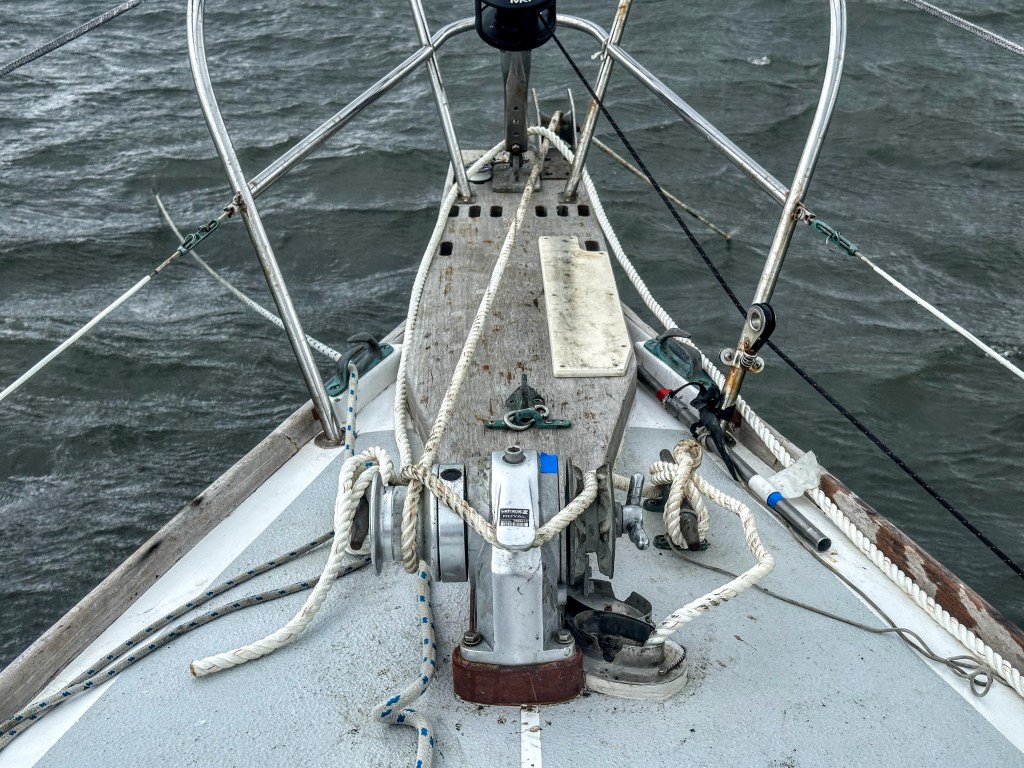
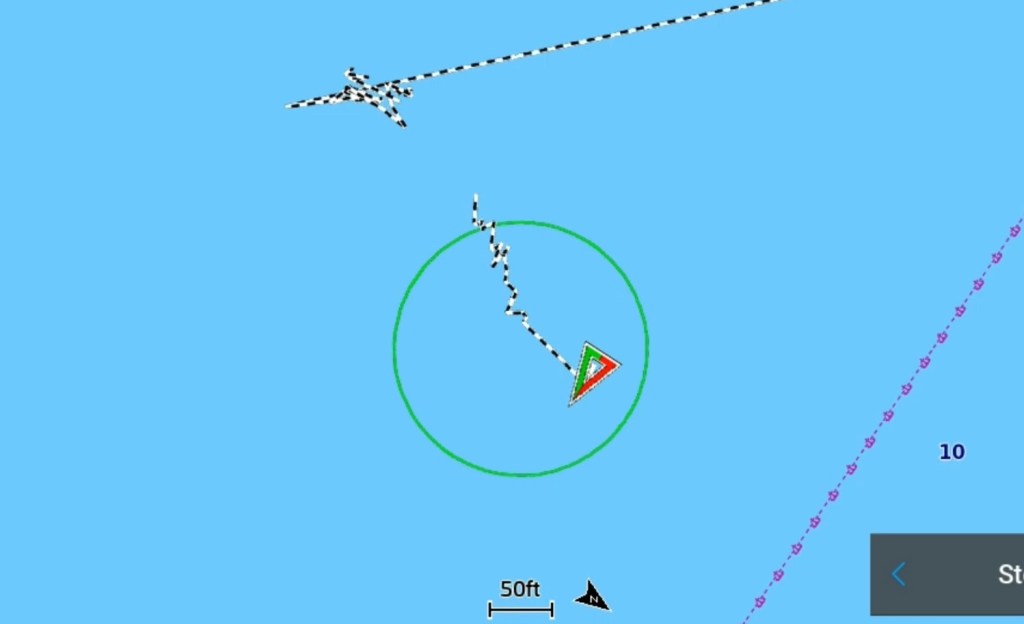
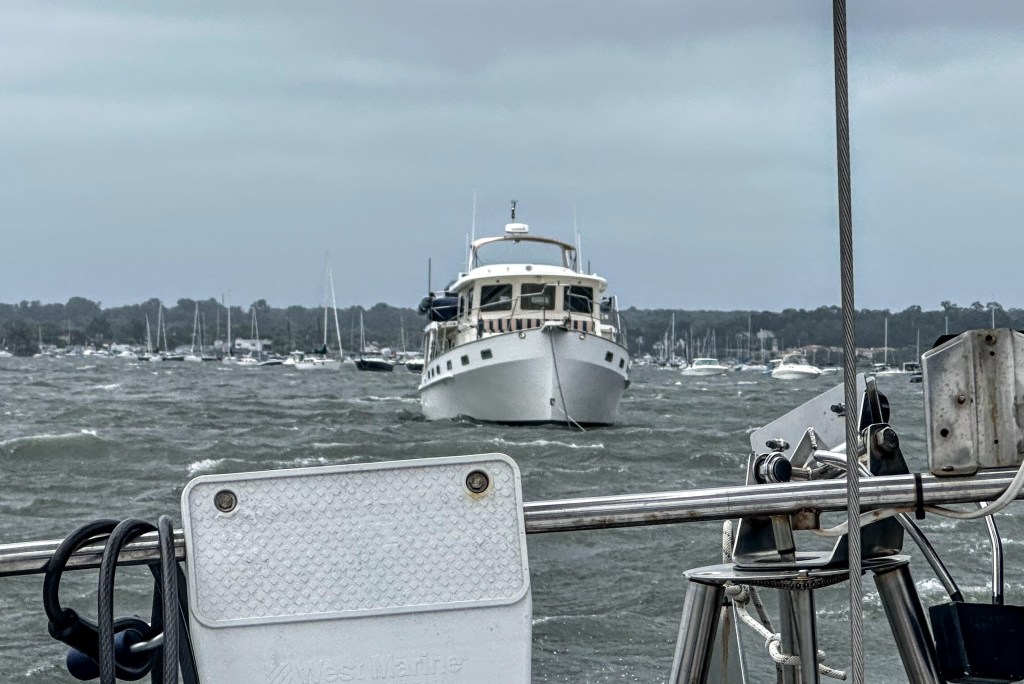
I’m tucked in at anchor in the far southeast corner of Manhasset Bay near Port Washington where I’ve been the past two nights. I spent more than a week at Oyster Bay waiting for decent weather to make the final relatively short sail of about twenty nautical miles to Port Washington, and even up to a few days ago the outlook was not good. Up until Tuesday, the forecasts were pointing to Thursday as the best and only option for a while, and even Thursday was not looking ideal, given the forecast for rain most of the day.
Forecasts had been calling for thunderstorms throughout the day on Wednesday, so I had nixed that as an option, but when I checked again on Tuesday afternoon, all the forecasts had changed and were now calling for rain with steady winds and gusts building in the afternoon, but no thunderstorms. The wind also was forecast to shift to the northeast, which was ideal, as I would have the wind behind me and could sail a straight course to Port Washington without tacking. So, last Tuesday afternoon I changed plans and decided to go for it on Wednesday. To avoid the strong gusts expected Wednesday afternoon, I opted for an early start and raised anchor at 6:30 am.
Sailing into Oyster Bay the week before had been tricky. The wind was on my nose, and the route into the anchorage was long and rather involved, including turning into a second inlet, dodging fleets of small sailboats out in the harbor, and piloting a narrow channel between two large mooring fields filled with boats. It was also tremendously gusty, which was another challenge. I finally managed to reach my anchor spot with a combination of close quarter tacking, sailing with furled genoa alone, and punching through the oncoming wind and current with only the motor, when needed. On the way out, things were easier. After an initial one-mile stretch with the wind on my nose, requiring use of the motor, I was able to put up the sails and make my way out into Long Island Sound with only a couple tacks. Once I rounded the last buoy, I was able to point downwind, and from there I sailed for the next few hours on the same deep broad reach.
One challenge was the sail plan. I was bracing myself for strong winds and gusts building as the day went on, and it was already very breezy, so the question was whether to go directly to the staysail or go with the genoa. In the end, I opted to stick with the genoa, even though I generally don’t like to sail with it partially furled because it puts heavy load on the furler. However, I wanted the flexibility to be able to furl and unfurl quickly in tight quarters, and I also knew I would be sailing downwind most of the day, which would help take off some of the load. In a pinch, knew I could either furl the genoa down to a handkerchief, if I really wanted to ease the load, or I could switch enroute to the staysail. So, I went with the genoa to start, which turned out to be a good choice.
Next, the mainsail, and here I decided a second reef would be about right, and that’s how I started. I set it up on the boom with the reefing lines before I raised anchor, and when I raised the sail, I clipped in the reefing tack ring for the second reef when the sail was raised that far. It was straightforward, but very quickly I felt the gusts building, and I decided early on to switch to a third reef, which I did soon after I exited the harbor into Long Island Sound. I ended up sailing with the third reef in the main and the genoa furled to about thirty percent for the rest of the way, and even with that conservative set-up, I clipped along at a decent speed. The day was chilly, overcast and drizzly, with patches of fog, so I sailed the whole way with my foul weather gear on.
As I neared Manhasset Bay, I was able to make out the silhouette of the New Rochelle skyline through the fog, and soon I was also able to pick out Execution Rocks coming up ahead. I ended up skirting the Rocks on the south side on a dead run and soon after was at the opening to Manhasset Bay. By that time, the fog had thickened, and I piloted through the thick grey blanket until I dropped anchor. The final approach was a beam reach, and I glided effortlessly the last two miles to my anchor site.
Yesterday, it was overcast and drizzling at times, but I decided to go ahead and make a trip ashore. I navigated slowly along the shore in the dinghy, passing the yacht clubs on my right and the mooring fields to my left, and found the public dinghy dock about a mile from Swan. I first walked about a half mile up to the public library, which is spectacular. I suspect I’ll spend some more time there. I walked through all floors but then decided to head over to a deli to get something to eat instead of setting my computer to work in the library. I found a nice Mediterranean deli nearby and had a late omelet breakfast, which was a treat. From there, I planned to make the long walk across the harbor to the Long Island Science Museum, but along the way I aborted and decided to go back and relax on Swan.
Today has been something altogether different. Remnants of Hurricane Debby led to forecasts of 20-plus knot sustained winds with fifty-plus knot gusts throughout the day. I woke up early and confirmed the forecasts had not changed, had a quick breakfast, and then headed on deck to deploy a second anchor. Fortunately, the winds were forecast to come from the south, as they already were, and that worked to my advantage. I was close to the shore on the upwind side, which would provide protection from the wind and reduce the fetch, and I had lots of open space and no obstacles nearby on the downwind side, which meant it would not be a problem if my anchor dragged a bit. I was able to deploy the second anchor with the dinghy relatively quickly and without incident, and both anchors were oriented well and seemed to be holding nicely. I wrapped a line around the furled genoa and rolled up the windshield on the dodger for good measure, and at that point I felt that I was set and well positioned to ride out the heavy winds.
I settled in below deck and sent an email to James, followed by a call with him, to discuss a stiff windlass, leaky rudder shaft, and considerations for when I leave the boat at anchor for extended periods. The day was off to a good start, but then I poked my head out of the companionway hatch and discovered that a large motorboat had anchored right behind me. I was frustrated on three counts. First, there was plenty of room, but for some reason they decided to anchor relatively close to me. Secondly, they anchored directly downwind, which meant that I would drag right into them if I had any anchor issues. Thirdly, this was the one day in which 50-plus knot gusts were forecast, which raised the risks considerably.
I tried to hail them three times without luck. They did not respond. I’d been monitoring my anchor alarm and boat position on the chart plotter, and I seemed to be dragging slowly. I wanted to alert them of the situation and let them know that I was solo with two anchors out and was not situated to take quick action to avert a collision, especially in these severe conditions. After trying unsuccessfully to contact them on VHF, a sailboat anchored some distance in front of me hailed me. They overheard my unsuccessful hailing attempts and contacted me so they could understand the situation. They were helpful in providing me the name of the motorboat and offered assistance, if I needed it. I tried once more to hail the motorboat, this time directly by vessel name. However, that also was unsuccessful.
For now, the two anchors seem to be holding, as they have for the past hour or so, and I’m hoping they will continue to do so. In the meantime, I’m sitting tight, monitoring the distances and chart plotter and hoping I won’t be forced to take action to stop any further dragging. The only thing I could do is to try to haul in the second anchor from the bow and then haul in the primary anchor, also from the bow. It’s too rough to haul in the secondary anchor from the dinghy, which would be the normal routine in calmer conditions. With the anchors in, I’d have to move the boat and then try to reset the anchors. It’s now 2:00 pm, and the heavy wind and gusts are forecast to continue past 8:00 pm, so I have many hours to go. Looking again at the chart plotter, I can see I have dragged slightly, and at some point, I’m going to have to decide on next steps. Never a dull moment, it seems.
……Fast forward to 4:30 pm. Much has happened in the interim. I did start dragging again, albeit slowly, about fifty feet over the course of an hour or so. Given that the severe wind conditions were forecast to continue for many hours, this meant that I could drag a few hundred feet still, and that would put me into the motorboat behind me. So, I decided I needed to take action, but first I consulted with James by phone. He pointed out to me that I still had more rode I could play out, and that would be the next step to stop the dragging. He also noted that trying to raise anchor, move to another spot, and reset the anchor would be risky, partly due to the challenge of getting both anchors hauled in and because I could start drifting downwind quickly once the anchors dislodged. This was exactly the situation I wanted to avoid because I could wind up drifting right into the motorboat behind me. Letting out more rode, of course, would also put me closer to the motorboat, but the logic was that I would still have enough distance, and with the additional rode I would no longer drag. So that was the new plan.
To implement, I needed to let out the remainder of the chain rode on the primary anchor and then start playing out the rope attached to the end of the chain. This was something I’d never done before. I always just used the 150 feet of chain rode, which generally has been sufficient. The rope and chain were already spliced together, but I needed to free up the rope in the chain locker where it was coiled and lashed to a hook. This meant I first had to move all the stowed items in the v-berth to access the chain locker from below. That included the spinnaker, a spare stay sail, the mast-climbing equipment, life jackets, kayak gear, and lots of other gear. All of this wound up in the main salon. I finally carved a way to the chain locker door, opened it, and removed the lashing to free up the rope rode. I then headed back on deck and up to the bow to begin playing it out with the anchor.
I encountered three challenges immediately. The gusts were fifty-plus knots, so there was tremendous load on the two anchor rodes already deployed. For the primary anchor, I needed to play out the remaining chain rode in a controlled manner so the rope rode would not start feeding out too quickly once the rope emerged onto the deck through the deck chain pipe, a small aperture through the foredeck that the rode runs through from the chain locker below. This was tricky, given the amount of load. Secondly, I needed a way to cleat off the rope rode so that I could let it run out at a controlled speed and secure it once it was fully deployed. I wanted to keep all ten of my fingers intact, so I took great care in putting one wrap of the rope rode around the windlass winch wheel and running it back around the aft side of the main windlass body and forward to the starboard bow cleat. This gave me all the control I needed. The third challenge was that the rope rode was twisted and kinked down below in the chain locker, and it would not feed cleanly through the deck chain pipe. I tried to nurse it through, but it was stubborn as can be, and finally I had to push the rope back down into the chain locker, resecure the chain rode, and then go below to sort out the tangled rode. In sailors parlance, kinks in twisted lines are called hockles, and I had plenty of them to sort out before going back on deck and up to the bow.
Finally, I was able to begin playing out the rope rode slowly. After letting out about twenty-five feet, I cleated it off and then switched attention to the secondary anchor, which was now bearing most of the load. I had tied the end of the rode to another long spare line and began playing that out until I’d let out a bit more than twenty-five feet. I repeated this back and forth, and at one point went back to the cockpit to check the anchor drag radius on the chart plotter to determine how the boat position had changed. All looked good, so I went to the bow one last time and finally cleated off the primary anchor rode when the 200 foot mark on the rode appeared out of the chain locker. At a depth of about twenty feet, two hundred feet of rode equates to about an 8 to 1 scope, which was more than sufficient. I then returned to the cockpit to monitor the movement of the boat on the chart plotter. Job done.
I reset the anchor alarm radius, and once the two anchor rodes stretched to full length, the boat locked in place. There was no more dragging, which was a huge relief. As an insurance policy, I set up the third anchor in the cockpit with the rode run to the bow and ready to deploy. I also put the dinghy motor and anchor in the cockpit for quick deployment, if needed. The plan was to monitor the boat position, and in the event of any additional drag, to deploy the third anchor. As of this moment, the two deployed anchors with additional rode are holding like a charm with absolutely no sign of drag. The last forecast calls for the winds to start easing soon, so I’m hoping that my current set-up will get me through this.
It’s been a good exercise, although not expected or welcomed. I deployed the primary anchor with the extra nylon rode for the first time. I also used the primary and secondary anchors in tandem with extra rode for the first time. Deploying extra rode in challenging weather conditions specifically to stop dragging was also a first, and it worked beautifully. I’ve also never deployed the third anchor, and while I have not yet as of this moment, and likely will not this time around, it was good practice to go through the drill of hauling it out of stowage and getting it ready to go. Based on James’ guidance, I was also reminded of the risks of trying to raise and reset anchor in severe conditions, and to first put out more rode, and then put out another anchor, if needed, to stop dragging.
As I write, it does seem that the wind is starting to ease. It’s a relief, and I hope it does not build back up again. It’s turned out to be a rather long, stressful and tiring day, and I would like it to end on the current positive note.
31 July 2024 – A Challenging Approach into Oyster Bay, Long Island
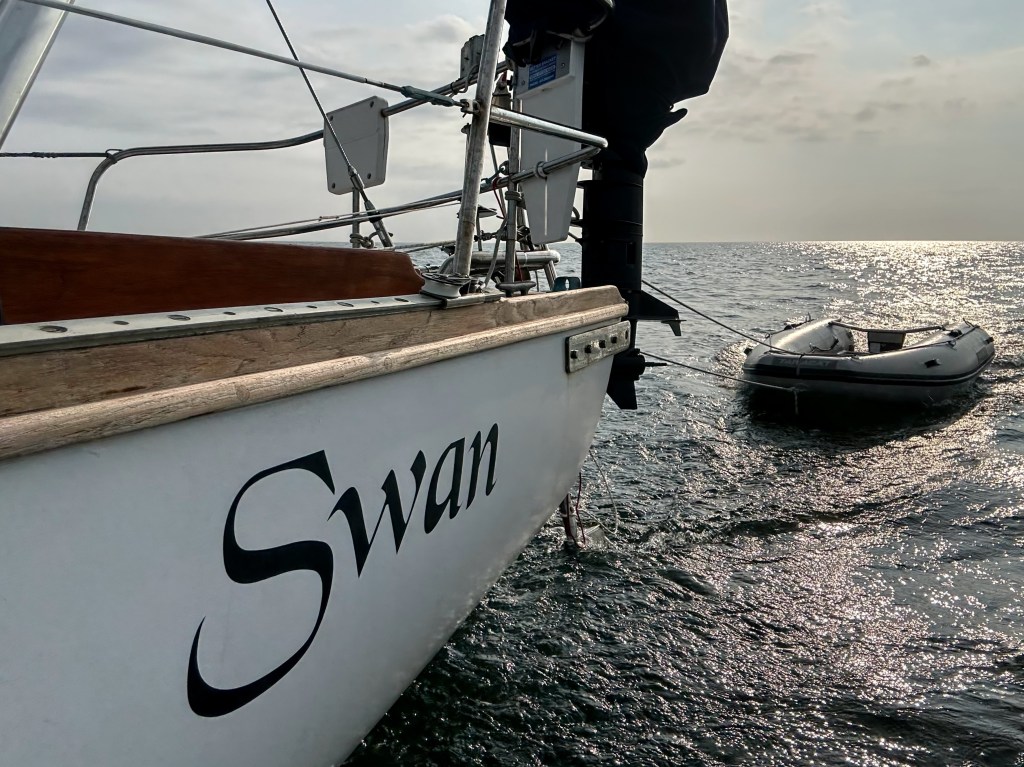
Yesterday was another full and challenging day of sailing. Windy.com forecasts called for steady winds throughout the day and building in the afternoon, along with strong gusts. I had two options for destinations, one being Northport Bay, which was about 20 nm from Port Jefferson, and the other Oyster Bay, which was another six nm or so along the north side of the Long Island coast. I was optimistic that I could easily make it to Oyster Bay but had the back-up option of ducking into Northport Bay enroute, if conditions required. I did not want to stay any longer at the dicey anchorage in Port Jefferson, especially with the strong winds and gusts forecasted, so one way or another I knew I wanted to move on to the next anchorage yesterday.
I raised anchor at 6:30 am and first relied only on the Navy 6.0 electric motor to cover the quarter mile over to the main channel. I’d considered setting up the staysail and maybe putting in a reef or two given the stiff breeze I was already feeling early in the morning. However, I opted to stick with full main and genoa and to make changes enroute, if needed. I was now sensitive to preserving the battery charge as much as possible, so I motored slowly at about two knots over to the narrow channel and then cut hard to starboard to head out through the narrow opening into Long Island Sound. As soon as I reached the last pair of buoys just out of the harbor entrance, I deployed the genoa and set my heading for the first waypoint out at the point a few miles away to my west. I saw in the distance one of the Port Jefferson-to-Bridgeport ferries steaming in my direction toward the harbor, so I quickly raised the main, built up some more speed, and made sure I was out of his way. From there, I reset the windvane to head for the waypoint and settled in for the trip.
I made decent progress, maintaining about four-plus knots, and found that the boat was not at all overpowered. Seas were mild, wind was steady, and Swan just slipped along at a comfortable pace. My chart plotter was telling me I could make it into Northport Harbor by around noon and into Oyster Bay by around 1:30, so time was not an issue, and I started thinking this could be my first outing with minimal drama. I made the easy decision early on to head for Oyster Bay and was looking forward to settling into a more comfortable anchorage. By around noon, the wind started picking up, and it was increasingly mixed with strong gusts that pushed the boat on its side and temporarily off course. The wind vane struggled with the uneven winds, and I was forced to constantly make course corrections after big gusts. Not much later, the boat was feeling overpowered, so I put in a second reef, which flattened the boat and smoothed out the ride. I was still making good speed, so it was the right trade-off.
I was on a close reach on port tack, and I needed soon to cut to port to make the turn into Cold Spring Harbor where the entrance to Oyster Bay was located. That meant I needed to tack, and to allow enough room to then make it into the harbor, I ended up sailing right past the entrance as far as I could go before making the turn. By this point, I already realized that I was going to have to make multiple tacks well into Cold Spring Harbor before making a final tack toward the separate entrance leading into Oyster Harbor. The winds were now blowing hard and gusting like crazy, and some of the gusts put the toe rails in the water. Fortunately, this was absolutely no issue for Swan, and she just shrugged it off and glided on.
Entering Cold Spring Harbor on the first tack, I needed to avoid various buoys and obstacles along the way, including a small fleet of dinghy sailboats out in the strong winds. About half of them were capsized, so I need to be careful not to run them over. In one case, as I was finally on my last tack into the entrance for Oyster Bay, one of the small dinghy sailboats crossed my bow, and the young boy aboard had his back to me and clearly did not know I was even there. I could have plowed right through him, and he would not have known until I hit him. I steered clear and passed by about thirty meters. Finally, he glanced over his should and was somewhat surprised to see a seventeen-thousand-pound thirty-six-footer sliding right by him.
Once in the Oyster Bay entrance, I found I was headed straight into the wind and needed to cover close to a mile before I hit a next waypoint where I could turn away to an easier heading. It was too tight to try to tack, which was compounded by the uneven and gusty winds, so I decided to furl the genoa and motor the rest of the way. At first, I was concerned because with the seas and wind right on my nose I was making just over a knot and chewing up a fair amount of battery charge. I was concerned I would run the battery down too quickly, but soon my speed picked up to two-plus knots, and I was able to manage the throttle to ensure I’d have enough range. It was a slow slog slipping by all the expensive looking boats on mooring balls on my left and right, but finally I made it to the waypoint and cut to starboard toward West Harbor, where I planned to anchor.
Once I made the turn, the wind and seas were on my quarter, so my speed picked up to three-plus knots, and I was able to throttle down and still maintain good speed. Sliding into West Harbor, I realized I was entering a huge round bay about one mile in diameter, and there were no other boats at anchor, just a few small motorboats moored very closely to shore. I headed farther up and anchored about halfway in on the east side. The depth was perfect – about twelve feet at low tide. By the time I dropped anchor, it was already 4:30 pm, and I’d spent about two hours just navigating and maneuvering through the multiple channels to arrive in West Harbor. It turned out to be good practice tacking into a narrow harbor in challenging wind conditions, but once again I was worn out after a very full day of sailing. The anchor rode was pulled tight due to the high winds, but the anchor did not budge.
29 July 2024 – Nighttime Anchor Drag in Port Jefferson, NY
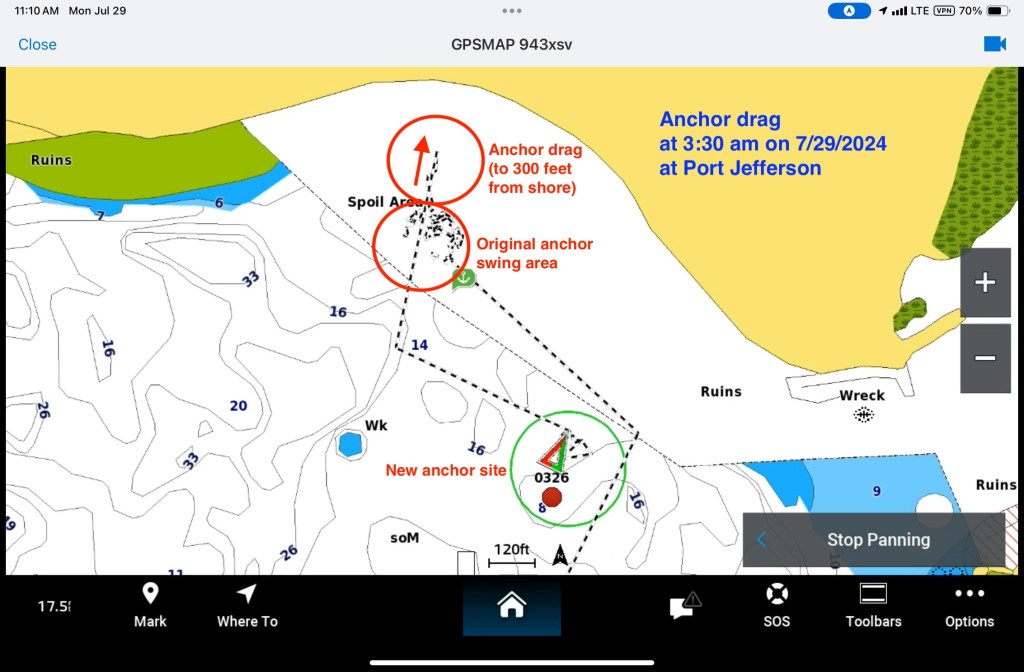
I’m now anchored off the sandy beach in the northeast corner of Port Jefferson, New York. This is my third day here after arriving Friday evening from Duck Island, Connecticut. The trip here was eventful, as all my outings seem to be. I raised anchor at 6:00 am and maneuvered away from the other boats and out from behind the breakwater using the electric motor. After deploying the genoa and shifting to sail power, I went up to the mast to raise the main sail but found that the winch would not lock properly and instead would spin counterclockwise dangerously with the winch handle, which should never happen. I struggled and hauled and somehow managed to raise the sail, but it was a challenge. It also added one more priority item to my long maintenance and repair list. Once out of the harbor, I immediately encountered light winds while heading into a strong tidal current. For the first two hours, the current won, and I ended up being set several miles in exactly the wrong direction I wanted to go. I almost aborted, and at one point was not confident I could even make the 12 nautical miles up the coast to the next anchorage at Joshua Cove.
However, the wind filled in nicely at around 9:00 am, and I found I was able to hold a course directly to Port Jefferson, albeit very close to the wind, and I decided to go for it. I made decent progress throughout the day, but the winds were finicky. They would pick up nicely, then fall off again, and then pick up again, and then later in the day they shifted direction, so I wasn’t able to hold a direct line to Port Jefferson any longer. This forced me to make a few large zig-zag tacks starting in mid-afternoon, and when I finally was within striking distance, the wind died off. It was now about 5:30 pm, so I made the call to motor the remaining three miles to the port entrance and arrived at about 6:30. The anchor spot I’d identified from my research ended up not being viable because the water was too deep, so I crossed back across the channel to the northeast corner near a long sandy beach where I saw two other boats anchored alone. I finally dropped anchor at 7:30 after more than thirteen hours of sailing.
It turned out to be a great spot, at least until last night, when my anchor dragged, and the boat started moving in the darkness in a straight line toward the shore. Port Jefferson is about one mile by one mile, and my anchor spot is far from the town and any structures on shore. In that sense, it’s been comparatively quiet and off the beaten path, except on Saturday, when local boaters came out in droves, mostly on motorboats and jet skis. The place was packed and buzzing for the whole day but quieted down again on Sunday. I was wiped out from the long sail on Friday so spent Saturday on the boat just resting and recovering. On Sunday, I lubed and repaired the mainsail winch and then took the dinghy to Port Jefferson. I tied up the dinghy next to the ferry terminal at a floating dock belonging to Port Jefferson Harbor Marina and then headed off on a thirty-minute bike ride to West Marine, where I bought some 5200 caulk to repair the dinghy rub rail. I also purchased two 25-foot dock lines that should work to tie up at a mooring ball, if needed in the future. For lunch, I ducked into a pizzeria next to West Marine and had two slices of veggie pizza before making the ride back toward the harbor. I was towing my blue folding wagon behind the Brompton but as usual had no issues. On the way, I stopped at Village Groceries and stocked up on some missing items. I was back to Swan by 3:30 and had everything stowed and the dinghy repaired, or at least one section, by 4:30.
I went to sleep last night at a reasonable hour and planned to make another trip into Port Jefferson today. However, at 3:30 am, the anchor alarm went off, and I discovered that the wind had picked up significantly, and I was dragging directly toward shore. I did not have that much distance to the beach, but there was still enough room to monitor the situation for a while longer. I knew I needed to change my anchor location but preferred to do it in the daylight, so I was hoping to buy another couple hours before started the whole operation. I changed the size of the anchor drag diameter on the chart plotter and watched to see if the anchor would catch and hold. It seemed to one point, after dragging directly toward shore, but then the dragging began again, and the boat slipped outside of the alarm range once again.
At this point, it was 4:15 in the morning, and I knew I needed to take action immediately. The motor was already lowered in the water, the Pelagic autopilot was set up and ready to go, and I was now in my foul-weather gear because of the rain that had been pelting down. I turned on my headlamp, tested the motor with a quick pulse of throttle, and headed to the foredeck in the dark to start hauling up the anchor. A white anchor light at the top of the mast identified the one other boat now in the anchorage, a large catamaran about 75 meters away. To raise the anchor, the first step was to disengage the snubber hook from the chain rode and set the snubber line aside temporarily. I then uncapped the deck chain pipe, the small portal through which the chain rode passed from the chain locker below deck up to the foredeck and to the anchor. With my beat-up sailing gloves on for protection, I planted each foot on the opposite side of the anchor windlass, grabbed the chain anchor rode with both hands, and gave a strong pull.
It was clear immediately that there was a heavy load on the anchor rode due to the wind and sea conditions and that it was going to be a tough job to haul in the anchor. I gave several more pulls and then went back to the cockpit and gave the motor a small amount of forward throttle. This would take off some of the load, but it would also cause the boat to yaw back and forth, so it was something of a trade-off. Somehow in the dark and drizzle, I managed to haul in the first one hundred feet of chain but still had fifty to go. The going was getting tougher, and the trick was that the boat would immediately start drifting toward shore once the anchor was dislodged. This meant that I could not dawdle with the remaining rode. I needed to haul it in as fast as possible. The load had increased, so I switched from hauling by hand to cranking the windlass, which was slower but steadier progress. However, for these last fifty feet, I had to crank as fast as I possibly could, and sure enough the boat started drifting when there was still about thirty feet left. I could tell because Swan was sliding behind the catamaran and heading closer to shore.
Finally, the anchor broke through the surface of the water, and I was able to crank it onto the bow pulpit. I then quickly moved back to the cockpit, gave the motor more throttle, turned hard, and started to slip away from the shore. I had studied the chart plotter carefully before starting and had located a next best site to head for. It was still in the same general location but farther from shore and in shallower water, which would make for better holding. I slipped quietly through the darkness over to the new location, confirmed with the depth sounder a healthy depth of seventeen feet, put the motor in neutral, then walked to the foredeck and dropped the anchor. At twenty-five feet of rode, I locked the windlass and let the boat slide back so the anchor would grab. I then let out another fifteen feet and then walked back to the cockpit and reset the anchor alarm to the new location. Then, it was back to the foredeck where I let out a total of one hundred-and-fifty feet of chain and then reset the anchor snubber line.
I was now safely away from shore and in a much better location. The chart plotter confirmed that I was not straying at all from the anchor alarm zone. For now, the anchor was holding, and the small crisis in the darkness of night had passed. However, I was not feeling well. After being dead asleep, and with no warm-up, I’d been forced to haul in the anchor quickly in seas that placed a heavy load on the rode. It was intense unexpected exertion, and it made me feel ill afterward. From about 5:00 am, I slept another three hours until 8:00 or so and felt a bit better. I’m still a bit out of sorts and have decided not to venture ashore again today. Instead, I’ll rest and prepare for a sail tomorrow to Oyster Bay.
One piece of the story not yet mentioned is my consideration at about 8:30 this morning of the possibility of leaving today for Oyster Bay. The reason was that the forecast was calling for reasonably strong winds tonight blowing straight into the beach again, and I did not want to repeat last night’s anchor drama in the darkness. In addition, the fact that I’d already dragged was not encouraging in terms of the holding here. Yes, I’d found a better location, but I was still not that far from shore, and the same scenario could repeat itself. Unfortunately, despite the size of Port Jefferson, the anchoring options are surprisingly limited. A key reason is that most of the bay is deep, exceeding twenty-five feet or so. The original anchor location I’d identified turned out not to be viable because the water was not shallow enough for good holding. In fact, that was probably a contributing factor to why I dragged last night. The water was around twenty feet at low tide, which is not ideal if the weather kicks up. It’s much better to be in water that’s closer to ten feet at low tide, which significantly increases the holding power of the anchor and rode. For these reasons, I thought it might be a good idea to cast off for Oyster Bay right away and avoid the anchoring challenges here. I did spend the next thirty minutes cleaning up and prepping the boat, but when I checked the forecast again, conditions had changed. Most importantly, the forecast for today and tonight was now much milder. Also, the sailing conditions for today were not promising, and so I decided to stick it out here another night and sail to Oyster Bay tomorrow. The forecast calls for good wind, so it should be a good sail without any complications.
Today, I’m going to take care of myself, pace myself, and prep the boat at my leisure for the sail tomorrow. I need to remind myself that I’m not on anyone else’s schedule anymore.
19 April 2024 – Completing the Circuit from the Abacos to Eleuthera to the Exumas to Cat Island and back to St. Simon’s
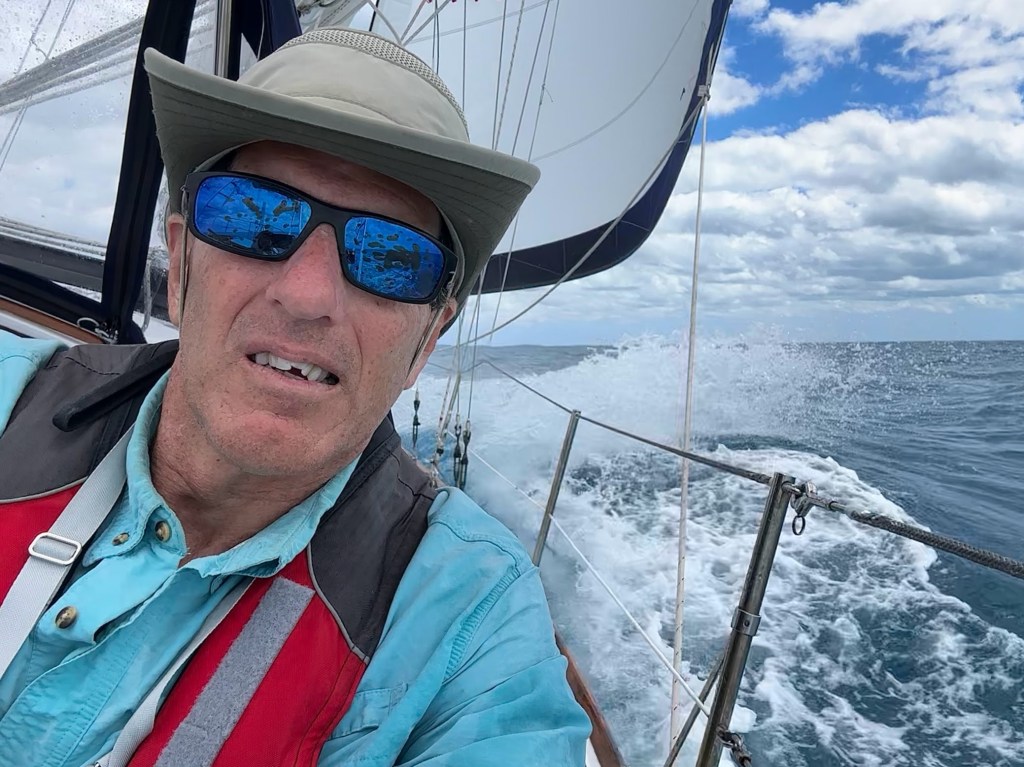
The past several weeks marked a new chapter in the Bahamas expedition and a new chapter in my overall sailing journey. I arrived in the Abacos at Great Sale Cay on February 11 after crossing the Gulf Stream the night before from West Palm, Florida. From that point on until the end of March, I spent all my time in the northern Abacos, north of Whale Cay Passage, sailing between various islands and anchorages, including Manjack Cay, Green Turtle Cay, Powell Cay, Allans-Pensacola Cay, Crab Cay, Foxtown, and Cooperstown. In March, I ended up spending a large chunk of time in and around Green Turtle Cay, mainly due to bad weather that kept me pinned down. John visited for a week in mid-March, flying out again on March 19 from Marsh Harbor, and it was my intention to immediately head south through the Whale Cut, then through the southern Abacos and on to Eleuthera. However, several strong cold fronts in a row prevented me from crossing the Whale, and they forced me into an extended stay in a slip at Green Turtle Club. Finally, on April 1, after one aborted attempt earlier in the week, I cast off from my anchorage at Coco Bay on Green Turtle Cay and made it through the Whale. That was the key milestone that started a domino-like cascade of others that followed one after another that included overnight offshore passages, transits through tricky cuts, and crossings between major islands or island chains. In the end, I’m now on track to complete the circuit originally suggested by James, which had earlier looked a bit ambitious. This consisted of a course that would take me to the Abacos, Eleuthera, the Exumas, Cat Island, and then back to St. Simons.
After sailing through the Whale Cut, I continued the same day down to Marsh Harbor, where I anchored on the north outside side of the harbor. To dodge yet another cold front with strong winds clocking around, the next day, April 2nd, I sailed around Sugarloaf Cay and Matt Lowes Cay and continued to Witches Point off Great Abaco Island, where I hoped to find an anchor spot with good protection from the southerly winds we were experiencing. It was a fast and intense sail, but unfortunately, I discovered once I arrived that it was in fact very exposed still and too rough for my taste to try anchoring. This forced me to retrace my steps for several hours all the way back to the same spot I departed from that morning on the north outside side of Marsh Harbor. It turned out to be a good sailing exercise but was a bit disappointing at the same time. Part of the reason for going to Witches Point was that it was that much closer to a logical launch point to head for Eleuthera, which was my next target. The next day, April 3rd, the southerlies clocked quickly around to northerlies, which forced me to abandon my anchorage, and this time I looped around Sugar Loaf Cay and Matt Lowes Cay but this time just ducked in and anchored off Boat Harbor on the south side of the small peninsula where Marsh Harbor is located. It was nothing more than dropping around from the north side to the south side of the peninsula, but it was two hours of extremely intense sailing. Swan was ripping through the waves, and spray was flying everywhere. It felt good to find my spot near the shore and drop anchor. I’ve found that I can never be complacent, even on these small trips.
Finally, on April 5th, I had a good weather window to make the crossing to Eleuthera. Since I was still holed up at Boat Harbor, very close to Marsh Harbor, I needed to sail about twelve nautical miles south through the Abacos even before I would reach North Bar Channel, the inlet just north of Lynyard Cay that I would use to exit the Sea of Abaco into the Atlantic. The original plan was to have sailed farther south within the Abacos to a launching point closer to North Bar Channel, but the weather did not permit it. This meant that the route would basically have two parts, the first being the tight-quarter sailing through the southern Abacos, which would take about three hours, and then a fifty nautical mile straight shot out in the open Atlantic to Eleuthera. The total distance was in the range of sixty-five nautical miles, which was more than I could sail departing and arriving the same day in daylight. For safety reasons, the top priority was to ensure that I would arrive with plenty of daylight left to allow me to navigate in tight quarters in a new anchorage. In addition, there was a tricky narrow cut I needed to transit right before the anchorage, and I needed to have plenty light to thread that needle.
The solution was to time my departure so that I would arrive sometime in the morning, which meant that I would need to leave the day before and sail through the night. I checked the tides and wind direction at North Bar Channel and concluded that I could make a safe passage through at around 1:30 pm. I calculated that it would take me three hours to sail through the south Abacos from Boat Harbor to North Bar Channel, so on April 5th, I raised anchor at 10:30 am and headed south. A casual glance at a map of the southern Abacos would lead anyone to conclude that it would be an easy and direct route, but the picture became much messier when I consulted my nautical charts and discovered large swaths of impassable shallow water that forced me left then right then back again and corralled me through some tricky narrow channels. Instead of a leisurely sail on a single tack, I ended up connecting multiple waypoints that had me sailing different directions and different points of sail. This was just the prelude to the main offshore portion of the trip, but it kept me on my toes.
At 1:30 pm sharp, I approached the North Bar Channel under sail. It was another challenge, but I made it through without any mishap. The normal route through would have put me on a dead run with the wind coming from straight behind me, and I did not feel comfortable going through on that tack. I needed flexibility to adjust course quickly and perhaps dramatically either to port or starboard, depending on the requirement, and sailing on a run would allow adjustments to one side but not the other. Even a minor turn to the leeward side could invite an involuntary jibe, an outcome that all sailors always want to avoid. It’s possible to just jibe in that case, but that is not something you want to be forced to do going through a tight channel with rocks on either side, waves crashing against them, and a washing machine of strong currents and chop around you. My solution was to head upwind on a starboard broad reach on my approach to the cut with the idea that I could then jibe around and sail through the cut at a slight angle on a port broad reach. It worked like a charm, but the only problem was that a large sailboat, a 45-footer, was coming through the narrow channel from the other side. I timed it so that on my first tack I passed right across his stern as he went by me, and then I jibed maybe fifty meters after that. I think he was surprised to see me sailing through, and I was surprised that he did not clearly make way for me, given that he was under power with no sails up. Once I jibed around for my final approach through the cut, the rest was easy. From there, it was just a matter of keeping boat speed and a steady hand on the tiller. I’m still not very good at estimating distances, but the rocks on the port and on the starboard sides looked very close, too close. The seas were swirling and confused where the Atlantic meets the Sea of Abaco. There was not much margin for error.
Once out of the channel, I was shot out into open space. No more tight navigating through narrow channels. No more close monitoring needed to avoid shoals, rocks, coral heads, and other boats. No more multiple tacks just to skirt shallow water and sand bars and stay in navigable waters. Within minutes, the depth sounder went from around twenty feet, which is typical in the Abacos, to about 1200 feet, which is more typical of Mother Atlantic. Deep water, no obstacles, no other boats, and just a fifty nautical mile rhumb line to Royal Island off the north side of Eleuthera. I set my course on my Garmin chart plotter, and within the first thirty minutes concluded that I was going to be on a dead run, meaning the wind would be coming from straight behind me. I was a bit puzzled because the forecasts called for a broad reach all the way down, but the real winds were not lying to me. To stay on a run for that long, it made sense for me to sail wing-on-wing, which meant I would keep the mainsail all the way out on one side, in this case the port side, and the genoa all the way out on the opposite side, in this case the starboard side. On a run, if both sails are kept on the same side, the main sail ends up blocking all the wind from the genoa. This renders the genoa basically useless for propelling the boat forward, and in addition, the genoa ends up just flopping around randomly, which is not good for the sail. It’s possible to sail wing-on-wing just by pulling the genoa over to the other side and steering very carefully. However, it’s tough to do, and invariably, the genoa at some point flops back over.
The key then, not just for the genoa, but also for the main sail, is how to avoid either from flopping over to the other side if there is a slight change in wind direction or boat heading. For the genoa, it’s a nuisance, but it’s not the end of the world if this happens. It’s just lots and lots of sail canvas aimlessly flopping around up front. For the main sail, however, it can be disaster, and it’s not an overstatement to say it can even result in death. It’s the classic involuntary jibe. On a run, to catch the wind properly, the main sail is sheeted all the way out so that the boom is close to ninety degrees with the hull of the boat. The end of the boom is a long, long way out there. If the wind catches the back of the mail sail, it will push it toward the opposite side of the boat, and this causes the boom to swing across the cockpit to the other side of the boat. In very light wind, you may be lucky, and it will be relatively benign, but in any reasonable wind, it can come flying across the cockpit and then will slam to a stop on the other side. In addition to potentially taking out an unlucky crew member, it can also damage the boom and rigging. Obviously, this all was something I wanted to avoid, and the solution was to deploy the trusty preventer, a line that runs from the end of the boom to the front of the boat, through a block, and then all the way back to the cockpit, where it is securely cleated. In the event the wind does catch the back of the main sail, the preventer stops the boom from swinging back toward the cockpit. It’s a basic safety device, and in this case, problem solved.
After deploying the preventer, I then turned my attention to the genoa. Fortunately, there is a nice solution here as well, in this case the whisker pole, but unfortunately, it’s much more involved and troublesome to deploy. My whisker pole is stowed against the mast and secured at the top with a small car that runs vertically from the bottom of the mast up to the position of the top of the whisker pole when it’s stowed. Without running through all the specifics, I detached the bottom of the whisker pole from the mast, slid the top of the pole down on the track while controlling it with a line from the top, connected the jib sheet and other control lines, and raised the pole to a horizontal position about five feet off the deck with the topping lift. I then secured its position roughly ninety degrees to the hull using the aftguy and the foreguy. With the hard work done, I unfurled the genoa, and in an instant, Swan was flying along wing on wing.
The deployment of the whisker pole and the wing-on-wing sail set-up was a success. The only problem was that in the intervening chunk of time it took me to set everything up, the wind shifted back to the originally forecast direction. This meant that staying on a dead run, which was necessary to fly the wing-on-wing set-up, pulled me off my course to Eleuthera. I smiled and chalked it up as a good sailing drill and then went back to the foredeck and undid all my work on the whisker pole. Once it was securely stowed against the mast again, I went back to the cockpit and steered Swan back on the correct heading. In the process, I pulled the genoa back to the port side, same as the main sail, and we found ourselves and a sweet broad reach, where we stayed for the rest of the day and through the night.
At the outset, we were ripping along at six plus knots, and my chart plotter was indicating an arrival time of around midnight, which was not what I had in mind. I absolutely needed daylight to navigate the last five miles of the trip, so if I arrived while it was still dark, it meant that I’d have to heave-to or otherwise bide my time offshore until sunrise. Only then could I make the final approach through the last cut and into the anchorage. With that in mind, a midnight arrival did not sound nice at all, as it would have required me to kill about seven hours somewhere offshore in the dark. I did not want to slow down yet, however, because I knew that the forecast called for gradually lighter and lighter winds through the night, and I would begin to lose speed. Sure enough, after dark, around eight o’clock, the edge started coming off a bit, and by ten o’clock I’d lost a good two knots on my speed. Since I was still close enough to land to encounter boat traffic, I did not sleep at all. By three o’clock or so, my speed was way down, but I’d made good progress earlier, so I was still on track to arrive shortly after sunrise, which was perfect. The biggest challenge of the crossing came a bit later, when I lost even more wind, but I still faced lots of swells and choppy seas. With virtually no wind keeping the sails full and the boat stable, this had the effect of rolling the boat back and forth, which in turn swung the top of the mast back and forth, causing the sails to snap full on one side and then the other. There was no danger in this, but it was not good for the sails. At the same time, I had no alternative but to keep pressing on. Unlike most other boats, I do not have a massive diesel and huge fuel tanks that can allow me to just drop the sails and plow through these kinds of conditions. I have no choice but to sail, which is my preference.
At last, sunrise and a visual of approaching land. I was approaching the north side of Royal Island, but to arrive at the anchorage on the south side, I needed to thread the needle between two small islands just off Royal Island, Egg Island and Little Egg Island. I knew from the charts that the channel was narrow, but I was struck by just how narrow. As I approached, I partially furled the genoa to depower, and as I came closer, I dropped the main sail, so that I was sailing only with a reefed head sail. I then turned on the outboard motor as a precaution and switched from the wind vane to the autopilot. It was tight on both sides, but I made it through without any drama or mishap. At this point, it was about nine-thirty in the morning. After passing through the cut, I turned left along the south side of Royal Island and headed for my target anchor spot about a mile away. I turned off the motor and sailed just with the reefed genoa until I was closer to the spot. With the last approach, I turned on the motor again and furled in the rest of the genoa, so now I was fully under motor power as I slid slowly toward my target. As the boat lost all speed, I walked up to the foredeck and felt relieved as the anchor splashed down off the bow. Unfortunately, after letting out a bit of chain, I was not happy with my location, so I raised anchor again and motored a bit farther along the coast until I found a better spot. Down went the anchor again, and this time it stayed. The time was ten thirty, which meant I’d been underway for a full twenty-four hours.
From Royal Island I decided to take a somewhat long sail down along the western side of Eleuthera to a beautiful bay called Ten Bay. It required a seven-mile sail to another tricky cut called Current Cut and then another twenty miles or so from there. Current Cut is known to have the strongest currents in the Bahamas, so it needs to be taken very seriously, and slack tide is essential. In my case, I chose to go through on a morning when slack tide was at 8:04 am, and this meant that I needed to cast off from Royal Island even earlier. I raised anchor at 6:30 am, before sunrise and arrived at the outside of Current Cut at exactly 8:04, believe it or not. The timing was perfect. However, the wind was not a good direction, as it was coming mostly on my nose, so my solution was to motor sail through with the main sail only. As I approached, I was stunned at how narrow the passage was. I came closer and closer to the land but could see no way through. I wondered if I would just run into the peninsula in front of me if I stayed on my course. Then, just barely, I saw a crack of light, which slowly became wider, but in the end, it remained far narrower than I would have liked. It was unnerving to point my bow toward that little crack in the land. Even with slack tide, the water was churning like a washing machine, but somehow any current there was seemed to be with me, so I passed through quickly and was relieved when the rocky shores were no longer reaching out to grab me on either side.
From there, it was another two miles through a narrow channel to stay out of the shallows, and once out, the genoa was back out and the motor was off. It was a great sail the rest of the way to Ten Bay, and the beauty of the location took my breath away when I arrived. It’s a long pristine white beach, and I was the only boat anchored there. The trick was that the sand closest to the beach had good holding for the anchor, but it became shallow very quickly. I needed to slide slowly over the grassy areas farther out and then once over the sand, quickly drop anchor and allow the boat to be pulled away from the beach again by the wind. The first time I tried, I didn’t have the nerve to bring the boat close enough to the beach to drop the anchor in the sand, so I dropped in an area where it was still grassy. With about fifty feet of chain out, it was the first time I experienced my anchor dragging. It was absolutely apparent, and I couldn’t leave it that way, or I would just continue to drag. On the second try, I built up the nerve to creep right up to the white sandy area, and once the bow was a few feet over, I quickly dropped the anchor again. This time, she grabbed nicely.
I spent one night at anchor at Ten Bay, and on April 9 sailed from Ten Bay to Rock Sound Harbor at the south end of Eleuthera. I spent a few days there at anchor, and on April 13 raised anchor and set sail for the Exumas. This was an offshore sail but short enough that I was able to comfortably manage it within daylight hours of a single day, so there was no need to make it an overnighter. Nonetheless, there were some tricky points at the front and back ends. Interestingly, I’ve found that the tricky parts tend to be when I’m near shore. Once I’m offshore, the water gets deep, the boat traffic thins out or disappears, the land and buoys and other obstacles recede in the distance, so the sailing becomes much less complicated. It’s no longer an obstacle course, as it can sometime be when sailing near shore. For this passage, I first needed to transit Davis Channel at the south end of Eleuthera to exit into the Atlantic. The channel was several miles long, but plenty wide, so in the end it did not present many challenges. However, in the approach, I saw firsthand what the charts meant by “multiple coral heads in the area.” Clipping along in Swan through the clear turquoise water, I suddenly made out a dark patch some hundred meters or so ahead. It was apparent that something was under the water, and no doubt it was one of the coral heads noted in the charts. This happened multiple times in the approach to Davis Channel and often required that I steer quickly to a different heading to stay in clear water. I don’t know if the water was still deep enough over the coral heads for me to pass over, but I did not want to put that to the test. Instead, I was on sharp alert until I passed through the danger area and was well into Davis Channel. At that point, I received a text from my buddy Jamey Kabisch, who I’d sailed with two years prior on the ASA Advanced Coastal Cruising Course in the Chesapeake Bay. In the interim, he’d also left his job, sold his house, and moved onto a sailboat to pursue a life of voyaging. The difference was that he was with his wife, Dani, and he opted for a magnificent catamaran. His text said he spotted me on AIS and was four miles in front of me and asked where I was headed. It turned out we were both headed to the Highborne Cut on the north end of the Exumas, and we ended up sailing the passage together for the rest of the day, with his boat, Leap of Faith, staying four to five miles ahead of me. I was able to monitor him the entire way with my AIS, a collision avoidance system that allows me to see the position and identity of other boats on my Garmin chart plotter.
The passage over was about twenty-five miles on a beam reach in about ten to twelve knots of wind, so it quickly literally was a breeze. It was a beautiful day with beautiful and easy sailing, that is, until I reached Highborne Cut, which kept me busier than expected. By then, I knew that these so-called “cuts” between islands in the Bahamas that allowed passage from the Atlantic to and from the smaller protected seas, such as the Sea of Abaco, came in many varieties. Broadly, there are the simpler cuts, like Dotham Cut or Current Cut, that consist of a straight approach to a single, short cut between two islands. Because they look simpler on the charts, it doesn’t necessarily make them easier because if the conditions are wrong, and particularly if there is a state of “sea rage” with huge swells and waves, it can be catastrophic to try to go through. Nonetheless, the route through is straight forward. Just approach directly and punch through. The other type of cut involves more hurdles to clear and can sometimes even feel like an obstacle course, even though it’s referred to as a single. The straight approach may narrow significantly and then take one or two turns, and along the way there may be small rocks, islands, and shallows to avoid and even additional cuts before reaching the main cut leading out. The additional distance to cover also increases the chances of encountering other boat traffic on the way, which of course must be avoided. Examples include Conch Cut and Highborne Cut, both in the Exumas. In my case, passing through Highborne felt exactly like the description above. To get through, I ended up passing through two very narrow cuts, dodging small islands and rocks along the way, altering course multiple times to thread the needle, and also fighting confused currents and choppy churning seas that complicated my progress and steering. I had not expected such a challenging entry and was hoping to sail in just with a partially furled genoa, but en route I deployed the Tohatsu outboard to get a bit more thrust to punch me through. In the end, it was all fine, and the transit came off without a hitch, however, the five hours of so of easy, relaxed, uneventful offshore sailing was a stark contrast to the ten minutes of intense close quarter sailing and piloting to maneuver through Highborne Cut.
Once I made it through, I came out into a large anchorage on the other side of Highborne Cay that was packed with boats at anchor, many of them huge luxury power boats, or perhaps super-yachts, as they’re sometimes called now. Jamey had since then called and let me know where he was anchored, and he headed up his way at the far end of the anchorage. As my anchor was dropping, he was already on his way over in his dinghy, and after showing him around Swan, we went over to his boat and joined Dani for dinner together. It was a great reunion, and I’m sure we will stay in touch as our sailing adventures continue.
The next day, April 14, I raised anchor early in the morning and sailed on to Shroud Cay some fifteen miles or so to the south. The whole week, northeast winds were forecast, which were perfect to allow me to sail down the west side of the Exumas. I didn’t want to miss the chance, so I decided to press on and continue hopping down the islands. In addition, I have dreamed of visiting the Exumas Land & Sea Park for many years, and Shroud Cay was right inside the norther edge of the park, so I was eager to keep going. I dropped anchor shortly after noon and was stunned by the natural beauty. The water was an almost surreal color of light but intense blue, and a couple hundred meters off the bow of Swan was a shoreline dotted with small islands and inlets and beaches. Restrictions are tight in the park, and there no structures or other permanents signs of human presence anywhere on the island. I also realized I lost all cell and Wi-Fi connection in the park, so this was truly remote, even more so than the other uninhabited islands I’d visited. After a quick lunch, I deployed the dinghy and went on a two-hour expedition to explore.
The next morning, April 15, I pressed on, this time sailing to Warderick Wells Cay on the south side of the Exumas Land & Sea Park. It was another stunning location and was the site of the administrative offices for the park, which I could see from my anchor location. I ended up somewhat farther from shore than I hoped, due to the need to avoid straying into the mooring ball area, and the winds in the afternoon were rather strong. As a result, I opted to enjoy the surroundings from the deck of Swan rather than venturing out in the Takacat dinghy. I also welcomed a bit of rest.
The next morning, April 16, I raised anchor and sailed from Warderick Wells Cay to Black Point Settlement, another twenty miles or so south down the Exumas. This meant exiting the Land & Sea Park. Black Point Settlement, as the name suggests, was a proper town, with grocery store, laundromat, and a few restaurants. Like most towns I visited to that point in the Bahamas, Black Point was just a tiny village, and calling it a town seemed to vastly overstate its limited size and scope. It did have its charm, and I did take advantage of the small grocery store and laundromat. Looking more closely, Black Point had the same wounded and weakened feel of other towns had that I’d seen, including Foxtown and New Plymouth. It was all due to the hurricane that passed through several years ago. It had the feel of a place that was a warzone in recent memory, and the cleanup and recovery was incomplete and stalled. Blown out and abandoned buildings are everyone, and what remains is sparse and seems to be hanging on by a thread. It is hard to imagine how these tiny remote communities could survive another direct hit.
I had planned next to sail from Black Point to Georgetown at the far southern end of the Exumas before casting off for the final offshore passage back to Georgia via Cat Island. It was long trip, however, with two cuts to transit plus a forty-five-mile offshore leg, so the planning was tricky. It did not look like there was enough time to do it within one day’s daylight hours, and it wasn’t clear how I would fit the pieces together into an overnighter, either. In consulting with James, he suggested I skip Georgetown altogether and instead start the trip to Cat Island from one of the cuts close to Black Sound. It was a great idea, and I didn’t feel any particular pull to visit Georgetown, so I agreed to go with that plan. The next question then was which cut I would take to exit the Exumas, and there were three options: Conch Cut, some fifteen miles north; Dotham Cut, immediately next to Black Point; and Farmers Cut, some distance south of Black Point. In the end, I picked Conch Cut for its reputation as the easiest cut to transit in the Exumas and based on how it looked on the charts. It certainly was not one of the simple types of cuts, as it required multiple turns and transits around small islands and shallows and had two cuts instead of one. However, it also was wider, and the larger expanses of water would allow for easier tacking. In addition, I’d taken the opportunity to hike as close as I could to Dotham Cut from Black Point, and I didn’t like what I saw. Rough seas were pouring toward the cut from the Atlantic, and I saw one large power boat struggling to punch out into the sea and clear of the rocky shores. Also, two captains also posted warnings about Dotham Cut on Active Captain, a sailing community app, and that was enough to steer me clear of Dotham. Farmers Cut didn’t have anything convincing to offer, so I chose to go with Conch Cut.
Since Conch Cut was still some distance north of Black Point, I needed to find a launch point closer to the cut where I could anchor. I found a nice spot on the chart on the west side of Pipe Cay which would put me in striking distance of the cut, and I left Black Point for Pipe Cay on April 19. I had not expected it, but I found Pipe Cay to be one of the most beautiful spots I’d visited anywhere in the Bahamas. Again, it was the strikingly clear neon blue water and twisty-turny shoreline punctuated with small white beaches, rocky shores, tiny islands, and hidden bays that made it almost magical.
On April 21, I raised anchor at Pipe Cay and departed for New Bight on Cat Island. Low slack tide at Conch Cut was expected at 1:15 pm, so I wanted to time my approach so I’d arrive at 12:00 noon, roughly one hour before. Favorable winds were forecast during the daylight hours, so I wanted to go through as early as possible. The next earlier slack was around 7:00 am, which was too early because I had roughly a two-hour sail to the Cut, and I did not want to sail out of my anchorage in the dark, as it required some careful piloting to reach open water. That left me with the next slack tide as my best option, and going through one hour earlier would give me one more hour of daylight sailing. In addition, I didn’t want to risk arriving after low slack because then there would be a risk that I could be sailing right into the incoming flood tide. I checked the charts and calculated that it was about nine nautical miles out of my anchorage, into open water, up the coast, into the approach to Conch Cut, and then through the winding channel right up to the cut, and assuming a conservative 4.5 knots, that would take exactly two hours. At 9:45, after removing the snubber line from the anchor rode, I placed both feet on either side of the Lofrans manual windlass, grabbed the chain with both hands, and began pulling in the anchor. It was now my regular routine to just haul in the anchor hand over hand instead of using the windlass winch. It’s tiring but much faster. Once the anchor was up, I tied the winch handle to the base of a stanchion so it wouldn’t go overboard while sailing, put the cover on the deck chain pipe where the anchor chain passes from the deck down into the chain locker, and lashed the anchor so that it could not come loose and fall in the water when underway. The boat was now floating freely without anchor or power, so I picked up the snubber line and the boat hook, which I keep handy at the bow when raising the anchor in case I need to knock off any mud or grass when the anchor comes out of the water, and walked back to the cockpit. I dropped the boathook below deck, pushed the snubber line temporarily out of the way into a back corner in the cockpit, checked my position quickly, and then turned my attention to deploying the Genoa. I first confirmed which side of the boat the Genoa would fill based on the wind, then released the sheet from the windward winch and put one wrap around the leeward winch with the other sheet. After uncleating the furling line and putting one wrap around the furling winch outside the starboard stern corner of the cockpit, I began pulling out the Genoa with the working sheet in one hand while using the furling line in my other hand to manage the speed of the deployment, mainly preventing the wind from pulling out the Genoa suddenly in an uncontrolled way. Since I was still in the anchorage with other boats and would need to maneuver out between a small island and some shoals, I deployed the Genoa only part way at first to give me maximum control and flexibility. I wasn’t going fast, but I had enough boat speed to steer and to move me along out into open water. Once out of the anchorage, I deployed the rest of the Genoa and raised the full main sail with no reefs.
From there I sailed out of the anchorage and then more north along the coast to reach the approach to Conch Cay. When I made the turn toward the cut, I still had a few miles to go, and I took the opportunity to review my preferred course through the channel and where I likely would need to tack. I saw immediately that I next had a two-mile stretch that would put me very close to the wind, and I was concerned that I would not be able to hold the course. At the front end of this channel, it was not a problem, because I had room to tack, but the channel progressively narrowed, and at the end, I would truly be threading the needle, and I did not want to tack there. In addition to being narrow, in these cuts, a narrow point generally means stronger current and bigger swells and waves. These are the points where you want to be under full power heading straight through as fast as possible. My plan was to sail that two-mile stretch on a single tack as close to the wind as I could sail, pass through an initial narrow cut between two small islands, continue another quarter mile into some more open water and then tack to starboard, continue about a third of a mile to the other side of the open area, make a tack to port at the last minute before entering shallows, and then stay on that tack as close to the wind as possible for two miles past the second cut and out into the Atlantic. When I made the turn into the first two-mile channel at the front end, I monitored my course closely and did my best to stay on the windward side. James calls this “money in the bank,” meaning it’s best to stay as high as possible on the windward side on a tight tack and to leave as much room as possible on the lee side. The room to fall of the wind, if needed, is the “money in the bank.” In my case, since I was in a narrow channel, I also needed to be careful of the lee shore. If you’re sailing near a body of land, and the wind direction is blowing toward the land, this is called a lee shore. The danger is that sudden strong winds and current can naturally push you into the shore, even if the boat otherwise if functioning fine. In addition, if anything should happen to disable the boat, you can end up shipwrecked on the shore even in mild or moderate conditions. For these reasons, I steered toward the windward side of the channel, keeping a close eye on the sails. The main and the Genoa were sheeted in tight and, so far, were not luffing. If they started luffing, it was the signal that I might not be able to hold the course. I knew I was right on the edge, but I was relieved to see that the sails were staying filled, and I was maintaining about 4.5 knots of speed. Generally, I don’t bother hand steering and instead leave it either to the Monitor wind vane or the Pelagic autopilot. In fact, more than ninety-five percent of the time I’m underway, the boat is being guided by one of these two self-steering systems. In this tight channel, sailing right on the edge of the wind, I relied on the Pelagic autopilot but was ready immediately to disengage it and hand steer if needed.
I made it smoothly and safely through the first two-mile channel on a single tack and then faced the first of two narrow cuts. I was struck by how little room there was on either side, and steering on the windward side kept me uncomfortably close to a large rock outcropping that I needed to pass. The water was plenty deep, so I charged ahead and punched through with no problem, somewhat relieved when all that rock started to recede off my quarter. Then immediately, as the water opened into a small sound, I saw a catamaran under power about 300 hundred meters off my starboard bow headed straight for me and a medium-sized cargo ship 200 meters behind him on the same course also headed straight for me. I was under sail still with full main and Genoa and no motor, so I was the so-called “stand-on” vessel with respect to the catamaran, meaning I had right of way. It was clear he was under power since he had no sails up. In this situation, in tight quarters, it’s necessary to still be ready to take evasive action in case the give-way vessel does not change course, for whatever reason. There was a long moment in which I watched the catamaran like a hawk for any sign of course change, all while monitoring the close shoreline off my port, keeping an eye on my depth sounder, and preparing for my next tack, coming within two hundred meters. I was now hand steering with the tiller. Then, to my relief, the catamaran made a clear course change so that we crossed bows and would pass starboard to starboard. One immediate problem resolved. However, I was still clipping along on a collision course with the cargo ship and with limited room to maneuver. If I were to change course, I’d have to tack hard to starboard and do it quickly to get out of his way. This would take me way off my planned route, and I would have to come up with a new ad hoc plan from there, but better that than a head-on collision with a cargo ship. Fortunately, the captain of the cargo ship then hailed me on VHF. “Swan, Swan. This is the cargo ship in front of you. Please pick up.” I grabbed my handheld VHF in the cockpit and responded, and not surprisingly, he asked my intentions. From his tone, I could tell he was relaxed and aiming to be cooperative, and I requested permission to stay on my course so that our bows would cross and that we would pass starboard to starboard, much like with the catamaran. This would require a small course change on his part, and he immediately agreed. “Understood, Swan. We will make a course correction so that we pass you starboard to starboard. Thank you.” Within seconds, I saw his bow coming around, and soon we were clear of one another.
At that point, I was able to focus again on my tack, and after eyeballing the shoreline on my port and angle I would have across the small sound, I pushed the tiller slowly to the leeward side. As he bow started coming around, I released the working sheet from the self-tailing cleat on the winch, and as the Genoa began luffing, took off the three wraps on the winch. The sheet was now free and the Geno was flapping and beginning to pull to the other side of the bow with the wind. I immediately grabbed the other sheet, which would become the new working sheet, and hauled in on it as fast as possible with one wrap around the winch. The goal was to pull the Genoa across the bow to the other side of the boat, in this case the starboard side, and to take out the slack and put in a couple wraps on the winch before the wind filled it out. If done too slowly, the Genoa will end up filled by the wind but sheeted too far out. Taking in the slack and trimming the sail then requires grinding hard on the winch with the full load of the wind in the sail. This is hard work, puts lots of load on the sheet and blocks and winch, and is mostly unnecessary, if the tack is done well. The tack went well, but I failed to haul in the sheet quickly enough, so I still needed to haul in the sheet some more. To make this easier, I angled the tiller slightly to push the bow back into the wind a bit to take out some of the load in the Genoa. This is a trick that generally works well. In this case, however, I did not have good boat speed, and the bow came over a bit too far. As a result, the Genoa backed in the wind, which means it not only luffed, but the wind filled it completely from the reverse side. This meant that I was on course to tack back around to the other side, except I did not have enough boat speed. If I stayed like this, it would be what’s called a heave-to, which is a useful tactic for stalling the boat, which is exactly what I did not want to do in that situation. Since I did not have enough boat speed to tack the bow through the wind, my solution was to jib around 360 degrees the other directly. This was not an elegant solution, and any observer would have wondered what on earth I was doing, but it worked with the wind in a way that naturally spun the boat back around onto the tack I intended. It was a small diversion, but all was well, and it was another lesson learned.
Once on the new tack, I sailed across the small sound, about one-third of a mile, and then made my last tack to port as I approached the shallows on the other side. This tack went like a charm and soon I was on my last two-mile leg out of Conch Cut. The challenge now, like on the first two-mile leg, was to stay on my course by sailing as close to the wind as possible. Any luffing in my tightly sheeted sails would mean I would need to fall off the wind, and this would take me off course and possibly require additional tacks at some point, something I wanted to avoid. Also still ahead was the transit through the final cut, the actual Conch Cut, which again brought through a narrow gap with land close on my windward side. I watched my course and sails and water depth closely and was able to sneak out of the cut and into the Atlantic on the single tack.
Almost in an instant, I was out in the deep blue Atlantic Ocean. It was a similar feeling as when I exited North Bar Channel from the Abacos. It was like being shot out into open space. Suddenly, the brilliant neon turquoise water of the Bahamas gave way to the deep rich royal blue of the open Atlantic Ocean. In the same minute, my depth sounder went from twenty-five feet to 1,200 feet, and around me, there was nothing, just open water. No more boats on collision courses. No more tight channels and shallows. No more encroaching rocks and shores with crashing waves throwing spray high into the air. No more narrow cuts between islands, with strong but currents and waves creating a washing machine effect. Swan was clear and in the open with full sails and already settling into her offshore groove. It was now 12:30 pm, and I was spot on in terms of my planned timing to exit Conch Cut. I would now sail overnight with the aim of arriving at my anchorage at Cat Island during daylight the next morning.
Next, however, was the question of how exactly I would make the passage to New Bight at Cat Island, some fifty-five nautical miles away as the crow flies. I would have loved to just point the bow in that direction, set the trusty Monitor wind vane to steer the course, and sit back and enjoy the ride. The good news was that sea state and wind speed were ideal for a good, fast but comfortable sail. I wasn’t going to get beat up on the way with high winds and high seas or get becalmed, either. Conditions were great. The problem was that the route to New Bight put me directly into the wind. This meant that one way or another I was going to have to tack my way across. I consulted with James, and he estimated that the total length of the trip would end to be around 80 nautical miles due to the extra distance added by the tacking. Our idea was that I would make an initial tack straight across to Cat Island, recognizing that I would wind up way north of New Bight. Then, I’d make the tack south along the western coast of Cat Island down to the large bay where New Bight is located. The course straight to New Bight was about 95 degrees from Conch cut, and James noted that I’d be doing great if I could stay on eighty degrees and that even seventy would be workable. The question was where the first tack would leave me. We really didn’t know but realized that I could end up all the way on the north end of Cat Island or even at Little San Salvador island, which is northwest from there. That would leave me with a long tack south back to New Bight.
Once clear of Conch Cut, I turned my attention immediately to confirming how close to the wind I could sail on my first tack, which would determine the course I could hold. I brought Swan as close to the wind as possible with both sails sheeted tight, but when the boat speed dropped below four knots, I steered downwind just slightly to bring the boat speed back up. My goal was to maintain about 4.5 knots. In those good sailing conditions, anything slower would be a wasted. With those small adjustments, I found the sweet spot between heading, sails, and speed, and then allowed the boat some time to settle in. At the outset, the course looked great. I was holding seventy degrees plus, and I thought I could just keep on the course and make the initial crossing on that tack. However, at 2:00 pm, I noticed that my track had begun to clearly shift to the north. I was now losing ground and barely able to steer a heading of sixty degrees. Soon, this was down to fifty degrees, and the change was all due to a shift in the wind direction. If I stayed on that course, I would end up at Eleuthera, which was way out of my way to the north and would make tacking back a huge time-consuming task. However, since the wind had shifted considerably to the north, I realized that this gave me an advantage on the southern tack. At that point, I decided to abandon the original plan of sailing across to Cat Island first, and to instead immediately tack south and make as much headway as possible in that direction.
At 2:30, I tacked south and began sailing down the eastern shores of the Exumas. I was about ten miles offshore of the Exumas and was able to set a course roughly parallel to the islands heading south. This was a great angle, as I was concerned that my course would slant me toward the Exumas, which would add distance and require additional tacks. In the end, I sailed for the next nine-and-a-half hours on that tack and ended up way down on the southern end of the Exuma island chain. At midnight, I checked the angle to New Bight and estimated that I could probably hold the course if I made the tack toward Cat Island. I made the turn east, set the new course and trimmed the sails, and found that I was spot on for a single direct tack straight into New Bight. From there, I sailed through the night and arrived at my waypoint outside the bay at around sunrise. I also realized then that the bay was so large that I still have another nine nautical miles, or about two hours, to sail before I reached the anchorage. I settled in and enjoyed the final stretch, which brought Swan through beautiful flat protected water driven by a steady consistent breeze. About an hour out, I a note from James noting heavy winds forecasted to clock around during the next twenty-four hours and his recommendation that I deploy a second anchor. We exchanged some more texts, and then I called to discuss directly, and there were some tricks to how best to set the anchors.
At this point, I had been awake more than twenty-four hours and was exhausted. Deploying the second anchor also required that I deploy the dinghy, which at the time was deflated and stowed in the v-berth below deck. That meant a lot of work. However, I knew I should follow James’ guidance. The bay was extraordinary in its size and was exceptionally easy to enter and scope out for anchoring. There was ample room and only one other boat for as far as I could see. With west and northwest winds forecast for later that day and night, James, who knew the anchorage from his own experience, suggested I tuck into the northeast corner of the bay right offshore of New Bight. Once the primary anchor was down, I took care of the standard boat clean-up, including stowing the lazy jacks; securing the main sail with sail ties; rolling out and securing the main sail cover; stowing the Monitor wind vane and Pelagic autopilot; coiling the sheets and furling line in the cockpit; lashing the tiller; and securing the Tohatsu outboard. Then it was on to the secondary anchor. I dragged the large heavy dinghy duffel from the v-berth to the foredeck and brought out the other large duffel with the dinghy accessories. I rolled out the deflated Takacat dinghy on the foredeck and pumped up the two main chambers about eighty-five percent. This gave the dinghy some structure that allowed me to insert the inflatable floorboard and the stern engine mount. I finished the inflating, tied two long bowlines to a stanchion, tipped the dinghy on its side on the starboard foredeck, then physically lifted it over the lifelines and threw it into the water. I use the spinnaker halyard to hoist the dinghy out of the water onto the deck, but I’ve found that it’s easiest just to lift it with my own strength and throw it overboard when deploying it.
From there, I finished prepping the dinghy, including putting the dinghy anchor aboard, attaching the oars, and installing the ePropulsion electric motor and battery. Next, I pulled most items out of the port cockpit locker to access the secondary anchor and rode at the bottom. Out came the fenders, dock lines, pfds, cushions and other gear. The bag holding the rode is very heavy, and the anchor itself is awkward and potentially dangerous to carry. With care but ample force, I removed both from the locker and transferred the anchor to the dinghy, resting it carefully on two cushions. I tied another one-hundred-foot line to the end of the rope dinghy rode and cleated it to one of the bow cleats. After running around the outside of the shrouds and stanchions, I then flaked all the anchor rode into the stern area of the dinghy, including 33 feet of chain, 110 feet of rope rode, and the additional 100 feet of line I’d attached. The dinghy was tied up at the gate by the forward starboard side of the cockpit, and I stepped in and uncleated the two bow lines. I then motored away from Swan and aimed for a position ninety degrees off the starboard bow. As I throttled up, I played out the long length of rope rode, keeping tension as I went. When the full length was deployed, I confirmed my position and then played out the chain rode. When it was deployed, I quickly and carefully grabbed the anchor, lifted it high and clear of the dinghy and threw it overboard, along with the trip line and float that I had attached. With the float, I could see clearly where the anchor was positioned, and I it looked like I got it about right with respect to Swan and the angle of the primary anchor rode. Ninety degrees between the two rodes is not standard, and sixty or so is more typical when putting two out off the bow. However, but I had only deployed fifty feet of rode for the primary anchor, and I still needed to deploy the remaining one hundred, and I knew this would tighten the angle. In addition, the wind at the time was from the southwest and blowing Swan toward the shore, but within the next twenty-four hours, it was forecast to clock around 180 degrees to the northwest. This meant I needed to allow the boat to shift position completely with respect to the anchors, and I suspected that a slightly larger angle between the rodes would make this easier. A final point is that generally my primary anchor and rode are sufficient, and the point of deploying the second anchor is largely as an insurance policy. Having it deployed roughly in the right area is the key, even if it is not carrying much or any of the load. In the outside event that the primary anchor drags or fails, then very quickly the second anchor would grab and take some or all of the load. That was another reason why I wasn’t too concerned about hitting sixty degrees or less.
It was a relief to finally get the secondary anchor down. I motored back to Swan, removed the dinghy motor and battery, secured the dinghy off the stern, and went below to rest. I was totally spent at this point. The whole exercise took me more than one hour and required physical exertion and mental focus. It came at the end of an eventful twenty-four-hour sail, and I couldn’t believe that I had been continuously awake since preparing to cast off from Pipe Cay the prior morning. I slept for several hours and used the next day at anchor for rest and recovery. I would have a few days at Cat Island to recharge and explore, and then I knew my next challenge awaited: a multi-day and multi-night non-stop offshore passage from Cat Island back to St Simons in Georgia.
28 March 2024 – The Unforgiving Nature of Sailing, and Being Eternally Humble
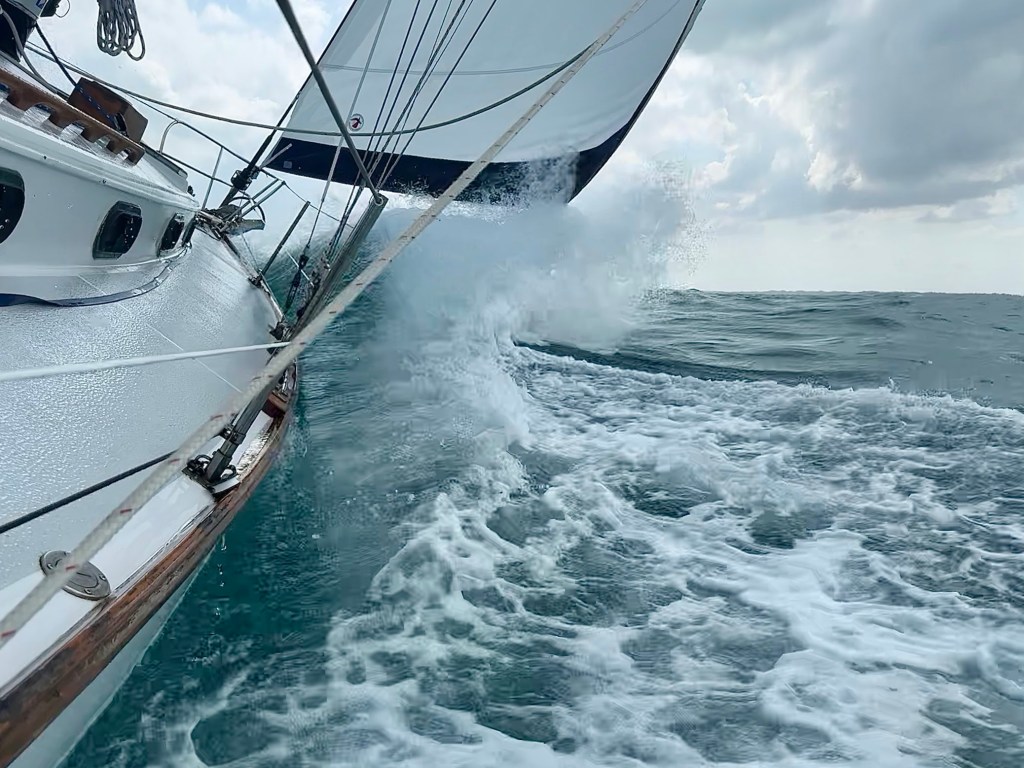
I was recently reminded of the unforgiving nature of sailing. Beneath the glossy, alluring images of yachts in beautiful and exotic locations lurks the harsh reality that a single mistake or miscalculation on a sailboat can result in punishing and sometimes dangerous outcomes. It can happen suddenly and unexpectedly, and things can quickly spiral out of control. Sometimes there is no one to blame, and sometimes there is someone squarely to blame. If a sailor is lucky, it will be a good lesson with no harm done, other than perhaps some bruised pride. If it goes bad, however, it can be a matter of life and death.
Lately, I’ve been holed up at Green Turtle Cay waiting for a weather window to sail through the Whale Cay Passage and on to other islands in the southern Abacos. The “Whale,” as sailors sometimes call it, is a route from the Sea of Abaco out into the Atlantic around Whale Cay and then back into the Sea of Abaco on the other side. It’s necessary to transit in order to pass Whale Cay from the north to south or vice versa. Normally, when sailing these waters, there is no need to go through a cut between islands and out into the Atlantic, as there is plenty protected sailing water in the Sea of Abaco to hop from island to island. Sailors tend to be very wary when it comes to passing through these channels, and the consensus is that they’re best to be avoided, if possible. The channels between islands are prone to “sea rage,” an extreme sea state with massive braking waves caused by sea swells from the deep Atlantic hitting the shallow waters of the Sea of Abaco and then being funneled into narrow inlets between adjacent islands. The same is true of the Whale Cay Passage, but due to impassable shallows on the Sea of Abaco side, transiting the Whale is unavoidable.
Depending where the measurement is taken, the Whale is somewhere between three and six nautical miles, which is not long. Clipping along at a reasonable pace would get any boat through in about an hour. The severe reputation of the Whale, however, leads most sailors to plan their passages carefully, timed to the optimal conditions, and to be ready to abort if needed. On many mornings, one can hear open requests on VHF channel 16 for reports on conditions from other boats making the passage. This is one common way for sailors to get advance notice of the sea state in the Whale.
In my case, I’d been biding my time looking for an opening, and two days ago, I decided to make an attempt. The info I was getting in advance was mixed, with forecasts calling for waves in the 10-12 foot range, but much of that accounted for by large swells with periods of ten or more seconds. It seemed possible that there were large but benign swells with small wind waves layered on top, which potentially could be passable. I discussed it with James, my sailing advisor, and we agreed I could sail to the area just south of Green Turtle Cay and then begin the three-mile approach leg to the channel next to Whale Cay. On the way, I could monitor conditions and abort if I thought it was too severe. In the end, I did just that. I sailed five miles or so to the approach area and finally decided to turn back when I was still about two miles from the channel. I’d seen enough, and it was not worth the risk.
About a mile in front of me, another sailboat had been motoring ahead toward the Whale, and at one point, I spotted two masts coming around Whale Cay from the opposite direction. They were finishing up the passage from south to north and seemed to be managing it. At that point, I reconsidered my decision to abort, for all of about five seconds, and then stuck with it, for the same reasons I originally opted to turn back. Right at that moment, I heard a mayday call on the VHF, and the sailor on the other end announced that his sailboat was sinking. It turned out this was happening right off the northern tip of Whale Cay, where I had been headed just moments before. The VHF was then taken over by chatter from boats in the area diverting to assist and the local Bahamian rescue team. What I learned later is that a 36-foot sailboat broached, and water poured into the cockpit and below deck through the companionway, flooding and sinking the boat within a minute. Broaching is when a boat catches a large swell or wave on the beam and tips sideways out of control on the steep incline of water. The three people onboard escaped onto their dinghy, but it was a difficult rescue in the high swells and roiling sea around them. Fortunately, everyone was saved.
I don’t know the details, so I can’t say exactly what led to the boat sinking. For some, it might be tempting to sit back and criticize the judgement or skills of the skipper. That’s not something I’d choose to do, even if the facts were clearer to me. After all, there were about a half dozen other boats that made the passage at the same time. Perhaps they were just lucky. In any case, it’s hard never to make a mistake. All we can hope is that our care and attention helps us reduce the number of mistakes we make and to avoid the worst outcomes.
In my own sailing, I have been learning and improving, and often through mistakes. In fact, I told James once that if making mistakes is really the best way to learn, then I must be learning at a break-neck pace because I’m making mistakes all the time. So far, I’ve been fortunate and have avoided the worst outcomes. In reality, I am very cautious, as reflected in my decision to abort the recent passage attempt through the Whale, and this no doubt helps keep me out of trouble. Also, joking aside, I really have learned from my mistakes, and as a result I have become a better and better sailor, and that process continues. So far, any damage from my mistakes has been limited to outcomes such as an inefficient tack, a fouled line, or a less than elegant docking attempt. Lately, things have been going smoothly for me on the sailing front in terms of minimizing silly mistakes, and I’ve become faster and more reliable in executing the various sailing maneuvers, including anchoring, tacking, jibing, reefing, and handling onboard equipment such as the VHF and self-steering systems. Things are starting to feel a bit more routinized and have been relatively seamless lately in execution.
Today, however, I was reminded of my two mottos: “Nothing is Easy,” and “Eternally Humble.” I was anchored outside of Green Turtle Cay and this morning at 9:15 raised my anchor to make the trip through the narrow, shallow channel into White Sound and on to Green Turtle Club. I’d reserved a slip for another two nights to take cover from yet another big blow coming in tonight. All of my attention was on navigating safely through the shallow channel and avoiding other boats, either underway or on mooring balls. I also was communicating by VHF with the dock crew at the Club. Since I had docked at the same slip once before with no problem, I assumed it would be the same this time. What I overlooked was the strong wind off my quarter as I approached the turn into the dock. I made the 180 degree turn very smoothly, but then the wind was right on my beam as I approached the slip. This pushed my bow, and in the end, I was not able to recover well, despite my attempts to use the stern thrust on the Tohatsu outboard. Basically, I failed to assess the wind and current conditions sufficiently and was blown into the boat in the neighboring slip. This was the classic case of no harm done, in the sense that Swan was safely tied up within five minutes with the help of the two dock hands and the neighboring boat owner. So, on the one hand, take it in stride, live to see another day, life is good, be happy, no sweat, no worries, laugh it off. On the other hand, it was a basic miss, the kind of miss I’m trying to purge from my sailing. I also knew exactly what I did wrong, even as I was trying to recover from the mistake. My mind was somewhere else when I needed to focus on some basics, namely wind direction, current, and how to effectively compensate. When I realized it, it was too late. This comes back to the unforgiving nature of sailing.
I have sailed enough with master sailors, like James Baldwin and Brett Grover, to see how instinct guides them through tricky situations. They don’t need a checklist, they just intuitively know what is important and what is required in different situations. I’ve seen both steer boats they are not familiar with perfectly into dock in challenging situations. I’m not there yet, and I have a long way to go, but I’m making progress. Another important lesson I’ve learned is to take care of myself, and that includes absorbing lessons that need to be learned, moving on, and not beating myself up about it. Confidence can be eroded by these mishaps, even if they are harmless in the end, but confidence is also essential for moving on and facing the next challenges with a winning mindset. It can be a tricky balance, and the key is the combination of experience, competence and care. Intrinsically, I’m careful, but lack of experience and competence can still undercut me. Fortunately, my experience and competence are also increasing, so I just need to stick with it. And along the way, I hope I’m spared from any more serious consequences from the inevitable mistakes I’ll make.
10 March 2024 – A Late Afternoon Adrenaline Rush
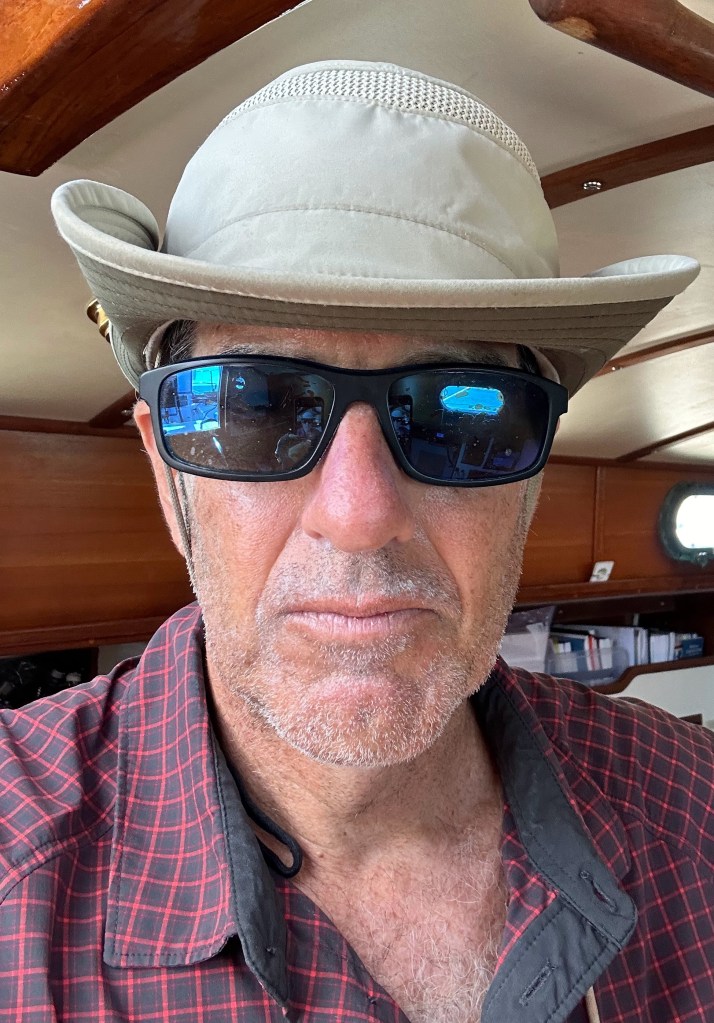
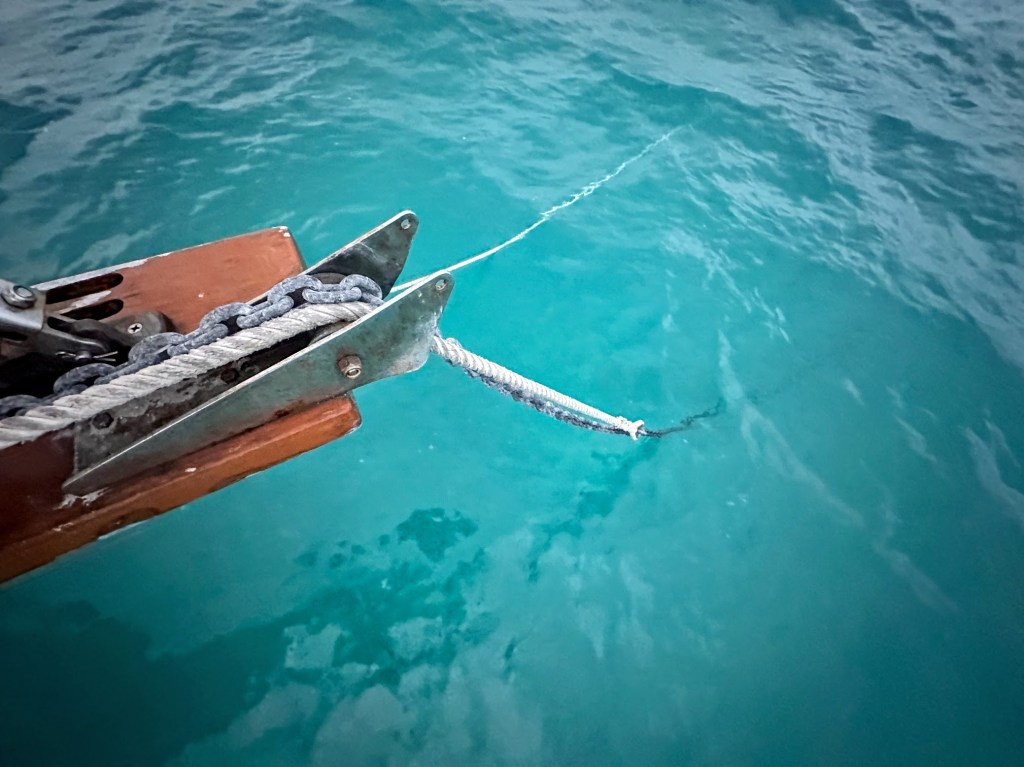
Earlier today, I was anchored just off the coast of Great Abaco Island directly across from Manjack Cay. I’d taken refuge there yesterday from winds shifting to the south and southwest. I’d anchored at the same spot about a month ago and remembered the deserted white beach, the stunning turquoise and pale blue water near the shore, and the rocky formations and mangrove nearby. Nobody was there the last time, and no one was there this time, and I enjoyed the remoteness of it. The plan today was to take care of odds and ends on the boat during the morning and early afternoon, when the south and southwest winds would keep me pinned down, and then sail about six miles south to another anchor location near No Name Cay in the late afternoon, when the winds were forecast to shift once again. All was fine, and I ended up having a much-needed Facetime call for several hours with my daughter, Leah, who was in Denmark, and my son, Kai, in Brooklyn. Then, at around 3:00 pm, I prepped the boat for departure, and by 4:00 pm, the winds had not only shifted dramatically but also built up significantly in strength. My anchor alarm went off, and I realized I was now dragging slowly parallel to the shore. I had plenty room toward land and was not yet concerned, but I needed to move fast because the wind would soon be pushing me hard toward shore. Also, something was different. The skies were dark and menacing, and the speed at which the winds and seas were building suggested some kind of local storm or squall, which could be very powerful and unpredictable. Sure enough, the rain started, and the wind continued to build and shift toward the shore.
The boat by now was mostly prepped to go, but I realized that the winds probably were too strong for the genoa, and I was concerned that a building storm could quickly put me in the thick of even stronger winds and seas. I took the prudent option and decided to deploy my staysail instead of the genoa, the staysail being the smaller of the two and intended for heavy weather conditions. However, deploying the staysail required that I first reattach the inner stay on the foredeck and then physically carry the staysail forward in its sail bag and prep it to be raised. The inner stay is a steel cable attached on one end near the top of the mast and the other end on the foredeck, and it serves as the attachment point for the leading edge of the staysail. As standard practice, when I finish using the staysail, I always detach the inner stay from the foredeck and secure it at the base of a stanchion on the port side in order to keep it out of the way of the genoa, which otherwise would get snagged on it whenever trying to tack.
The boat was now bouncing and bucking in the building seas, and I moved carefully up the port side deck to the stanchion where the inner stay was attached. I first unlashed the metal retaining brace James had specially machined for me for stowing the inner stay. I carried it quickly back to the cockpit so as not to lose it overboard and then returned to inner stay. There I pulled out the retaining pin holding the stay in place at the base of the stanchion, pulled the stay around the outside of the shroud, and walked the stay to the bow. Kneeling carefully to keep my balance on the bouncing foredeck, I inserted the end of the turnbuckle into the deck fitting and secured it in place with the retaining pin. I then manually rotated the turnbuckle at the base of the inner stay counter-clockwise to tighten it and stopped at the tapped markings on the screw threads, which indicated the point that would provide the proper tension in the inner stay. First job done.
Then I made my way carefully back to the cockpit, released the two staysail sheets from their cleats, grabbed the large sail bag for the staysail, and headed back to the foredeck. I located the tack, the bottom forward corner of the sail, secured it to the fitting at the base of the inner stay, and then began attaching one by one the metal hanks that secured the sail to the inner stay. Once done, I went back to the mast, uncleated the halyard for the staysail, unclipped the opposite end of the halyard from where it was attached to a stanchion for stowage, walked the end to the top of the staysail and clipped it on. I then took a sail tie, a strip of clothe for tying and securing sails, and lashed the staysail along with the halyard to the port lifeline to keep it out of the way of the anchor windlass, since in a matter of minutes I would need all the room I could get to bring the anchor back in. Before going back to the cockpit, I attached the two staysail sheets to the clew of the staysail, the bottom back corner of the sail. As I dropped back into the cockpit, I quickly grabbed the port staysail sheet and pulled it snug, both to help keep the sail secure on the foredeck and also to pull it to the port side and out of the way of the windlass.
I was now ready to leave, and I needed to do so quickly given the building and shifting weather. I stepped down the companionway ladder and turned on my Garmin Inreach satellite tracker, which I always do before setting sail. Then I checked my navigation and other systems. Chart plotter, depth sounder, VHF, AIS, and autopilot were all on. Earlier, I’d set up the Pelagic autopilot and the Monitor wind vane, my two self-steering systems, so they were ready to go. The remote control for the Pelagic was around my neck, and I was wearing my offshore personal flotation device. The mainsail cover was off, the mainsail halyard was attached, and I’d already set the lines for a triple reef, the most suitable set-up for the mainsail for heavy weather. I opened the engine well, started the Tohatsu outboard in neutral and headed to the foredeck to raise the anchor. Once at the foredeck, I realized that the force of the wind and seas were putting a huge load on the anchor rode, so I went back to the cockpit, shifted the Tohatsu into forward, and gave it a bit of throttle. The risk in doing this is that the boat can yaw back and forth against the anchor rode when the engine is powering the boat forward. However, I needed all the help I could get and would hope for the best. Once back at the foredeck, I inserted the steel pipe for the windlass into the winch and cranked several cycles to bring in about four or five feet of the chain rode. I needed to do this in order to first detach the snubber line, a thick three-strand nylon line with a heavy hook at the end. When deployed, the hook is locked onto the anchor rode about six or seven feet down from the bow, generally about a foot above the water, and the free end runs up to the bow along with the chain rode and then to the bow cleat, where it is cleated off. By then easing a foot or two of chain out, all of the load is borne by the snubber line and bow cleat instead of the windlass. After detaching the snubber line and setting it out of the way on the foredeck, I began the difficult and tedious process of cranking in 150 feet of heavy chain stretched taught between the boat and anchor by the heavy winds and seas.
In mild conditions, it’s possible to just grab the chain from a standing position and haul it in hand over hand. It’s hard work and requires gloves, but it’s quick and effective. In today’s conditions, however, that approach was absolutely impossible. I was struggling even with the slow but very powerful windlass winch. The Tohatsu was helping a bit by pushing the boat forward and taking off some of the load. I then found that the trick was to time my pumps on the winch handle to the instant that the bucking bow of the boat created a second or two of slack in the chain. It was stop-start, exhausting, and very slow going, but I gradually hauled the chain up and dropped it through the deck chain pipe into the chain locker below. Once I was down to about fifty feet left, I became concerned that the anchor could dislodge and the wind and seas could push me quickly toward shore. I cranked the final stretch as fast and hard as I could, and finally the anchor broke the surface of the water, and I was able to winch it onto the pulpit. Then, in a fast and daily repeated drill, I tied the windlass handle to a stanchion to prevent it from falling overboard, put the metal cover back on the deck chain pipe, and lashed the anchor to the bow cleat so that it could not slip off the bow while underway. I grabbed the snubber line and headed back to the cockpit.
I throttled up the Tohatsu and pointed the boat directly away from land. I then checked my course, engaged the Pelagic autopilot, gave some slack in the staysail sheets, and headed immediately up to the foredeck to raise the staysail. I removed the sail tie keeping the staysail secure then went to the mast and hauled down on the halyard to raise the sail. It went up fast, and in seconds I had the free end of the halyard cleated and secured on the mast. I headed back to the cockpit where I checked the course again quickly and pulled in the working jib sheet to trim the staysail. I then turned off the Tohatsu, tipped the prop out of the water and closed the cover for the engine well. I then immediately disengaged the Pelagic steering arm that attached to the tiller, set the Pelagic in standby mode, adjusted the course control lines on the Monitor wind vane so the vane was standing straight up, and then engaged the Monitor by clipping the steering chain onto the tiller.
I was now underway with sail power alone and steering by the wind vane. At last, I could take a breather and just monitor the situation. I had six miles to go, and since I was making decent enough speed just with the staysail, I decided not to bother raising the mainsail just yet. I also wanted to take it a bit slow to allow time for the heavy winds and seas to die down a bit before I arrived. After about thirty minutes, conditions began to ease a bit, and I realized that it would be easier for me to deal with the genoa when arriving at the anchor location rather than the staysail. The genoa allows for quick and easy deployment and dousing from the cockpit, which is ideal when sailing into a potentially tricky or crowded anchorage, whereas the staysail requires me to go up to the foredeck in order to bring it down. By that point, I thought the genoa would be fine in those wind conditions, so I went ahead and unfurled it all the way. This powered up the boat immediately, and soon I was ripping along at six knots or so. The staysail was still deployed, so after checking the course and the wind vane, I went to the foredeck, lowered the staysail, stuffed it in its sail bag, and carried it back to the cockpit. I threw the staysail bag below deck to get it out of the way temporarily, and then I was back at the foredeck this time detaching the inner stay from its bow fitting and stowing it out of the way on the port side.
The rest of the trip was smooth and easy. The Monitor steered me the whole way until about the last mile, when I switched back to the Pelagic. When I was about half a mile away from the anchor site and still blasting along at a good speed, I depowered by furling in about half of the genoa. This slowed the boat down immediately and allowed me to shift to piloting and anchoring mode, requiring slower speeds and careful control over the boat. At about a quarter mile out, I started the Tohatsu in neutral, and soon after I furled in the rest of the genoa. I shifted the Tohatsu into forward, double checked my course, and throttled up a bit. Then it was back to the foredeck to prep for dropping the anchor, which included freeing up the deck chain pipe, unlashing the pipe handle, and unlashing the anchor. Back in the cockpit, I confirmed my final approach into the wind, and at a point where my depth sounder showed ten feet, I gave the Tohatsu a quick shot in reverse to stop the boat, shifted back to neutral, then headed quickly to the foredeck. With the pipe handle, I loosened the wing nut and gave the anchor rode a tug to allow the anchor to drop. Down it went, hitting the water with a splash, and I then allowed about twenty five feet of chain rode to run out. I walked back to the cockpit and pumped the Tohatsu in reverse a few times to help set the anchor firmly. I then headed back to the foredeck where I gradually let out 150 feet of chain rode. Once I was happy that the anchor was deployed properly and the foredeck was in good shape, I went back to the cockpit and set the anchor alarm on the Garmin chart plotter. I set it for a 100 foot radius, and as soon as I engaged it, the chart screen reappeared, this time with a green circle around my boat. In the event the boat migrated outside of the circle, the alarm would go off. Technically, since I always put out 150 feet of rode, a 100 foot radius alarm does not mean that I’ve dragged anchor. Still, I like to be forewarned, so I generally set it at 100 feet. No harm done.
Now I was securely anchored after a late afternoon adrenaline rush getting out of my prior anchorage. However, the work was not done yet. When I spoke to James yesterday, he suggested I put out a second anchor tonight based on the expected conditions and the location. I only had about an hour of daylight left, and I was tired and nursing a strained neck muscle, but I thought that James’ recommendation was the way to go, so I immediately went into overdrive again. The first step was to deploy the dinghy, which was lashed to the foredeck. I usually hoist it up from the its bow using the spinnaker halyard, and then I lift the other side of the dinghy over the side of the boat. Today, however, I was feeling impatient with all of that, so instead I tied a long bow line to the dinghy, positioned the dinghy on its edge on the starboard side of the foredeck, got a good handhold, then lifted and threw the dinghy over the side with my own strength. I don’t think it helped my neck strain, but I got it done and quickly. Next, I tied it up by the gate near the cockpit and proceeded to mount the electric motor, battery and oars. In went the dingy anchor, a backpack with handheld VHF and headlamp, in case it got dark, several floatation cushions, and the trip line and float for second anchor. Then, back in the cockpit, I pulled out the bimini, cloth awning, storm jib, mainsail cover, fenders, and other gear from the starboard cockpit locker so I could access the second anchor and rode at the bottom. After hauling them out, I positioned them carefully by the gate near the dinghy, then walked the free end of the rope anchor rode up to the foredeck, being careful it ran on the outside of all the shrouds, and then cleated it on the port bow cleat. Back in the dinghy, I made sure I had everything I needed, and then carefully took the second anchor from the deck and set it in the dinghy. I then flaked out all of the rope and chain rode into the dinghy near the stern, and once done untied the dinghy and began motoring toward the front of Swan. As I passed the bow, I aimed for a heading some sixty degrees off of the primary anchor rode and throttled up the dinghy away from Swan’s bow. As I proceeded, moving now somewhat quickly away from Swan, I feed out the rope rode over the stern of the dinghy. Once all the rope was played out, I began playing out the thirty-three feet of chain, trying desperately all the while to keep the dinghy in a good position to drop the anchor. Finally, the chain was all deployed, and I carefully lifted the anchor and threw it over the side. I then took the float and trip line, which was tied to the anchor, and threw them over the side. The anchor was now deployed, the dinghy was free, and I was able to turn and go back to Swan. Once back, I inspected the anchor rodes at the bow and found that I hit a pretty nice angle of about forty degrees between them. It’s now 10:00 pm, I’ve just checked the anchor alarm again, and the boat has not budged.
It’s been another interesting day in the Abacos, and not untypical. Let’s see what tomorrow brings.
10 March 2024 – More Dodging and Weaving, and the Agile Mindset in the World of the Solo Voyaging Sailor
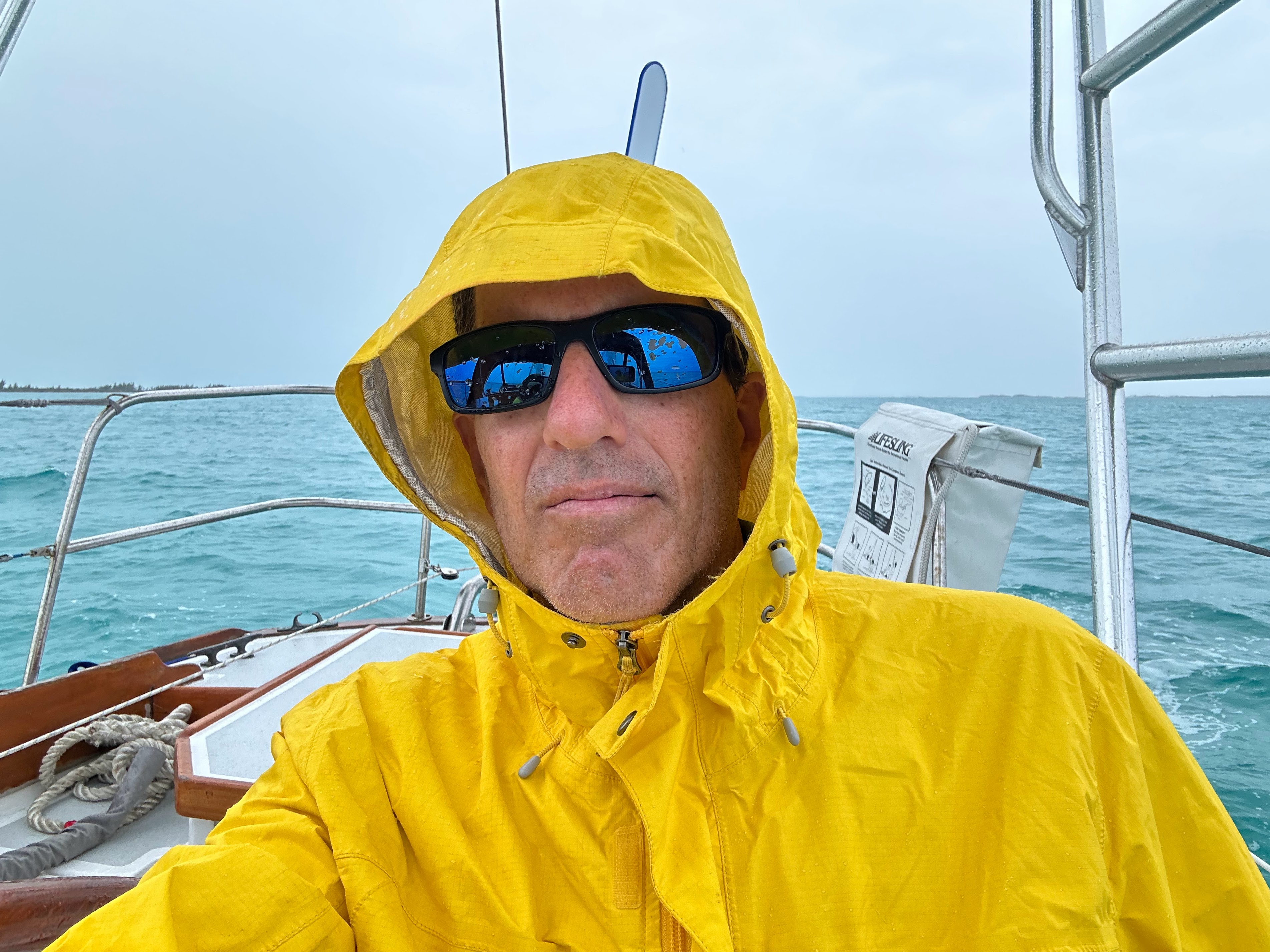
My daily routine of checking Windy.com, a go-to weather app for sailors, and ducking for cover into new anchorages continues. Apparently, at this time of year in the Abacos, regular cold fronts and other weather systems generate highly unstable wind patterns, resulting in frequent shifts in wind direction and wind speed. There is a degree of predictability at times, to the extent that incoming cold fronts generally cause the wind direction to clock around 360 degrees within a day or two and the wind speed to increase significantly, but this common pattern is embedded in a broader context of volatility, so the overall picture is always changing and uncertain. Getting caught at the wrong anchorage at the wrong time can be dicey and even dangerous. If strong winds and seas are pushing your boat toward a nearby shoreline, and then your anchor begins to drag, you could wind up being the next victim of what sailors call shipwreck at anchor. Even if the situation does not become that dire, there is an incredible load on the anchor and anchor rode when trying to wait out rough conditions on the hook. In the end, it’s all best to be avoided, and the trick is simple: try to find a place to anchor where nearby land will provide some protection from the wind and where there are no immediate obstacles downwind that you could be blown into, including land, shallow water, or other boats. Each day for the past five days, I’ve had to move my anchor location to escape the strong and shifting winds. Yesterday, I dodged three miles from Coco Bay on Green Turtle Cay to tuck in along the coast of Great Abaco Island in order to shelter from strong south and southwest winds. The day before, I’d slipped into Coco Bay from a location a mile south outside of White Sound in order to get better shelter from southeasterly winds. Later this afternoon, the winds are expected to clock around to the west and then northwest, so I will need to move to a spot about three miles from here just off of No Name Cay, and then tomorrow, when the winds shift to the southeast, I’ll duck into a spot right outside of Black Sound and New Plymouth. It’s kept me on the defensive and on my toes constantly.
So, I have a few hours to kill before I make the next move. As I sit below deck in my tiny quarters at my fold-up table, I’m taking a look at a list of themes and topics I keep related to my sailing experience, and a few jump out at me that seem particularly relevant to this past five weeks since I cast off from St. Simons Island in Georgia.
They are: Uncertainty, Fear, Risk, Confidence, Competence, Solitude, Patience, Age, and Focus
Uncertainty defines the life of a solo voyaging sailor. At the core, Mother Nature decides everything — where you will go, when you will go, and how you will get there. In my prior life in the corporate world in New York City, part of my portfolio was project management, which is all about trying to squeeze uncertainty out of undertakings and situations that are inherently uncertain. I’ve learned quickly that in my new life of sailing, it’s impossible to take a “waterfall” approach — in the parlance of project management — which involves planning every detail at the outset and then just executing. A good analogy is an architect who draws up a detailed blueprint for a building and then hands it off to the construction company who then goes and builds it according to spec. This is impossible in the world of sailing. There is too much uncertainty. Instead, the sailor must always have an “agile” mentality. In the corporate world, “agile,” taken from agile project management, has become a fashionable buzzword, the type that people use in meetings because it sounds smart and informed, so it’s parroted and overused. All the while, the real meaning generally is not understood. The uninformed conventional wisdom seems to emphasize the importance of being able to react quickly and ad hoc to unexpected events. In reality, agile is the opposite. It’s all about how to manage work in a systematic, methodical and highly proactive manner amidst a high degree kind of uncertainty and change. It’s all about avoiding a reactive and ad hoc stance, not promoting it.
What’s important is when and how to plan next steps in the midst of such uncertainty. The sailor knows she is often dealing with an incomplete and changing deck of cards in terms of information. It is, after all, the weather itself that determines what, when and how she will be able to take her next steps, and weather forecasts are worthless if more than five days out. This necessitates the agile mindset. A good sailor knows that you make a high level plan, and one or two contingency plans, but then you wait until you know the specific conditions you’re facing before you solidify the real plan of action. Since those conditions can change quickly, you need to be ready to go once the plan comes together, and the plan itself can materialize very quickly. Until then, the good sailor knows not to sweat it. The NYC project manager (me) will drive himself crazy trying to make and remake detailed plans way in advance while the experienced sailor will kick back and wait, knowing the right time to engage, and will use the intervening time instead to varnish that chipped teak on deck or dive in for a nice snorkel in the beautiful turqoise water. Among other things, this is another area of ongoing learning for me.
Other themes I mentioned above will await comment for another day!
9 March 2024 – Water, Trash, Laundry and an Errands Run on the Dinghy
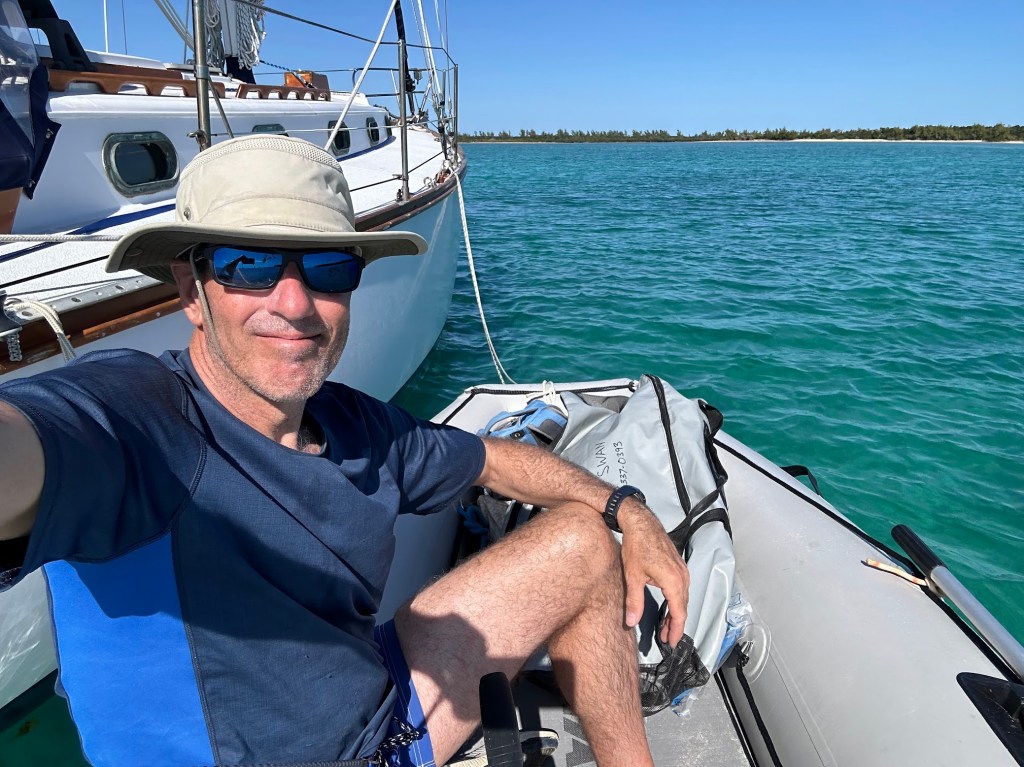
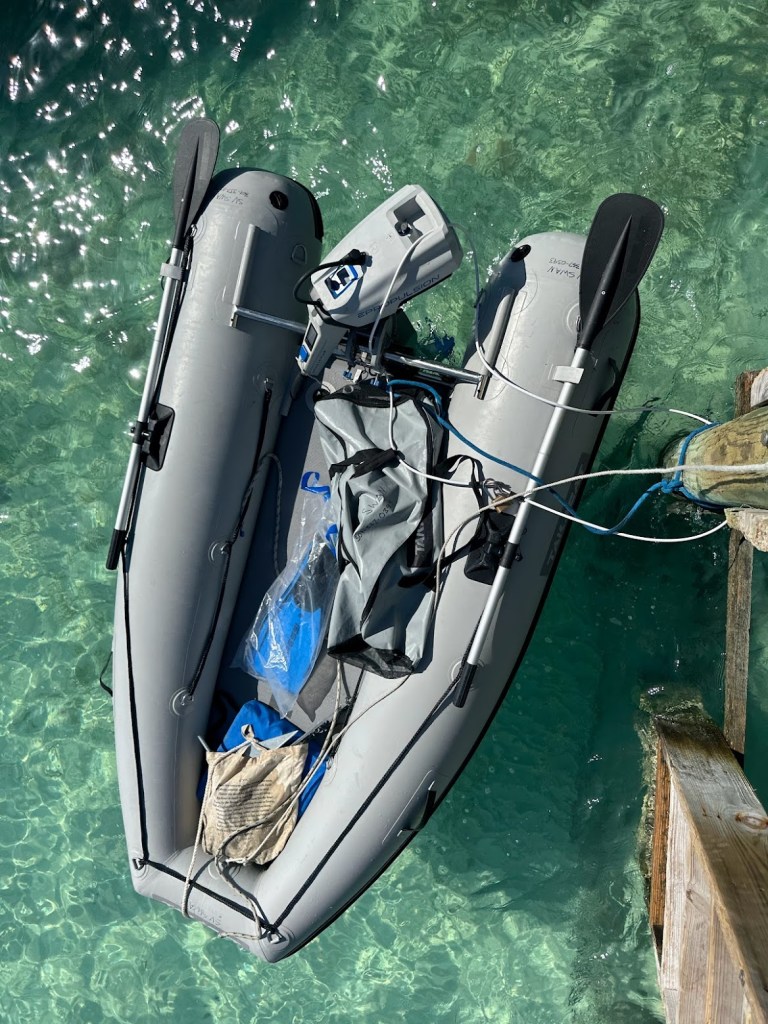
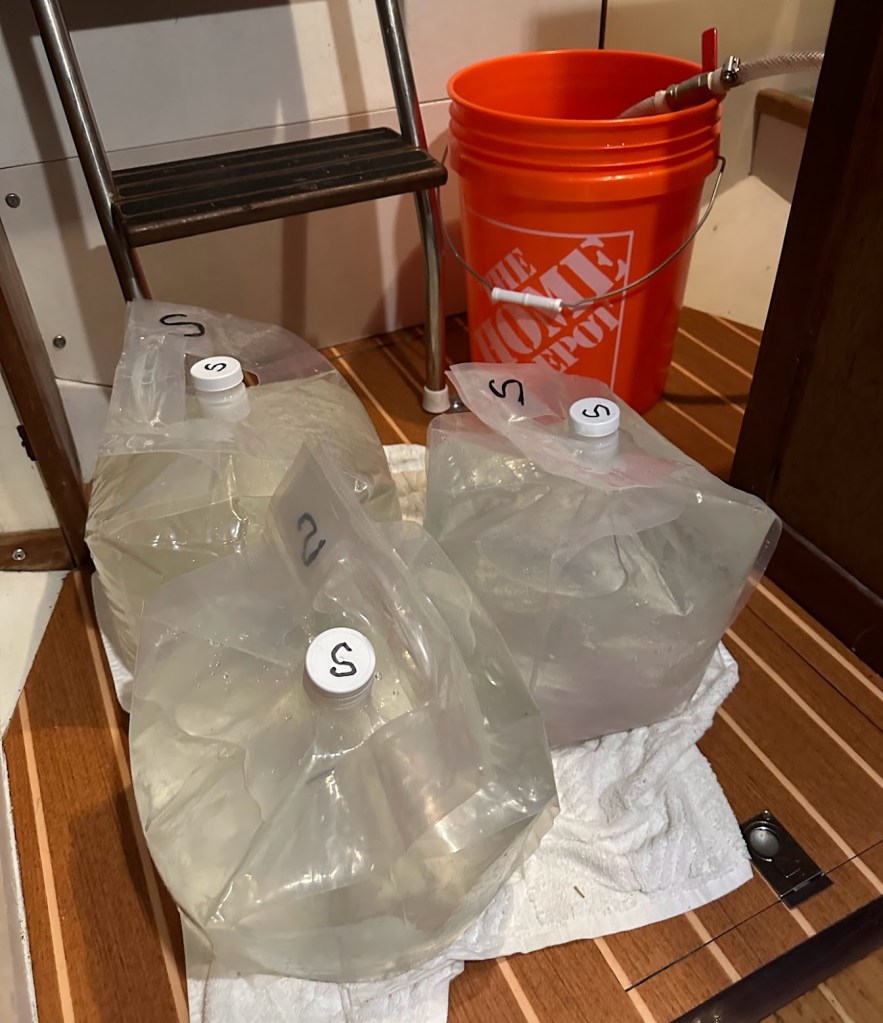
Yesterday morning, I was back anchored just outside of White Sound on Green Turtle Cay, the first place I anchored a month ago when I dinghied into White Sound and cleared in with customs at the Green Turtle Club. This time I was back after about ten days exploring some islands to the north, and I needed to catch up on some basic errands, including laundry, trash disposal and replenishment of my water supply. I picked this site to drop my hook both because it gave me the protection I needed from the winds on that particular day and also strategically because it was a quick shot in with the dinghy to Green Turtle Club where I could take care of all of those tasks at once. White Sound is definitely the posh moneyed side of the tracks as compared to Black Sound, the site of the main town, New Plymouth, which has a homey charm and is more down-to-earth. Normally, Black Sound is my preference, but for convenience sake, I knew I could duck quickly into the Green Turtle Club and take care of my errands most efficiently.
I loaded up my tiny Takacat dinghy, which groaned and moaned under the weight of two sacks of dirty laundry, a big bag of trash, the dinghy anchor, my backpack, the duffel bag of dinghy accessories, and of course, me. Still, she was as stable and reliable as ever and ferried me slowly toward the White Sound entrance, into the channel, and along the long turquoise stretch to the Green Turtle Club. Along the way, another dinghy passed me slowly, and I struck up a quick conversation with the occupant, Ann, from a sailboat called Bees Knees who was coming in to clear with customs. As she putzed along away from me, she pointed to her Yamaha outboard and said with an unhappy face, “Very loud!” I have an ePropulsion Spirit 1.0 electric outboard for my dinghy, which I absolutely love. Many people worry about range, much like with electric cars, but I generally keep the throttle at around 100 watts, which moves me along at a slow walking pace, and I can go for hours and hours without recharging. I’m never really in a rush, so that pace is fine with me, and I can always throttle up if needed. Another benefit is how quiet it is. It’s amazing how loud some of these gas dinghy motors are. You can be in a quiet secluded cove, and someone’s small gas dinghy motor will cut through and destroy the silence, even from a distance. I’ve discovered that I can use my dinghy under power much like a canoe or kayak and explore beautiful natural areas in very shallow water. The motor makes virtually no sound, so you just ghost along without startling the wildlife.
Once at the Green Turtle Club, I found a good place to tie up on the very high docks, threw my laundry bags, trash bag, and knapsack up and over onto the wood planks, and tied up. Following James’ advice, I always lock the dinghy using a special long cable he made for me for that purpose. The bow gets tied up with a line, and then at the stern I run the cable through the motor, battery, dinghy and duffel bag before looping it around a piling and then clicking the combination lock shut. It serves as a kind of stern line, which is convenient, but I’ve learned with these very high docks that the trick is to tie the bow line up high so it’s still reachable from the dock. I had a couple occasions when I tied the bow line down low, and then the dinghy migrated away from the ladder leading up to the dock, which left me no easy way to untie the dinghy or to get down to it. I solved the problem by dropping myself off the edge of the high dock into the dinghy, and managed to do it without killing myself or sinking the dinghy, but that’s a different story. Suffice it to say that I now always keep the bow line tied high so that I can grab it from the dock and then use it to pull the dinghy back towards the ladder. As I’ve learned, there’s an art even to tying up a dinghy.
The trash quickly disappeared into a large garbage can on the dock, and one errand was immediately checked off. I then went to the desk at the Green Turtle Club and bought a half dozen tokens for the laundry machines and dryers at five bucks a piece. I barely spend money on anything, and finally getting laundry done was a high priority, so the expense was no issue. Soon, my clothes and sheets were spinning in suds in four laundry machines, and then I was off to find water. I was able to fill eight 2.5 gallon soft jugs from a hose on the dock at 35 cents a gallon, and that allowed me to top off my full water supply at about 110 gallons. My regular water tanks hold 75 gallons, and I keep an additional 35 gallons stored mostly in soft jugs in a couple lockers. I recently confirmed that I use about 1.5 gallons per day, so if I’m at full capacity, in theory I can go for almost 75 days without replenishing my supply. One recent milestone was my use of a new rainwater collection system that James and I installed. By “system,” I don’t mean that it’s in any way complex or sophisticated, because the beauty is in the simplicity of it. All it involves is a hole in the deck and a hose running below with a couple valves. We drilled the hole on the port side by the galley, so the hose runs straight into a cabinet in the galley where it can be easily coiled and stowed. When it starts to rain, I run out on deck with three small rubber plugs I cut from some spare gasket and plug the three drain holes on the port side toerail. That stops up the water and allows it to collect and flow into the intake hole. From there, back in the galley, I just put the end of the hose in a bucket, open the two valves, and let the rain water flow. I discard the first half gallon or so which carries with it any dust and dirt collected on deck, and then I just take as much rain water as I need or as much as Mother Nature has to spare at the time. The other day, I quickly filled three 2.5 gallon soft jugs, which was all I needed. For now, I am using the rain water I collect for bathing, which I do in the cockpit. At the moment, I have enough water for about five or six showers, and given that I don’t shower that frequently, which is another story, it hopefully will last until the next good rain.
I treated myself to a conch lunch at the Green Turtle Club, a rare moment of decadence, and then walked up the dock to untie my dinghy and head off. I discovered that somebody from some superyacht had pushed aside my dinghy and tied up their 35-foot high-speed motorboat straight across the ladder going down to the water. This made it impossible for me to access my dinghy as I’d planned, by simply climbing down, and instead I had to revert to my commando technique dropping myself directly into the dinghy from the high dock. In the end, it was no problem, because I’m now somewhat of an expert, but it was almost shocking to see someone tie up their boat in that way. There are several basic protocols about tying up dinghies in the Bahamas that seem to be Gospel to sailors here, including using a long bow line to allow other dinghies to squeeze in and to never tie up in a way that blocks the ladder for others. But then, I’m not responsible for other peoples’ thinking and behavior, so I quickly got over it. It just seems to be from another universe.
My two bags of laundry were splashed with some sea water on the dinghy ride back to Swan, but my sheets dried out quickly once I hung them over the boom under the sun, and overall it was a successful little expedition. Next up: a grocery run to Sid’s or Curry’s in New Plymouth to restock before John arrives.
8 March 2024 – Foxtown and Allans-Pensacola, and Mother Nature Keeping Me Humble
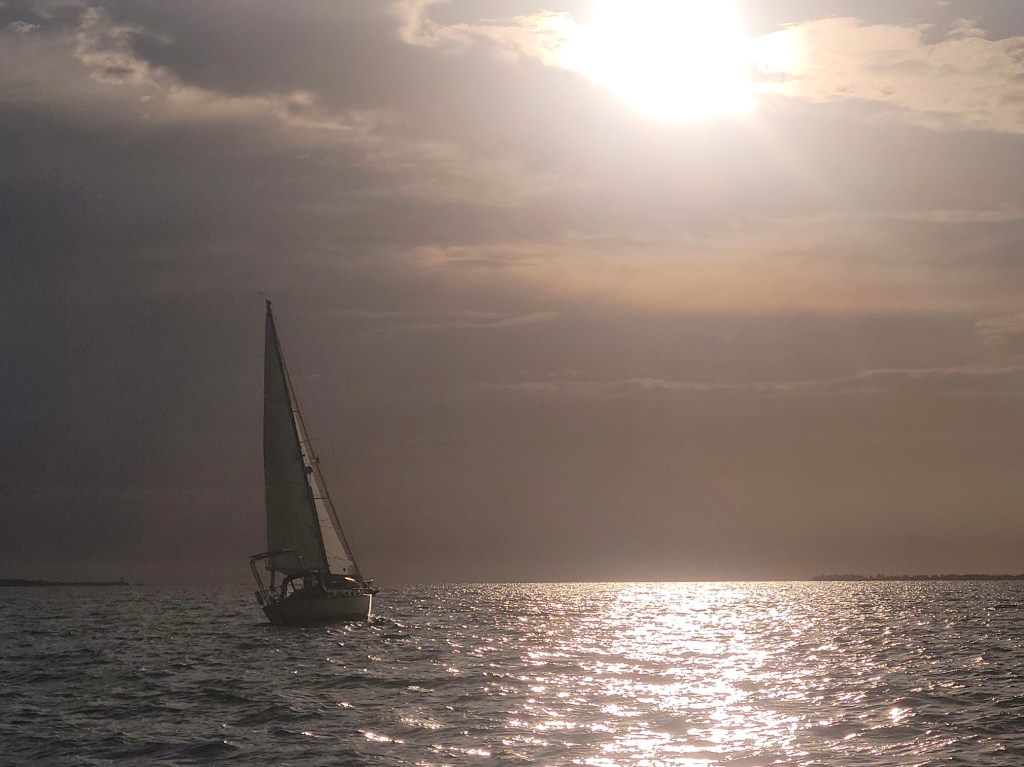
Yesterday, I sailed down to Green Turtle Cay from Cooperstown, where I’d ducked in to anchor for a night for protection from southwest winds. Before Cooperstown, I was at Crab Cay for a night taking cover, and before that I was at Foxtown. I didn’t even have a chance to get off the boat at Cooperstown or Crab Cay, but I spent a nice few hours onshore at Foxtown, including a conch lunch at Da Valley restaurant, some food shopping at the the only real grocery store, and a stroll up and down the main street. The conch lunch was the best meal I’d had in ages and really lifted my spirits. I was so glad I decided to treat myself. The view from the tiny deck at the tiny Da Valley restaurant was spectacular. I was right at the water’s edge looking out at the Sea of Abaco, Hawksbill Cay, and the multitude of other small rocky cays scattered randomly right off the shore. The turquoise water looked like it was backlit it was so brilliant and clear.
I loved the quiet low key feel of Foxtown and appreciated the lack of any sign of the tourist industry and related commercialization. That, of course, cuts two ways, because the town also was a bit run down, and I suspected that folks there might have been struggling economically. There were also signs of hurricane damage everywhere, which is common in the Abacos, but in Foxtown it was more visible, and the recovery looked less complete, if not abandoned altogether. I struck up a conversation with a young Bahamian, Marco, who instructed me where I could tie up when I was coming in on the dinghy. We sat in the small gazebo next to the public dock and shot the breeze about this and that, including how there were many more small cays in the Abacos than in other parts of the Bahamas, according to Marco, and how many sharks there are in these waters, underscored by an attack suffered by his uncle who was left with a savage scar across his back and shoulder. This kind of casual connection with people and place was what I needed. Foxtown was a pleasant and much welcomed reset for me.
Foxtown was actually preceded by a trip to Allans-Pensacola Cay, both of which were part of a week-long excursion north from Green Turtle Cay, where I’d been holed up for a while due to weather just after I arrived. I’d hoped also to make it to Moraine Cay, Powell Cay and Double Breasted Cay, but again due to weather those will need to wait for another day. Still, it turned out to be a worthwhile trip, even though it amounted to skipping from Crab Cay out Allans-Pensacola and then out again to Foxtown before starting the trip back to the Green Turtle area. I’m meeting my brother, John, at Green Turtle on March 12, and I wanted to get an early start back so as not to risk any delay. I know enough about the weather here now that you need to take your opening when you get it, otherwise you could be out of luck getting to where you need to be. The good news, as mentioned above, was that I sailed from Cooperstown yesterday to Green Turtle Cay, so I’m back to where I need to be to meet John in a few days.
That simple trip from Cooperstown, however, was not without its own weather-related complications. The forecast called for decent wind from a decent direction from sunrise until about 1:00 pm, at which point the wind would die off and also shift direction. I realized I could get stuck partway to Green Turtle, so I got an early start to take advantage of the favorable morning conditions. I raised anchor at 7:00 am and was soon clipping along at 6.5 knots on a broad reach with full main and genoa. The sunrise created a spectacular view across the Sea of Abaco with the islands in the distance, and as I was taking it all in, I noticed a small motorboat with outboard engine changing course toward me, and the fellow at the helm clearly was taking photos of Swan and me with the sunrise in the background. He made a friendly gesture from a distance, continued taking shots, and then sped up and pulled up along Swan on the starboard side by the cockpit. He had a card in his hand, and he deftly maneuvered his boat close enough to Swan so I could reach across and take it from his hand. It turned out his name was Gary White, and later that day, after anchoring, I emailed him with the address on his card. Shortly thereafter, I received a reply with several stunning shots of Swan, and I thanked him profusely for steering out of his way and going through the trouble of sending me the photos.
From there, the trip went too well, meaning that I was going so fast that I would arrive at Green Turtle before the wind eased and shifted direction, which would make it impossible for me to anchor there. Sure enough, despite my efforts to slow the boat, including easing the sheets and furling part of the genoa, I arrived at 10:30 when the wind was in full force from an unfavorable angle for dropping the hook. I thought I’d kill some time until the wind conditions changed and tried heaving to for a while, a simple way of setting the sails that usually kills much of the boat speed. I did that for half an hour and then decided I’d cross the couple miles over to the coast of Great Abaco Island and anchor there, since that was the one place with protection from the southwest winds that were blasting through. I figured I could have lunch at anchor, monitor conditions, and at the right time scoot back over to Green Turtle to anchor for the night. Unfortunately, the wind shift, while it did finally come, was much delayed, and it wasn’t until about 4:00 pm that I raised anchor and headed toward Joyless Point, the rather inauspicious name of the spot where I planned to drop anchor just outside of the entrance to White Sound.
As these things go, not surprisingly, not only did the wind finally ease up after I raised anchor, but it almost died off completely. I only had a short distance to go and didn’t want to trouble with the mainsail, so I was patient and tolerated the 2.5 knots or so that the full genoa was able to squeeze out for me. When I finally arrived and dropped anchor, it had turned out to be another day in the Abacos with unexpected twists and turns, and while there was nothing extreme I needed to deal with, there was enough from the moment I awoke in the morning to keep me on my toes constantly through the day. I actually am enjoying all of this, and as long as my stamina and sense of humor prevail, I’m comfortable knowing that it’s also likely making me a better sailor. I no longer have any expectations of lazy days in paradise, which is fine. Bring it on, as long as it’s still in manageable doses for something of a newbie to all of this. I know full well it’s too soon to get cocky just yet. I’ve been tested enough already that my new motto is “Eternally Humble,” which takes the proud position next to my prior long-standing motto, “Nothing is Easy.” Especially true in the face of Mother Nature in the Abacos.
7 March 2024 – A Whirlwind First Month Voyaging on Swan
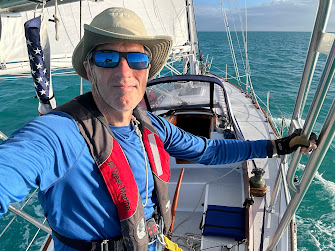
On 28 January, I cast off for good from St. Simons Island, Georgia, which had been my home base for the past twenty months. I was finally transitioning from the long refit project with James Baldwin, my mentor, to actually living and voyaging aboard Swan. The target destination was the Abaco Islands in the Bahamas, and the trip began with a demanding first leg to Fort Pierce, Florida. Fort Pierce was chosen as a good stop-over anchorage and also potentially a good launch point for crossing the Gulf Stream to the Sea of Abaco. Due to weather, I was forced to take this route south hugging the coast instead of going straight offshore and then dropping down straight into the Bahamas. I was joined by Brett Grover, an outstanding sailor and friend from St. Simons, and since I was not going to be single-handing right away, it meant that we could make this longer coastal passage without stopping. A single-hander can get sleep if sailing well offshore where there is minimal boat traffic, but along the coast, it’s highly risky to doze off, so solo sailors often limit their coastal legs to overnighters, which is basically the limit for how long someone can stay awake comfortably. With Brett aboard, however, we could alternate watch duty at night and thus each get a reasonable amount of sleep, and this allowed us to sail for a longer period of time without stopping to rest. The trip to Fort Pierce took about forty-eight hours. We left at noon on a Sunday, sailed through the night and through Monday, continued through Monday night, and arrived around noon on Tuesday. Most of the time we were ripping along at six to seven knots, day and night. It was a great sail, but Brett and I were exhausted by the time we arrived.
Since setting sail, I have been constantly on the move on Swan, first making the coastal passage down to Fort Pierce, then on to West Palm via the Intracoastal Waterway, and from there across the Gulf Stream and into the Sea of Abaco and the Bahamas. It’s been a whirlwind of challenges and new experiences, and every day has been rich and full, if not easy. Brett returned home to Georgia after we arrived in West Palm, so I was on my own from there on. The thirty-hour solo sail from West Palm to Great Sale Cay felt like one the biggest milestones in my life. When I finally dropped anchor off the beautiful, uninhabited island, I was emotionally and physically exhausted but also euphoric. I couldn’t believe I’d reached the destination, and making the crossing from Florida single-handed gave me a special feeling of accomplishment. Navigating solo across the Gulf Stream and into the Sea of Abaco at night was something I will never forget. The current threw me so far off course that I thought I might end up all the way north of the Bahamas and have to tack back the next day, but fortunately, once the current eased, I was able to sail on a much better angle and recovered all the ground I lost. Around midnight, I ended up sailing into the Sea of Abaco at White Sand Ridge, exactly where I’d originally planned.
Since arriving in the Abacos and checking in with Customs at Green Turtle Cay, I’ve spent most of my time dodging strong and shifty winds common this time of year, and I’ve rarely stayed anchored at the same location more than two nights. As a result, I’ve anchored at four different locations at Green Turtle Cay alone, two at Manjack, two right across the water along Great Abaco Island, two off of No Name Cay, plus additional stops at Foxtown, Crab Cay, Allans-Pensacola Cay and Cooperstown. Since I’ve constantly been on the move, raising anchor and setting sail to a new anchorage for protection almost every day, the last month has been like an intensive solo sailing course. I’ve raised and lowered anchor more times that I can count; used my second anchor on multiple occasions, including for a Bahamian mooring at Allans-Pensacola and a do-or-die heave off the bow at night at Foxtown as insurance not to drag into the shore when a squall suddenly roared in; raised anchor and left under sail multiple times without the engine running; put in and shaken out reefs in the mainsail multiple times while underway; switched between the staysail and the Genoa while underway; managed some tricky passages straight into strong wind and choppy seas; become adept at switching seamlessly between the Pelagic autopilot, the Monitor wind vane, and hand steering; learned how to depower quickly from a fast and furious tack with full sails up to a slow and controlled tack with reduced sails and a gentle glide up to the anchor spot.
I’m still new to this, and there’s so much more to learn. The good news is that while I’ve felt stretched to the limit at times, I’ve avoided any major mishaps and have become more comfortable and competent each day. Knock on fiberglass that my good fortune will continue. For now, it’s amazing to reflect back on how much has happened and how far I’ve come in just one month. Let’s see what tomorrow brings.
4 March 2024 – A New Life… Not for Everyone
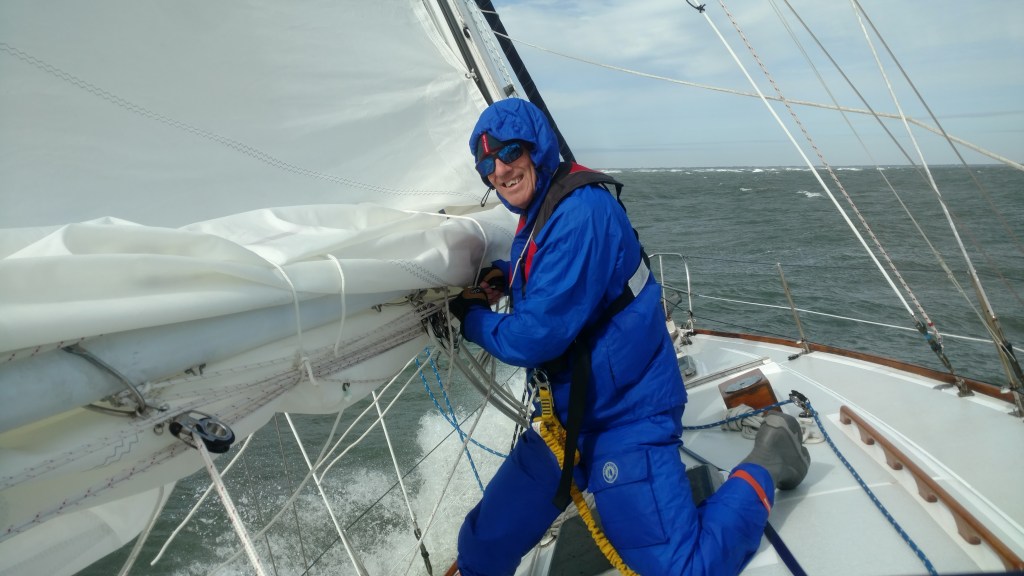
It’s been well more than a year since my last post, and in that time my life has been transformed,…again. Major milestones include completion of the Swan refit, moving onboard, and final casting off from St. Simons Island, Georgia for a life living aboard and voyaging. My first destination was Bahamas, and I arrived at Great Sale Cay in the Abacos on 11 February after crossing the Gulf Stream from West Palm, Florida. Since then, I’ve been on the defensive dodging strong and shifty winds from cold fronts and have been ducking into new anchorages almost everyday for protection. I’ve also managed to explore some of the most beautiful and unspoiled island environments in the world and find my breath taken away several times a day by the stunning nature around me.
Having said that, the single sentiment I’m left with at this point in my adventure is that it is not something I would wish upon anyone. It may sound surprising, especially if you see the photos I’ve taken of gorgeous sunsets and beaches and sailboats. This all is part of the daily reality for sure. However, it does not capture the essence of what this life is all about, and it may even be a bit misleading. The real nature of the experience is about meeting unending physical and mental challenges; needing to be focused, alert and aware at all times; and tolerating a spartan lifestyle with a high degree of built-in physical discomfort and forgoing many of the basic amenities and conveniences of modern life ashore. At the core, it’s self-imposed physical and mental stress. And as a solo sailor, when you look over your shoulder, there’s no one else there. Everything that will happen, and needs to happen, will be done by one person. There is never someone else’s turn. It’s always your turn, whether it be deploying a second anchor from a dinghy in a bouncy choppy sea, hauling down the staysail on a heaving and slippery foredeck raked at a hard angle with spray flying across the bow, or putting in a third reef on the mainsail in building winds and seas. If some action needs to be taken, you are up to bat, sometimes at extremely short notice, and it’s up to you to get it done, whether you are tired, hungry or otherwise not feeling up to it. With sailing, it’s further complicated by the fact that when things go wrong, they can really go wrong, with potentially serious consequences. Swan weighs 16,000 pounds before being loaded with tons of equipment, gear and provisions, and with the power of Mother Nature in the mix, there are tremendous forces at play. It’s not good to be slow or to get it wrong. You need to be all there, all in.
I feel tested all the time. It feels sometimes that nothing is easy. And yet, everyday is full and rich. For me, there is nothing I would rather be doing. But I would not wish this on anyone. Taking this path must come from within, and it’s not for everyone.
30 November 2023 – An Intense Solo Offshore Overnighter
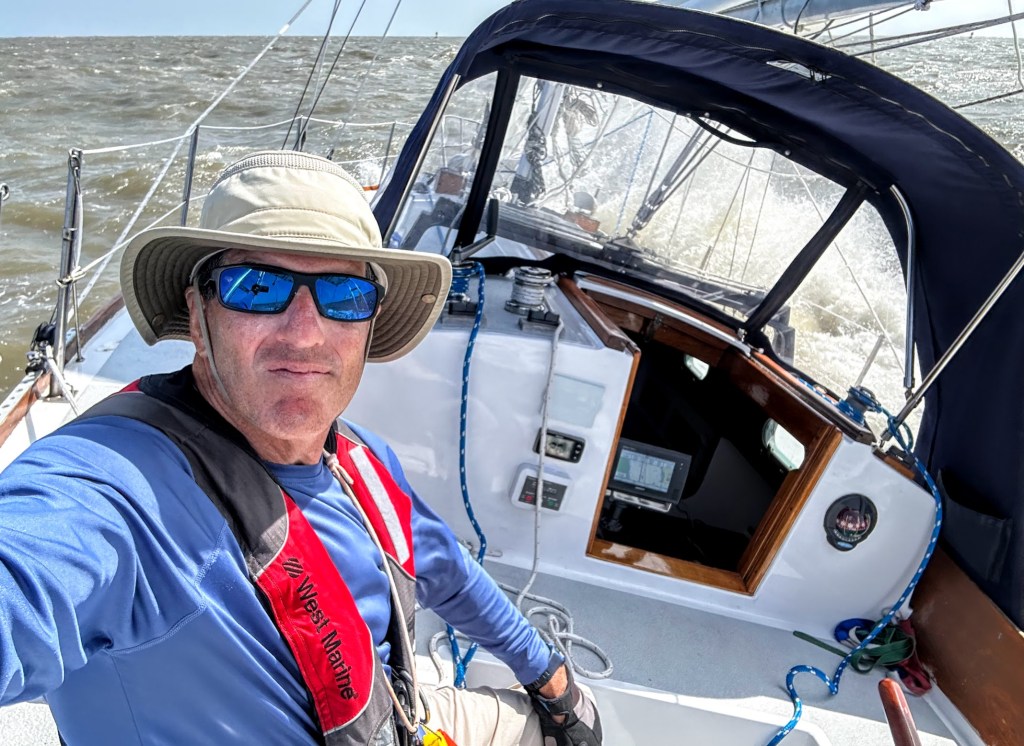
On Tuesday (11/28/2023) and Wednesday (11/29/2023), I did another offshore solo overnighter. This time, my goal was to make the whole process more routine and to reduce the level of adrenaline and drama. I also wanted to try to settle into a more predictable sleeping pattern. Overall, I wanted to see if I could do a one-nighter in a repeatable way and thus open the way for longer multiple day passages. I also needed to conquer the seasickness that wracked me during my first solo offshore overnighter. Unfortunately, it didn’t turn out as I’d hoped. Like the first solo outing, it was challenging, intense and exhausting. However, I also realized that anything within thirty miles of shore is still coastal sailing and not pure offshore sailing. The difference is in the amount of boat traffic. I spent most of the time within thirty miles of shore where there is still significant boat traffic, and that turned out to be the main challenge in terms of not being able to get sleep. Once past the thirty-mile mark, the boat traffic decreases, and things quiet down, making the sailing – and sleeping – much easier. That was a key take-away. Anyway, back to the trip.
On Monday, I spent the day prepping for departure the next day. This meant going through my usual checklist, including checking the waypoints and route both on the paper charts and chart plotter; checking the weather; filling the gas tanks; filling the water tanks; reviewing the AIS function on the VHF; charging all electrical devices, including iPad, iPhone, Inreach, portable battery, handheld VHF, headlamp, 12v house battery, and 48 v battery; preparing food, which this time included PB&J sandwiches and a few ziplocked bags of cooked pasta in the cooler; and preparing the ditch kit, a set of key items to grab in case it is ever necessary to abandon ship and board the life raft.
On Tuesday morning, I took a shower and finished the departure prep, which included setting up the jacklines and readying the inflatable life jacket; setting up the Monitor and Pelagic self-steering systems; stowing the stay sail stay; deploying the lee clothes; checking the bilge and opening all drainage valves; stowing all items below deck; emptying the urine bottle and bucket in the head; setting out the handheld VHF and winch handles in the cockpit; disconnecting and stowing the shore power cable; checking the Tohatsu oil and cooling water; turning on all sailing instruments, including depth meter, chart plotter and VHF; testing the Inreach and starting the tracking and sharing functions; and stowing the fenders and preparing the dock lines for cast off.
-
I was expecting light to moderate winds in the range of 10 knots mostly from the north and northwest based on a careful check of Windy.com the day before departure and a double-check on departure day. I decided to start the outing with full main sail and genoa with the stay sail stay stowed. I could always deploy it again if needed. I cast off at 12:40 pm with the wind almost dead behind me, which meant I needed to wait a bit for a better angle to raise the sails. By the marker ICW249, roughly a mile or so out of Frederica, I had the mainsail and genoa raised. This time I raised the main first and then the genoa, which worked fine. From there, it was a tricky departure from St. Simons Sound with the wind right on my stern. With the wind behind, the preventer should always be deployed so that the boom doesn’t swing around in an involuntary jibe, but I was in tight quarters and needed to be able to jibe quickly and frequently, so I managed without it for a while. Being short-handed seems to require these compromises sometimes because there are not enough hands. Fortunately, I was riding out with the tide, which guaranteed some forward progress. I ended up jibing a couple more times to navigate through the channel of buoys out of St. Simons Sound, but just when I was preparing to turn windward to cut across the channel and head north offshore, I saw a cargo ship heading up the channel from Brunswick. I decided not to try to cut across the channel in front of him and instead killed some time on the outside of the channel on the south side until he passed. That added about thirty minutes to my route, and I ended up crossing the channel and heading offshore on a seventy-degree heading at about 3:30 pm.
The winds remained light to moderate for a while, and I was only managing about four knots. My decision at that point was whether to reduce sail before dark. I didn’t like the idea of getting caught with too much sail up during the night, and as time passed the wind began picking up, so I opted to furl the genoa, deploy the stay sail and put a single reef in the main. At one point, I was close to sticking with my original deployment of genoa and full main, but it turned out to be the right decision to reduce sail, as the wind continued to pick up during the night. This time, the full process of switching out the headsail and reefing the main took about an hour, and it all went smoothly. Stowing the stay sail stay is an extra step with my cutter rig, but that step went quickly and without hitch this time. It was a bit cumbersome at times managing the six-foot tether that was clipped between my lifejacket on one side and the jackline that ran from bow to stern on the other side. I was clipped in this way whenever I was in the cockpit or on deck in case I was thrown overboard, but it complicated my movements on the foredeck, especially when I needed to move from leeward to windward side, or vice versa, which sometimes required that I unclip from the jackline running down one side deck and clip on again on the other side. It goes with the territory, and somehow I managed it.
I was sticking to my east-northeast route of seventy-degrees that I’d mapped out the night before on my paper charts with the idea that I could shoot out offshore on a beam reach and then tack around to another beam reach when I was ready to return home. It worked out nicely, although I ended up on a broadish beam reach going out, which left me between a close reach and beam reach coming home. The navigation side of things was simple: a straight line out and a straight line back, which is how things worked out. One hurdle waiting for me coming home was that I would have the wind exactly on my nose coming through the long narrow five-mile buoy channel back into St. Simons Sound. The key was to time it so I would ride in the flood tide and thus would be guaranteed to make some progress, even if I needed to tack back and forth into the wind. That was important mainly because at some point I would need to turn around offshore and come home, and I wanted to time it so I could catch the flood tide at the St. Simons entrance channel. That decision would come a bit later.
When the sun set shortly after 5:00 pm, I put on my tricolor navigation lights and put on my headlamp. The wind continued to pick up, and soon I was making good time at around five knots or so. My seasickness was held at bay so far, but around 7:00 pm I had a sudden swell of nausea and wretched over the side of the boat. After that, I was fine. I took Dramamine before I left and chewed raw ginger root and sipped ginger beer during the trip, which seemed to do the trick. A different challenge on this trip was the cold. I somehow ended up choosing the first frost of the year in Georgia to venture out this time, so I bundled up with long johns and multiple layers of sweatshirts and windbreakers to keep warm. At around 10:00 pm, I put on my foul weather gear, excluding the boots, to help break the wind and to ensure I wouldn’t get soaked and then risk hypothermia. It worked out well, and I was warm throughout the trip. However, temperatures plunged further just before daybreak, and I ended up putting on my cold weather sailing gloves and layering my Helly Hanson wool hat under my sweatshirt hood and windbreaker hood to keep warm. By early morning, I could clearly see my breath and could feel the cold penetrating through all my hats and layers when I was exposed to the direct wind.
As dark settled in, I turned on the AIS alarm on the VHF. I needed to rely on it this time because I had to send my Digital Yacht AIS back to the factory in the UK to update the MMSI number. The MMSI number that was registered was from a different boat, called Barbara Jay, so on my last trip I was misidentified several times by other boats, who thought Swan was an Auberg 30 called Barbara Jay. It was disconcerting to be hailed on the VHF by a different boat name, and it’s also an FCC violation to use the wrong MMSI number, so I’m glad I recognized the problem and am getting it fixed. In the meantime, I need to rely on the AIS in my VHF. I’d reviewed the functionality the day before, and it seemed straight-forward. The key issue was that I could not transmit my location to other boats. I could only receive their location signals. Another issue was that the screen was so small on the VHF, it was not always easy or clear to determine other boats’ respective positions. In the end, I found it easiest to use the bearing and distance that could be displayed for each boat to understand their respective position. Another serious issue was the alarm setting. A CPA (point of closest approach) distance can be set, such as two nautical miles, and this sets off the alarm any time another boat is projected to pass within two nautical miles. The TCPA (time to closest point of approach) can also be set, such as thirty minutes, and in this case, the alarm goes off if another boat is projected to come within the distance of their CPA. So, if a boat were projected to come within one mile of Swan, the alarm would go off thirty minutes before the other boat reached this closest point.
These are helpful alarms, but due to some quirks in their set-up, they went off constantly, even if there was not an immediate threat. I played around with the alarm settings but was not able to find a good way to resolve this. As a result, the AIS alarms kept me up most of the night. There was an additional responsibility on me to monitor other boats’ positions since I could see them, but they could not see me. I ended up hailing three different boats to let them know I was tracking them on AIS and that we were projected to pass very close. I learned that the easiest way to communicate was to inform them of my bearing and distance from their position, and then they could try to establish a visual of Swan by spotting my navigation lights. In one case, I was on a direct collision course with another sailboat that was under power, and after monitoring our positions and staying in close contact over VHF over the course of an hour, we ended up passing within a quarter mile of each other. There never was any danger, but there was no way I could step away and stop paying attention. Aside from these hailing cases, there were multiple other cases where I needed to monitor another boat’s position until I was sure we were safely clear of one another. There were boats everywhere until I was about thirty miles offshore, and that was the first time my AIS screen was clear for a while. Closer in, I generally had five to ten and sometimes more boats on my AIS target list.
A few hours after the short bout with seasickness, I had some pasta and so was able to keep up my strength. It was a clear sky and full moon, which reflected beautifully across the endless black water and made it easier to see without my headlamp. By this time, there was nothing in sight around me except the sea, the moon and the stars. The only sounds were wind and the waves. As always, Swan felt steady and assured, completely at ease in the open sea. We were now ripping along at six to seven knots, and the Monitor windvane was steering us reliably, as she always does. The day before I’d removed the control box for my Pelagic autopilot and installed the new test box supplied by the company. My own control box had been regularly pulling “crazy Ivans” – suddenly steering full to port or starboard – which was potentially very dangerous, so Pelagic sent me a separate new control box to do some testing. When I departed Frederica in the morning, I relied on the Pelagic to steer through St. Simons Sound as I raised the sails, and it worked flawlessly. Once the sails were up and I was on a reliable tack, I switched over to the Monitor, which is the better option for offshore. For the next period of hours, the Monitor steered the boat on our broadish beam reach as we tore along at a very nice clip. Swan was in a grove, as she always seems to be offshore, and this left me to keep a close eye on the AIS and to snatch some moments in the berth to get some rest, and hopefully some sleep. Even during the relaxing spells in the berth, I was constantly awakened by the AIS alarm or my own alarm clock, which was never set for more than forty-five minutes.
I was now ripping along through the night and was well offshore, and I needed to decide when to turn around. One option was to aim to enter the St. Simons buoy channel at around 7:00 am sunrise, which would allow me to ride in the flood tide until high tide at 10:00 am. I had a good five nautical miles to cover once entering the channel just to reach St. Simons Sound, so I needed to leave enough time to make it through, especially since the wind would be on my nose, and I’d likely have to tack my way in. The key was to make sure I would not be in the channel with the tide against me. I knew I would never make it back in if I tried to tack against the tide.
The other option was to wait for the next low tide at 4:00 pm and ride in the next flood tide that would follow. The only issue there was that sunset would be soon after 5:00 pm, so I’d likely have to navigate part of the way in the dark. I knew the channel and the Sound well by that point, so that wasn’t such a concern. In fact, it would be a good experience – the first time navigating into a harbor solo in the dark. However, I soon realized that it would be unlikely that I’d get much sleep, and I was concerned about exhaustion and having the stamina to hold out through the whole next day until the 4:00 pm tide. I opted to go for the early morning entrance into St. Simons, knowing that I could always choose to extend the trip if I felt more rested later. By my estimate, that meant turning back at around 10:00 pm, and in the end, I added thirty minutes and made the tack around at 10:30 pm.
I immediately noticed a significant drop in my speed on my return tack. Before the turn, I had been clipping along at six or seven knots, but after turning, I was down to about four. On my chart plotter, I set a course back to the St. Simons entrance, and it showed an estimated arrival of around 10:00 am, another twelve hours or so of sailing and too late to catch the morning tide. As my speed varied with the seas and wind, and sometimes slowed further, the arrival time on the display also jumped around, sometimes having me arrive even later, even in the afternoon. So, it was decision time again. Do I stick with the current sails and likely miss the morning tide, requiring that I wait until 4:00 pm for the next opening into the Sound? Or do I power up with more sail and go for the morning tide? I waited another fifteen minutes or so to monitor my speed and then decided to power up by stowing the staysail and deploying the full genoa. I opted to keep the single reef in the main sail to see how that would work. Before dropping the stay sail, I first deployed the genoa to keep the boat in balance. At that point, I had three sails up – the two overlapping headsails and the main sail. I’ve worked out a process and routine for furling and deploying the genoa, and it worked well. The challenge, as always, is not having enough hands. Both deploying and furling requires one or two hands on the winch and a hand on each of the furling line and the jib sheet. The process I worked out is a bit slow, but it’s reliable.
Once the genoa was deployed, I went back up to the bow and dropped the stay sail without much difficulty. Once down, I fought to unhook each of the hanks and then jammed the sail into the oversize sail bag. I dragged it back to the cockpit and threw it below deck and was preparing to head back up to the bow to stow the staysail stay. However, my usually reliable Monitor wind vane steered the boat too close to the wind, and we ended up tacking involuntarily at the worst moment. Now the genoa was backed against the mast, and we were basically hove-to. I was concerned about releasing the windward sheet because the genoa might get fouled and wrapped around the stay sail stay, which is the whole reason why the stay sail stay needs to be stowed when sailing with the genoa. Now we were back on our offshore tack headed out to sea, exactly the wrong direction, and I needed to find a way to stow the stay sail stay with the genoa backed against the mast and blocking the whole foredeck.
I decided to take a gamble and eased the windward sheet, and luckily the genoa pulled cleanly between the forestay and the staysail stay. Sails were now set as they needed to be, but we were still headed in the wrong direction, and I still needed to stow the stay sail stay before I could tack again. I checked that I was clipped onto the jackline, headed back to the bow, released the stay sail stay, and secured it onto the base of one of the stanchions. Fortunately, we were on a port tack, which meant I could do this final step on the windward side of the boat and not the leeward side with cold water washing over my feet on the toe rails. With the stay sail stay stowed, I tacked around to my return route, but with all the jockeying with the sails, I backtracked all the way out to the farthest point I had sailed, which reduced the chance I’d ever make it back in time for the early morning tide. However, once I made the return tack with the full genoa deployed, we added two or three knots to our speed, and soon I was tearing along at seven plus knots. The chart plotter showed me arriving at the St. Simons channel at around 5:30 am, which was even earlier than needed but would still be fine.
From there, I had a short respite from the AIS alarms since I was now thirty-plus miles offshore, so I double-checked our course and sails and climbed into my berth for some rest. By this time, we were slightly closer than a beam reach, which can be a bit bouncy. The wind had picked up further, and we were clocking speeds around seven to eight knots. Swan was well heeled over and plowing through the seas, which had also built up a bit. The noise below deck was an incessant loud roar mixed with bashing sounds and an occasional loud bang when the bow reared up over a swell and crashed back down into the sea on the other side. The motion and movement were intense. The lee cloth stretched along the side of my berth was the only thing that kept me from falling onto the floor. The stove once again swung wildly on its gimbals, and I had to jam towels all around it to prevent it from breaking. (I later discovered it has a latch that prevents it from swinging.) This time, I made a better attempt to stow items below deck, but things still went flying. Paper charts and notebooks were strewn across the floor. Fortunately, the lee cloth on the other berth kept secure the various duffel bags I’d packed for my ditch kit, which I’d grab in case I needed to jump into my life raft at short notice. That included food, water, medical supplies, extra clothing, emergency flares, batteries, and other essentials. I recalled the comment of one of my crew mates on a prior offshore sailing course, who said his few hours off watch were like “trying to sleep in a washing machine.” As Swan rode the swells and battered through the waves, and as I took deep breaths and tried to rest, I thought, yep, just like a washing machine.
Soon, my brief rest was interrupted by new AIS alarms, and at about 3:00 am, I gave up on any hope of further rest and stayed awake and focused for the remaining few hours to the entrance to the Sound. It was during this stretch that I had to contact some boats to avoid collisions, and in all, I was in direct contact by VHF with three boats through the night. I was relieved to finally see the nav lights of one boat I’d been tracking for an hour pass me on the port side some quarter mile away. From there, it was a couple more hours tearing through the waves at seven-plus knots before I spotted the blinking green and red buoys of the long channel back into St. Simons Sound. I knew that once I made the turn into the channel, I’d be heading into the wind, so the trick would be to tack up the channel as far as possible – likely about four miles – before turning on the outboard and motor sailing the remaining short stretch. By that point, my hope was that the seas would be calm enough to allow me to use the outboard, which does not perform well in rougher seas.
At 5:30 am, I turned into the channel, set a course as close as possible to the wind, and then let the Monitor wind vane take over the steering. I was not able to stay in the channel with my tack, but it was a good angle, and I was making good progress. However, I was sailing too close to the wind, and due to a quick wind shift which the Monitor did not react to in time, I ended up tacking involuntarily. The bow began turning in the wrong direction with the genoa still backed against the mast. I decided not to bring the genoa over and instead tried to steer the boat all the way around 360 degrees, jibing along the way. I barely had enough boat speed, because I basically was hove-to, but it worked, and I managed to get back on course. However, it was time-consuming and a bit nerve-wracking. It happened again, and from there on I hand steered so that I could stay as close to the wind as possible without tacking. Picking out the buoys in the dark was tricky at times, but soon sunrise approached, and things became clearer in the morning light. This was the coldest point of the trip, and by this time I was thoroughly bundled up with multiple hats, layers of clothing and foul weather gear. Fortunately, there was no other boat traffic in the channel, so I had freedom to maneuver and was able to make it well up the channel just under sail.
On the last tack, I lowered the outboard, started it in neutral and then furled the genoa. Now I was down to just the reefed main, and I put the motor into forward. I turned directly up the channel and knew then I was on the final stretch. I passed St. Simons Lighthouse at 7:00 am then quickly deployed the lazy jacks and dropped the main sail just before buoy ICW249, about a mile from my slip at Frederica. The pier in front of the lighthouse was the same one I’d visited frequently when I just arrived in Brunswick more than a year ago. I’d walk out to the end and look out to the sea, imagining that someday I would be sailing past on Swan out through the channel to the open ocean. At the time, it still seemed like a long way off, almost a fantasy.
I dropped anchor at 7:30 am just off Frederica. Numerous boats had anchored there in recent weeks, but it was empty when I arrived, leaving me nothing but open water to pick my spot. With a couple more hours of flood tide left, I dropped anchor in sixteen feet of water, which was about right given the full range of potential depths with the swing of the tide. When trying to drop the anchor initially, the gypsy wheel on my windlass jammed, and I was not able to drop the anchor. As I was fussing with it, the anchor was swinging around a few feet off the bow, and the boat was floating freely in somewhat shallow water. I jockeyed around with the windlass and finally freed up the gypsy wheel, and the anchor and rode finally dropped freely. It was not a pleasant way to end the trip, and I’ll need to sort out the problem before going out again.
I was exhausted but spent the next hour stowing lines and equipment on deck. I then set up my mooring lines and went below for breakfast and an hour of sleep. High tide was at 10:00 am, and I needed some ebb tide against me so that I could maintain steerage while coming into the slip. At 11:00 am, I saw a jelly fish a foot below the water floating slowly out to the Sound on the ebb tide. I dropped a few goldfish crackers over the side and confirmed that there was about one knot of current, which was about right. I started the outboard in neutral and went up to raise the anchor. It was a smooth quiet ride the last few hundred yards to my slip, and I pulled off my smoothest solo docking so far. It was nice to conclude the trip with a moment of zero drama. I ended up covering 101 miles over 19.5 hours of sailing.
The trip was intense from start to finish, even a bit brutal at times. I was pushed absolutely to my limit and started wondering if I have the stamina for longer offshore passages. While I was not able to dial down the adrenaline and drama from my prior trip, I did make progress on some fronts. It was a big step forward to begin stabilizing my seasickness, which was not all-consuming this time. As a result, I was also able to eat, and this allowed me to keep my strength. The amount of boat traffic and time required to monitor the AIS was not a surprise this time, and I became more comfortable with and effective in communicating by VHF. Relying on the VHF for my AIS was problematic, but the overall AIS situation should improve once I have my Digital Yacht system reinstalled. Then, I will also be able to transmit my own location, which will be a huge improvement and will make collision avoidance more of a shared responsibility with other boats. Managing the sails also started feeling more routine, but I need to smooth out my tacking, which was a real problem during this trip. Neither the Pelagic nor the Monitor steer the boat sharply enough in rough seas to allow the boat to tack, so the boat stalls before the bow comes around. This means I need to hand steer through the tack, which makes it difficult to handle the jib sheets. This causes all kinds of problems and turns simple tacking into high drama. I need to practice and find a process that works and that I can routinize. I also realized that the recent offshore overnight trips I’ve taken are not pure offshore sailing. They really are coastal offshore, with the key difference being the amount of boat traffic. I realized this time that if there was no boat traffic, I could rest and get some sleep. This is the key to being able to make longer passages. For this kind of solo coastal offshore trip, an overnighter is really the limit for anyone. In that sense, there is still hope for making longer offshore passages.
18 July 2022 – Midstream Reflections on the Refit
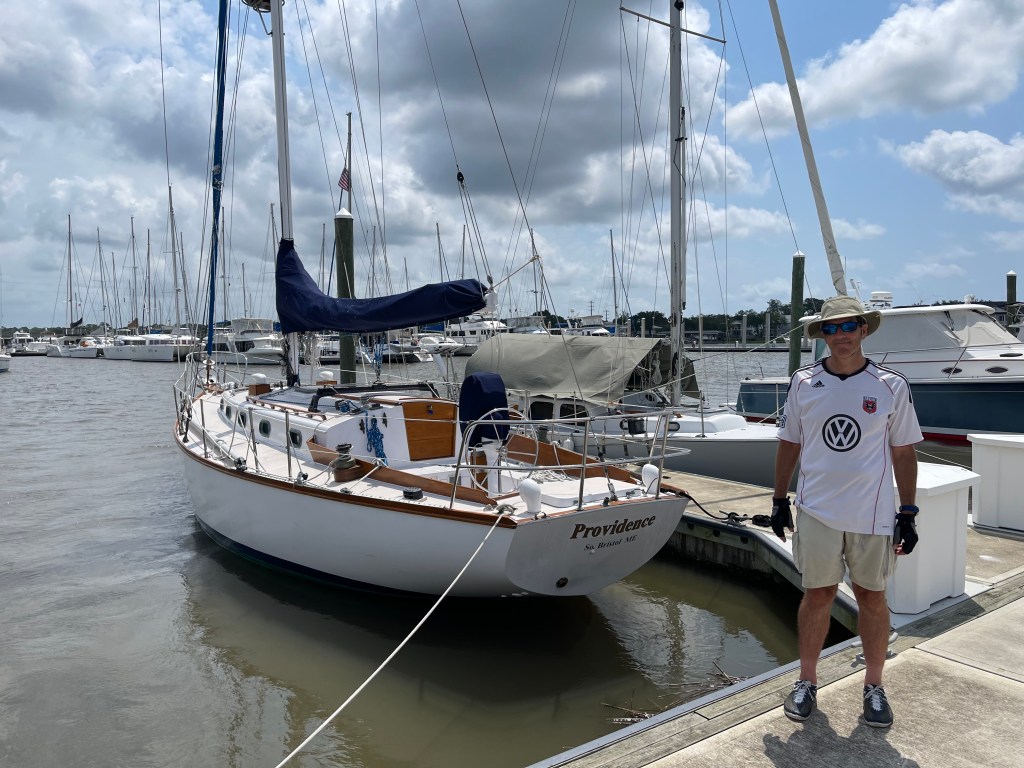
I’m now well into the latest leg of the journey, a one-year refit of my Cape Dory 36 for offshore voyaging. After about ten weeks of work, the refit itself is proving to be a unique and extraordinary undertaking and quite unlike anything I’ve ever done or experienced before. It’s tough work. It’s very challenging. It requires a special kind of persistence and patience. Fortunately, I never expected any of this to be easy, and I’ve slowly become accustomed to the daily rhythm and routine.
It boils down to working patiently through a long, long list of projects spanning every aspect of the boat, including rigging, sails, engine, steering, water and waste tanks, pumps and plumbing, electronics, wiring, and all gear and components — really everything. In some cases, we’re adding something that was missing. In others, we’re replacing something that was inadequate or in poor condition. And in others, we’re redesigning and rebuilding core parts of the boat, in some ways that are quite innovative.
So far, we’ve rebuilt the chain locker, a small compartment under the bow for storing the anchor chain; built water-tight storage lockers in the v-berth, the sleeping quarters at the front of the boat, which will prevent sinking if ever the hull is punctured in that vulnerable bow area; replaced a single light-weight anchor with a heavy-duty primary anchor, a secondary anchor, and an additional emergency anchor; hand spliced the rope and chain for three new anchor rodes, the chain or rope used for anchors; installed a manual windlass on the bow, which is a kind of winch used to raise and lower the primary anchor; replaced some of the halyards and sheets, the lines used to manage sails; and removed numerous unneeded deck fittings on the bow and sealed the resulting holes with epoxy, fiberglass, and epoxy deck paint. Next up will be installation of an electric motor in place of the old diesel engine; design of an arch over the cockpit made of steel poles to mount two large solar panels; installation of a dodger, a canvas tent-like structure at the front of the cockpit to block waves and rain; conversion from wheel steering to a tiller; and installation of new winches and blocks for the running rigging, the various lines used to manage the sails.
The interesting and sometimes amusing twist is that I’m doing much of the work myself, even though I come to this with virtually no relevant knowledge, background or skills. It can be unnerving at times, and I’ve tried to be patient with myself as I climb an almost vertical learning curve. The essential component that makes it all work, and so far has kept me from causing any serious damage, either to the boat or myself, is the role of James Baldwin as my guide and mentor. James is a seasoned solo sailor who has circumnavigated the globe twice and is also a master sailboat craftsman. He’s authored four books about his own adventures and deserves an entire separate introduction, but suffice it say that I rely on him heavily for his advice and instruction every step of the way. At my first working meeting with James and his wife, Mei, at their workshop, they were kind enough to start with the basics, namely, all of the tools I would need. For well over an hour, they showed me every power tool and hand tool I would require, many of which I had never seen or used before. I snapped photos quickly to capture everything — angle grinders, oscillating cutters, orbital sanders, jigsaws, hole saws, drills, and a huge assortment of hand tools — and was then given my first assignment: to assemble my own tool kit as fast as possible. Those tools are now all on the boat getting heavy daily use, and I’m gradually learning what they are all for and how to use them. I still take three deep breaths to calm myself before pulling the trigger on any power tool.
My days are spent either at the boat or with James at his workshop. Given the crushing Georgia heat and humidity, I’ve taken to early morning starts at the boat so that I can get through a good chunk of work before the heat settles in and before the dark afternoon thunderclouds gather. Every now and then, I fail to make my escape before the afternoon storm hits in force, and then I must rush to close up the hatches and portlights before hunkering down to wait it out in the boat.
Mostly, it’s just me alone at the boat, maneuvering in a small space packed with tools, parts and other supplies. It’s a solitary routine, and the work can be difficult and tiring. It often requires intense and unwavering concentration. There is no room for spills or other errors when mixing industrial strength epoxy paint on a rocking, narrow floor space and then having to carry it through the boat to the work space, or even onto the deck. It requires a Zen-like focus. I’m usually completely spent by the end of the day.
But I feel more alive than ever, and there’s nothing I’d rather be doing.
 A New Journey